
Last week, I promised to break down my approach to revising the messy climax sequence in The Magician & the Labyrinth of Yesterdays, so let’s get into it…
Timing is Key
💡 First, it’s important to say what I didn’t do: I didn’t attempt this revision after the first draft, or even the third.
Despite meticulous outlining, there’s always an element of surprise once I start writing. The first couple of drafts are about getting the story onto the page and stabilizing the plot. They’re exploratory by nature, even when I know where I’m headed.
With The Magician, by Draft 4, something important had shifted. The characters’ progression through the climax sequence was mapped, at least in a physical sense. Everyone was showing up in the right place, at the right time, more or less doing the right things. I wasn’t likely to make radical structural changes at that point, which made it the right moment to drill down into specifics.
💡 Just as importantly, I finally had the mental bandwidth to tackle this work. These climax revisions were a subset of the larger group-dynamics glow-up we talked about last time, and trying to do all of that earlier would have been a recipe for burnout.
Attempting to revise your story from too many angles at once is a reliable way to trigger overwhelm and procrastination. If revising feels like hell, narrowing your focus can make all the difference!
Clear goals make it easier to sit your butt in the chair because you know exactly what you’re meant to tackle next, rather than scrolling through your manuscript with the vague intent of “revising.” Without a plan, it’s far too easy to lose yourself in line-level tweaks when larger plot or character-arc issues need attention first.

Choosing a Draft Focus
So how do you decide what to focus on in a particular draft?
The frustrating but honest answer is: it depends—on you, on the project, and on where you are in the process. Not every book will follow the same progression.
For me, I usually start to sense the focus of the next draft about halfway through the current one. In this case, while working through Draft 3, I noticed that too many of the side characters felt flat. That flatness showed up most clearly in the climax—the first time they’re all on page together—where the interactions felt cookie-cutter.
✍️ Rather than trying to address that during Draft 3, when I already had plenty of structural changes on my plate, I created a Draft 4 checklist. Whenever I spotted a revision related to side characters or group dynamics, I added it to my list and organized those notes by scene and character.
This did two things: it kept me from getting sidetracked mid-draft, and it meant I entered Draft 4 with a clear, contained focus.
Group Dynamic Plan
Last week, I walked through how I built my group-dynamics outline: mapping both the arc of the group as a whole and the individual character arcs within it.
I combined that outline with the checklist I’d been compiling during Draft 3, which gave me a master plan for my next draft: scene-by-scene, character-by-character, focused entirely on group dynamics.
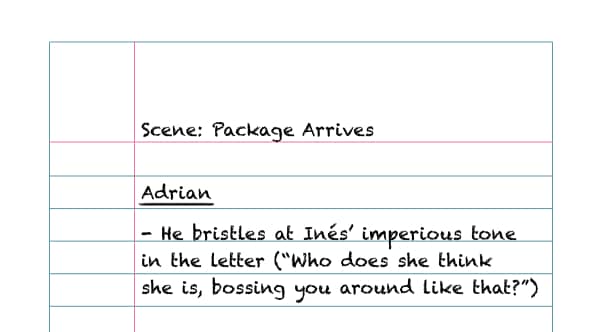
At that point, the question became less what do I need to fix? and more where do I start? 🤔
Why I Started at the End
Every project is different, but in this book, the side characters don’t appear together as a group until the climax. Because of that, it felt far more manageable to revise the climax sequence first and then tackle the rest of the book. By hammering out where the group ends up, I could clearly see what needed to be earned earlier.
For example, knowing that Adrian eventually needs to relinquish control and trust other people made it obvious that I needed to show him grasping for control—and fearing trust—earlier in the story.
Your brain could work very differently from mine, and revising out of order might sound like a nightmare to you. Adjust as needed!
The real takeaway here isn’t start at the end, but rather: notice when your usual approach is creating unnecessary friction. I usually prefer working linearly, but in this case, insisting on that order was generating too much mental static. Once I adjusted my approach, those roadblocks turned into tumbling dominoes—one solution revealing the next.

Breaking Down the Climax
My climax sequence consists of 10 scenes. Simply telling myself “revise the climax” was far too blobby of a task. So I broke it down.
✍️ Working backward again, I started by revising Climax Scene 10 using my outline checklist. From there, I expected to move on to Scene 9, then Scene 8, but diving into Scene 9 felt like slamming into a brick wall.
Once I paused and examined the resistance, the problem became clear: the climax alternates between action scenes and reaction scenes. Action scenes carry forward momentum—events, decisions, consequences. Reaction scenes process that momentum, emotionally and strategically, and my brain simply didn’t want to switch gears mid-revision.
So I didn’t.
✍️ Instead, I worked backward through only the action scenes on my first pass. This small adjustment made the process feel intuitive and energizing instead of sloggy. Once the action backbone of the climax felt solid, I returned to the reaction scenes, this time revising from the beginning of the sequence to the end.
My point in sharing such nitpicky details is to illustrate how you can combine a clear plan—my scene-by-scene checklist—and adapt when you meet resistance—huh, I actually need to start at the end—rather than letting things grind to a halt if they’re not working the way you expected.
Expanding Beyond the Climax
With the climax revised, I zoomed back out to the rest of the book—again, in a deliberately constrained way. Remember, Draft 4 was solely about group dynamics, and I used my checklist to guide the work. I didn’t get sidetracked by line edits, nor did I dive into other issues if they arose. Those were added to my Draft 5 checklist!
✍️ Starting at Chapter 1, I revised each character’s arc leading up to the climax, ensuring their individual goals and conflicts were clearly established before they converged.
Once that groundwork was in place, I returned to the climax one final time to add any ripple effects—small details that now felt earned because the foundation was now established.
Do Try This at Home
When a scene or sequence feels impossible to revise, it might be because the problem is too big for your brain to comfortably hold. Books are complicated little beasties!
Clear focus. Smaller tasks. Willingness to adjust when you hit resistance.
These are the tools that turn a tangled ball of yarn into a puzzle your writerly brain actually enjoys solving. If you’re staring down a revision that feels overwhelming, my hope is that this gives you permission to shrink the problem until forward motion becomes possible again.
Next week, we’ll wrap up this series on All the Writing Shit I’ve Learned Since My First Novel with a few more thoughts on outlining, revising, and bringing the spark back into your work.
See you then!