One of the reasons I decided to heed my spirit guides and create Will I Ever Finish This F#@king Book? is because I wanted to talk about a pet theory of mine:
I’m convinced the unconscious sets up sneaky little laboratories inside our creative projects.
I’ve stopped keeping count of how many times I’ve grappled with a craft issue, only to realize that the exact skills I’m developing on the page are precisely what I need to navigate some speed bump in the rest of my life.
Coincidence? Methinks not.
This week, we’re talking about the totally fake podcast I wrote inside my book, which ended up being a secret trial run for…you guessed it: my actual podcast.
Want to be the first to know when my book releases?
Join my mailing list to hop to the front of the queue. (Autocorrect for the win. I misspelled “queue” eight different ways.)
Episode 7 Transcript
[00:00:00] What if the fix to your story problems is hiding in plain sight? And what does that have to do with the almighty cat god?
[00:00:11] If you’ve ever devoted yourself to a creative project that ended up consuming your entire fucking life, this one’s for you. I’m Aven Winslow, romance writer and Jungian witch. Join me in the final stretch of writing my second romantasy novel. Craft breakthroughs, perfectionism spirals, and all the eerie little ways that fiction can start bleeding into real life.
[00:00:33] Welcome back, friends. We’re starting with our fire segment where we ask, what is our craft issue for the week?
[00:00:41]
[00:00:43] So I’ve mentioned on this show before how I believe that the unconscious sets up little laboratories in our creative work. In my case, things that unfold in my novels. And in working through these craft issues, I realize, often quite belatedly, that they were basically a practice round for something in my real life.
[00:01:02] And I couldn’t pick a better example of this than this week’s craft problem. So, let’s get into it. My current work in progress, The Magician and the Labyrinth of Yesterdays, follows Ev Knox, a young writer whose debut novel is being adapted to the big screen. During filming, Ev has to spend a month in the extremely haunted Harrowfell Hall with the leading man, Matt Byrne, who happens to be her very inconvenient celebrity crush.
[00:01:28] This week’s craft problem relates to the book within the book, meaning the novel Ev wrote that’s being adapted into a movie. That book is called The Chalice and the Gates of Dawn, which I’ll henceforth refer to as CATGOD to save my voice, and because that’s the best acronym ever. And no, I did not plan that.
[00:01:45] It was a very happy accident. So, as I was working through draft six, it became very clear that the story would be stronger if I found a better way to weave the story of Ev’s book into my story. There are reasons why this is important, reasons that would be a big spoiler. But suffice it to say, my task was, how do I convey what Ev’s book is about in a way that’s engaging and that ties into my plot at the most relevant moments?
[00:02:12] As in, I didn’t wanna just dump the plot line of her book in a confusing prologue or have Ev tell it to another character in one long info dumpy dialogue chunk. So what else could I do? Last week, I mentioned that I occasionally get story-related insomnia, and the solution to this problem landed on an unsuspecting Wednesday at three AM.
[00:02:34] I’d been toying that week with the idea of writing excerpts from CATGOD and using those as chapter epigraphs, and I actually gave that idea a shot. It worked okay, but it didn’t have that zingy aliveness I look for in a winning idea. It just sorta sat there on the page. And what I realized is that it was really tricky to write an excerpt from Ev’s book that conveyed the information I needed in a very short amount of space, but without feeling info dumpy.
[00:03:02] So that’s our craft issue for this week. The solution? For that, I’ll see you in the next segment.
[00:03:08]
[00:03:10] Air asks, “What tools did I bring to help solve this week’s craft issue?” In this case, I didn’t really bring shit. The unconscious basically delivered a complete solution right to my doorstep, which man, is it ever cool when that happens.
[00:03:24] But I can guess where the inspiration came from. So in my work in progress, The Magician in the Labyrinth of Yesterdays, I mentioned in the last episode that parasocial relationships play a big role. In a nutshell, Ev has to negotiate the fantasy version of Matt Byrne that she sees online, with the very sweet, very nerdy guy that she’s actually getting to know.
[00:03:45] And one of the ways I show this on the page is through Ev’s internet stalking. So she’s reading comments online, looking up the Byrne Baby Byrne fan page, reading fanfic, and all kinds of stuff. So I already had this idea for what I’m calling a visual prologue, and I was going to put that at the beginning of the book.
[00:04:03] Basically, I created a fake social media post, and originally, this post was about Matt, a sort of teaser to show how famous he is and how Ev is very much aware of his abundant hotness before she ever meets him. But that social media post morphed into something very different midway through draft six.
[00:04:20] All right, let’s set the scene. I wake up to go pee at 3:00 AM, and I’m already back cozying under the blankets when suddenly my brain bursts into flames. I rush into the other room, and I’m barely able to scribble notes fast enough. Instead of a social media post about Matt, it turned into a post about Ev’s book, Cat God, and in the comments, two fans decide they want to start a podcast about the book.
[00:04:45] This fake podcast ended up being my vehicle for conveying plot info about Cat God in a way that felt so energized, so sparkly. I sketched out the first four podcast transcripts, just snippets, mind you, because that’s all I need for these epigraphs, but I sketched them all out that night, and then I went back to bed and I slept like a dead rock.
[00:05:05] So thanks to this podcast within the book, I no longer have to come up with a short paragraph of prose that elegantly conveys the necessary plot details without sounding info dumpy. I can have these characters, my fake podcasters, talk about their favorite parts of Ev’s book in a way that’s funny and entertaining and never feels like a boring plot summary, even though that’s exactly the function it’s serving.
[00:05:28] And not only that, but it works thematically on multiple levels, including the aforementioned parasocial versus offline connection, because we have these podcasters discussing Ev’s book while you, the reader, are getting to know Ev for real, and there are other thematic tie-ins, but honestly, those would be hard for me to explain without spoilers.
[00:05:47] Point being, the podcast solution was thematic catnip for my brain, which is a sure sign of a winning idea.
[00:05:54]
[00:05:56] Water asks, “What do these craft insights reveal about me personally?” This is a two-parter actually, so we’re gonna revisit this in the next episode. But the reveal for this week is something that my conscious mind finds excruciatingly annoying because it goes against my brain’s entire operating manual, and that is sometimes when a problem refuses to budge, the answer isn’t to try harder.
[00:06:19] Sometimes it’s only when you stop trying to make the wrong solution work that the right one has the space to emerge. Because that’s what was happening with the Cat God experts. I had the right instinct. I knew Ev’s book needed to be threaded into mine. I knew it couldn’t just hover in the background as the supposedly important text that we never actually experience.
[00:06:40] But that material didn’t want to be crammed into polished little excerpts. It wanted to hang out with two nerds on a fake podcast spiraling over plot theories and their favorite moments of swoon. This is where I truly believe the unconscious is smarter than my conscious mind, because my conscious mind too often keeps trying to solve the problem inside the frame I already chose.
[00:07:01] It’ll say, “Well, the epigraphs aren’t working yet, so just, I don’t know, make the epigraphs better.” Yep, this is the part that feels uncomfortably personal because I can look back at so many places in my life where I’ve responded to friction by assuming I needed to become better at enduring the friction, more disciplined, more patient, more reasonable.
[00:07:24] And sometimes, sure, that’s true. Sometimes growth means developing the capacity to stay with something difficult. But sometimes difficulty is information. Sometimes the thing that feels dead feels dead because it is. A scene, a business strategy, a creative identity, a relationship. Which brings us to our final segment.
[00:07:46]
[00:07:48] Earth asks, “How did the fix go? And what do these insights ask of me in real life?” Let’s do this backward and start with the second question. My answer this week is, maybe you don’t need to make yourself smaller, calmer, more productive, more palatable, more willing to white-knuckle your way through the thing.
[00:08:06] Sometimes you just need to burn it all down and create a new container. That doesn’t mean the new container will make everything easy-peasy necessarily. Those fake podcast epigraphs still have a job to do. They still have to reveal the right information at the right moment. They still have to be funny enough, brief enough, and thematically relevant enough to justify their existence.
[00:08:28] So far, the hardest part of the process hasn’t been coming up with ideas for the fake podcast. It’s figuring out the right placement for those epigraphs within the larger narrative. But even though that’s tricky, it’s a really satisfying challenge. And that’s the point. Once I found the right container, the work had energy again.
[00:08:46] That’s the difference I’m trying to spot, hopefully a little bit earlier each time. Is this hard in a way that feels dynamic and alive? Or is this hard because I’m trying to resurrect something that never had a pulse in the first place? So let’s pinky swear before we go. Ready? No Franken-stories stitched together from dead ideas that we should have buried in the backyard.
[00:09:14] Thanks for listening to Will I Ever Finish This Fucking Book? Speaking of finishing, I’m getting so close to the finish line. So if you want to be the first to know when my book releases, head on over to twinflames.life/freebies. No matter which freebie you choose, you’ll be added to my list, and you won’t miss a thing.[00:09:35] Next week, in our season finale, we’re returning to the idea of perfectionism. We all know that perfectionism, if left to its own devices, will ravage the countryside and never let us finish a damn thing. But sometimes perfectionism is hiding an even sneakier creative roadblock, and it took receiving a nasty 14-page letter from one of my parents for me to uncover what that roadblock really is.
What if the fastest way to save your book is to do this one embarrassing thing?
In this episode, I talk about the genius of Jennifer Lynn Barnes’s Id List and how it can make writing fun again (for you and your readers).
I share how the fanfic-within-my-book became a roiling cauldron of lusty fun and why I spent weeks telling myself it wasn’t allowed. 🚫
I also present my incredibly well-reasoned argument for why the answer, in art and possibly in life, is sometimes (often?): just add ghost sex.
Want to see my Id List in action?
Hop on my mailing list, and you’ll be the first to know when The Magician and the Labyrinth of Yesterdays releases, in all its Id List glory.
Episode 6 Transcript
[00:00:00] What if the fastest way to save your book is to do this one embarrassing thing?
[00:00:09] If you’ve ever devoted yourself to a creative project that ended up consuming your entire fucking life, this one’s for you. I’m Aven Winslow, romance writer and Jungian witch. Join me in the final stretch of writing my second romantasy novel. Craft breakthroughs, perfectionism spirals, and all the eerie little ways that fiction can start bleeding into real life.
[00:00:34] Welcome back, friends. We’re starting, as always, with our fire segment, the element that asks, what’s our craft problem of the week?
[00:00:42]
[00:00:44] Every once in a while, I’m hit with insomnia. I wake up in the middle of the night to go pee, and usually I can coax myself back to Sleepy Town. But there’s one very special circumstance that is useless to try and fight, and that is when a story refuses to shut up, even though it’s three AM.
[00:01:02] During these nocturnal downloads, I’ll get entire scenes complete with dialogue plunked right into my brain, or the overall plot from beginning to end will unfurl like a map in my mind. And so I wrap myself in a blanket and stumble into the next room to scribble it all down before I forget. On nights when a story is feeling especially chatty, this process will repeat sometimes three or four or five times.
[00:01:28] What I’ve noticed, though, is there’s a pattern to these downloads. When I’m nearing the finish line of a book, I’ll start getting midnight transmissions for the next book in the series, which, I mean, that makes sense, right? My brain is just gearing up for the next project. But a few stories in my series arc seem to exert massive gravitational pull, book nine and book seventeen.
[00:01:52] Before we get into why, we need a brief context intermission.
[00:01:55]
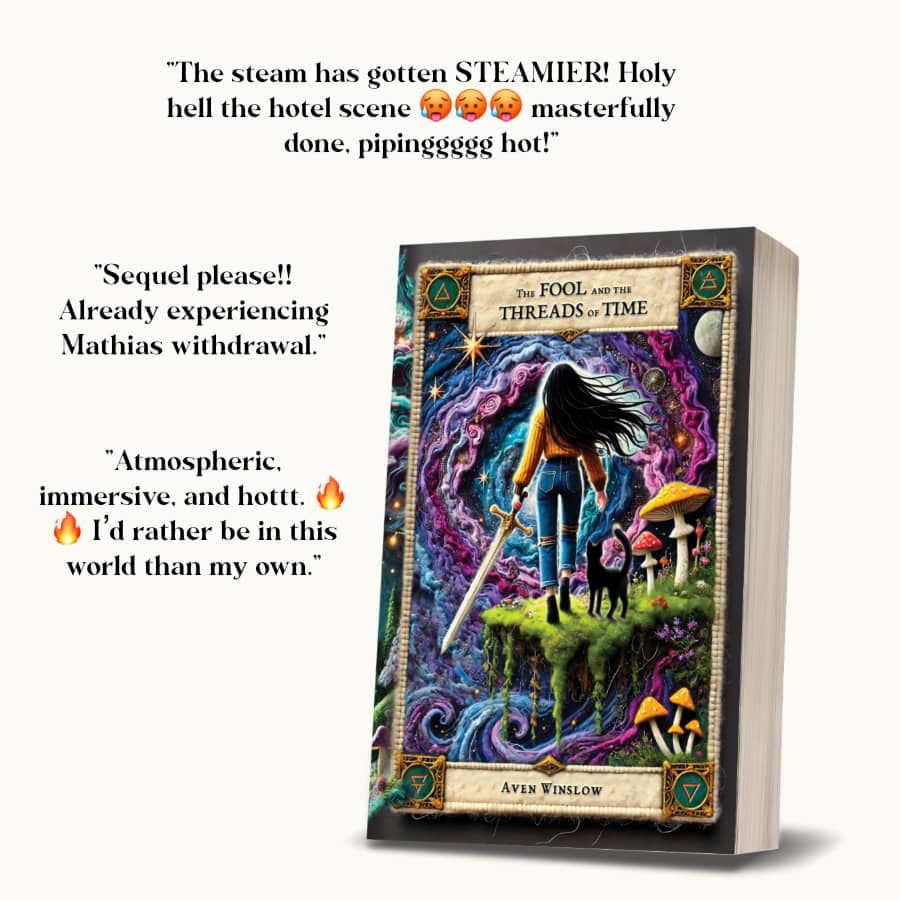
[00:01:58] How do I know how many books are in my series, much less what’s happening in book seventeen? Well, my Twin Flame series is based on the Major Arcana of the tarot. This is why the first book, The Fool and the Threads of Time, is denoted book zero, because the fool is card zero.
[00:02:16] I also spent weeks mapping out my entire series, which looked like rows of tarot cards and a million colored index cards covering our entire dining room table. I know exactly how my series is going to end, but that doesn’t mean I have complete plots for every book in between. I do have major plot points mapped out for every single book.
[00:02:36] They’re kind of like locations on a map that I know I have to visit, but how I get there exactly is still flexible. And I like this mixture of structure and freedom. It means that the series isn’t aimless, and I can plant all kinds of foreshadowing nuggets as we go along. But I’ve given my unconscious plenty of wiggle room to fill each book’s vessel with copious amounts of unexpected magic.
[00:02:59] All right, back to those nocturnal transmissions. Why are book nine and book seventeen so magnetic to my psyche? For that, we need to introduce our craft tool of the week, so I’ll meet you in the air segment.
[00:03:13]
[00:03:15] Air asks, “What tools did I bring to help solve this week’s craft problem?” Those of you who have been in my world for a while know that I rarely talk about Freud.
[00:03:25] This is because Carl Jung is my spirit animal. But for today’s craft talk, we need to define the Freudian concept of the id. The id is the instinctive, unconscious part of the psyche. It’s like the raw engine of appetite, impulse, fantasy, aggression, pleasure, and desire. It doesn’t care about morality or social acceptability.
[00:03:45] It just wants what it wants. In Freud’s model, the id operates according to the pleasure principle, meaning it seeks immediate gratification and relief from tension. In 2018, at a Romance Writers of America talk, novelist and professor Dr. Jennifer Lynn Barnes introduced the concept of the id list. Here’s Barnes from a 2023 Writer’s Digest article.
[00:04:09] Quote, “Create a giant, ever-evolving list of all your favorite things in fiction, characters, tropes, settings, tiny little details, all of it. I call mine my id list, and it is enormous, just pages and pages of things that I love in books or movies for no particular reason at all.” End quote. She goes on to list some of the items on her id list, like helicopters, paternity revelations, scenes set on rooftops, characters eating ice cream, fake dating.
[00:04:37] Here’s Barnes again. Quote, “In between projects, I go back to my id list and actively work to identify more and more things that I love. And then, when I begin writing a new project, I’m conscious about using my id list as license and a guide to put so much that I love in my books. It brings me so much joy as a writer and ends up solving a surprising number of craft problems for me as well.” End quote.
[00:05:01] What I realized is that book nine and book 17 were jam-packed with stuff from my id list, which includes, in no particular order, summer camp for adults, lush, mossy forests, people coming together, nerdy guys who are secretly good in bed, exploring lost ruins, forced proximity in remote locales, gender fluidity, ancient books with tortured histories, characters realizing they had what they needed inside them all along, having sex with a ghost, artists seeking inspiration in foreign places, creepy fairy tales, and literally anything to do with psyche and eros.
[00:05:37] All the way back in episode one, I mentioned that I’d never read a romance before I started writing one. Maybe not the ideal author pathway, but here we are. I did, however, read a romance-adjacent book in my late teens, one that I go back and reread every few years around Samhain. That book is called The Heart of a Witch by Judith Hawkes, and it is chock-full of my personal id list material.
[00:05:59]
[00:06:01] Since I don’t wanna give you hella spoilers for later books in my series, let me share a little tidbit from my current work in progress, The Magician and the Labyrinth of Yesterdays, that ended up being an idlist supernova. So, quick context recap in case you’re just joining us. In The Magician and the Labyrinth of Yesterdays, my main character, Ev, falls for Matt Byrne, the internet’s smoking hot boyfriend who happens to be starring in the film adaptation of her debut novel.
[00:06:27] The story takes place in their month of forced proximity while filming at a haunted castle. Yes, please. Without giving away too much, one of the things I explore in the book is the nature of parasocial relationships, and a big part of Ev and Matt’s romance arc is Ev stripping away all the layers of fantasy and fame bubble wrap so she can see Matt for the very real guy that he is.
[00:06:50] Early in their relationship arc, I have Ev really grappling with the contrast between Matt the person and Matt the celebrity, and in one scene, she stumbles on a fan page that leads her to an entire universe of fanfic, some of it quite steamy. There’s one fanfic in particular called Never Answer After Dark, or NAAD for short, and it becomes so popular it spawns its own sub-universe of increasingly raunchy spinoffs.
[00:07:16] So, one night, alone in her bed with only two walls separating her room from Matt’s, Ev tumbles down the NAAD rabbit hole. For this scene, I had to actually write parts of that fanfic story, and oh, my God, was it ever fun. And I realized this was in large part because I’d given myself a free pass to pour on all of my favorite tropes, like only one bed, fever nest, cabin in the woods, until that scene was overflowing with idlist material.
[00:07:43] This realization led to another realization, that wait a minute, I could have this much fun with the rest of my writing, too, not just this fanfic within a story scene. And in fact, the only person stopping me from doing that was me.
[00:07:58]
[00:08:00] Water asks, “What does this craft discovery reveal about me personally?”
[00:08:04] Well, it introduced me to an inner part within my psyche who wholeheartedly believes that if I find something enjoyable, there must be something wrong with it. Uh, what? Actually, this wasn’t surprising at all. Not after I thought about it for all of two seconds in the context of how I was raised, specifically with a deep, primal terror of my own inner life.
[00:08:26] My uncensored thoughts, my unfiltered feelings, my needs, my desires, all of that was bad. There was a chunk of time where this badness was specifically sinful. This was the phase when one of my parents was an evangelical Christian I remember a book, I think it was called The Bondage Breaker. I distinctly remember an illustration of this thick chain being shattered on the cover.
[00:08:50] But in the back of the book was a list of all the demonic things I needed to be scared of. And what’s hilarious is, if memory serves, most of the things on that list are now, like, my favorite stuff. Tarot cards, smutty books, witchcraft, you name it. Check, check, and check. I can laugh about it now because it genuinely is funny that the list of things that will destroy your soul turned out to be more or less my brand.
[00:09:16] But the residue of that kind of upbringing is less hilarious when it crops up in my creative process in unconscious ways. When you’ve been taught to distrust your own pleasure, your own fascination, this distrust often doesn’t announce itself in neon lights. It can feel much more sophisticated than that.
[00:09:35] It can feel like taste or discernment. It might sound like, “Well, I don’t wanna be self-indulgent,” or, “That trope is too obvious,” or, “Sure, I like that, but is it any good?” And listen, sometimes that’s a totally valid craft question. Not everything we love belongs in every story. If I tried to cram ghost sex, ancient ruins, fever nests, and adult summer camp into every book…
[00:10:00] Actually, that sounds amazing. I should totally write that book. But the point is, I think there’s a difference between making a craft choice and preemptively sanding the fingerprints off your own work because you’re afraid the thing you love is embarrassing. And that’s the part I’m really trying to pay attention to, because the it list, it isn’t just a writing exercise.
[00:10:20] It’s a permission slip. It asks, “What do you love before you start explaining yourself?” For me, this also connects to something I’ve wrestled with as a romance writer, which is that I can be weirdly picky about romance novels. I love romance as a structure. I love longing and angst and sexual tension all day long.
[00:10:41] I love the holy shit of two people finally seeing each other for who they are and loving the hot mess that stands before them. But I read way less romances than it feels like I, quote-unquote, should. And for a while, I really beat myself up about that. I mean, if I’m writing romance, shouldn’t I be reading it constantly?
[00:11:00] Shouldn’t I have encyclopedic knowledge of the market? To be clear, I do think reading in your genre is useful. I’ve encouraged myself to read more romance in particular, and more fiction in general in recent years, and I’m enjoying the hell out of it. But I’ve also stopped forcing myself to finish romances that aren’t grabbing me just because I think that’s what a real romance writer would do, even if that means I put aside the majority of the books I try to read.
[00:11:27] I’ve always read more nonfiction than fiction. I will probably always read a lot of Jungian psychology and occult history and weird little books on random sociology topics. But maybe that doesn’t make me deficient as a romance writer. Maybe my particular brain flavor isn’t a liability I have to compensate for.
[00:11:47] The more I work with the id list, the more the question shifts from, “How do I make myself want the correct things?” to, “What happens if I trust the things I already want?” Because if I’m bored by my own restraint, there’s a decent chance the reader is too. And if some strange, mossy, ghost sex-loving part of me is clawing at the walls trying to get into the story, maybe my job isn’t to lock the door and call that craft.
[00:12:14] Maybe my job is to ask what it wants. And maybe sometimes the answer is throw that ghost in a cabin in the woods with only one bed.
[00:12:23]
[00:12:25] Earth asks, “How did the fix go? And what does this ask of me in real life?” Well, on the book level, this fix was the bee’s knees. Once I saw the fanfic within the book scene as an id list supernova, I understood why it felt so alive, and I could just slather more of that joy jam on the rest of the book. And side note, you better believe the next book in my series is going to be front-loaded with so many id list ingredients.
[00:12:53] But the deeper question isn’t really about the book, right? The deeper question is, can I trust that what I want matters? Can I trust that my needs are valid, even if other people find them inconvenient, confusing, excessive, or even offensive sometimes? And to be clear, saying, “My needs are valid,” does not mean everyone else is duty-bound to cater to them.
[00:13:15] Other people get to have needs, too. Other people get to have boundaries. But I am allowed to need what I need. I’m allowed to want what I want. I’m allowed to make choices that are right for my life, even if those choices rock the proverbial boat. If you’ve been in my world for a while, you already know that I’m estranged by choice from my entire family, and that wasn’t some dramatic one fell swoop situation.
[00:13:41] It was a series of painful decisions made over a number of years. And every step of the way, I was deeply aware that other people did not agree with me. In some cases, they downright despise my decision. And if their words are anything to go by, some of them downright despise me as a result. There is a very particular pain in disappointing people you love.
[00:14:06] That’s part of what makes it so hard. Estrangement doesn’t necessarily mean the love disappears or that it was never there in the first place. No, the love, it’s still there. It’s just living side by side with the knowledge that love is not always enough to make a relationship livable. For a long time, I tried to make relationships work that simply did not work for me.
[00:14:31] I tried to be more accommodating, more understanding, more understandable, more endlessly available. I tried to make my needs small enough that they wouldn’t cause any trouble. But that was far more painful in the end than being disliked. It was soul-draining and corrosive, and it drilled in the lie over and over again that the price of belonging is self-abandonment.
[00:14:55] But it’s not, really. It just depends on what you’re trying to belong to. For some relationships, the cost of admission is selfhood, and that’s a price tag that’s no longer in my budget. When I think about letting myself write from the id list, I think of it as part of a much bigger practice, the practice of not betraying myself in advance, because that’s the temptation, right?
[00:15:19] To pre-reject yourself before anyone else gets the chance. To sand off the wonky edges, to make the book smoother, safer, more marketable, more whatever you think will protect you. But of course, it won’t protect you. This is where years of being disliked for my choices have unintentionally become excellent training for being an artist.
[00:15:40] Because if I make something with any real charge in it, some people are going to hate it. Actually, scratch that. If I make something, full stop, some people are going to hate it. That’s not a possibility. That’s a guarantee. I hope there will also be people who love it as deeply and obsessively as I do, but no artwork since the dawn of time has been universally loved.
[00:16:02] Two examples from Reddit, in case you don’t believe me. “Mona Lisa is an overrated piece of shit.” That’s a direct quote, by the way. To which someone added, “She’s worse than the pyramids.” So that’s Da Vinci and, you know, one of the defining monuments of human civilization knocked off their stupid little pedestals in one fell swoop.
[00:16:22] Here’s one more, just for fun. This is an Amazon review for Pride and Prejudice. “Just a bunch of people going to each other’s houses.” Brilliant.
[00:16:35] Thanks for listening to Will I Ever Finish This Fucking Book? If you want to see how my ID list experiment turned out, hop on my mailing list and you’ll be the first to know when my book releases. You can do that over at twinflames.life/freebies. No matter which freebie you choose, and I’ve got some pretty fun stuff for you over there, you’ll be added to my list and you won’t miss a thing.[00:16:59] Next week, we’re gonna take a peek at a curious little writing experiment I didn’t realize my unconscious had set up for me until the changes I’d made to my book led to very real changes in my life.
What if your scenes are dragging, not because nothing is happening, but because the real action is hiding somewhere you haven’t thought to look?
In this episode of Will I Ever Finish This F#@king Book?, I tackle scenes that look like they should work—goal, conflict, stakes, banter, the whole shebang—but still feel like limp little rags on the page.
I share the two books that turned my conception of storytelling upside down, a tool for resurrecting a shambling zombie scene, and how to use the magical art of bibliomancy to make your characters more compelling.
My sexual tension experiment…
Want to read the short story where I began experimenting with stretching out the rubber band of romantic and sexual tension?
[00:00:00] What if your scenes are dragging, not because nothing is happening, but because the real action is hiding somewhere you haven’t thought to look?
[00:00:12] If you’ve ever devoted yourself to a creative project that ended up consuming your entire fucking life, this one’s for you. I’m Aven Winslow, romance writer and Jungian witch. Join me in the final stretch of writing my second romantasy novel. Craft breakthroughs, perfectionism spirals, and all the eerie little ways that fiction can start bleeding into real life.
[00:00:34] Hey friends, welcome back. We start as we always do with our fire segment, which asks what’s our craft problem of the week?
[00:00:41]
[00:00:43] Have you ever read a story with an intriguing premise, empathetic characters, and satisfying twist and turns, yet certain scenes still feel kind of flat, and maybe you can’t put your finger on what’s missing?
[00:00:56] I’d hit a point in draft six of my current work in progress, The Magician and the Labyrinth of Yesterdays, where certain scenes were sagging, and I couldn’t for the life of me figure out why. In the interim between writing this, my second book, and my first book, I’d read a bunch of writing craft material on the topic of creating emotional impact.
[00:01:16] I’d learned things like how important it is to forge a connection between the reader and your character. Otherwise, even if that character is hanging by their acrylic fingernails from the windowsill of a skyscraper, the reader won’t really care if those nails snap off and the character plunges to their doom.
[00:01:32] I mean, they’ll care-care in the sense of, “Oh, no, a person is dying,” but it’ll register more as like a vague bummer than the gut-plunging shock that you’re likely intending. I’d learned that your character needs a goal for every scene, and you need to make it really, really hard for them to go after it.
[00:01:48] There also has to be stakes if they fail. All of these things can help keep your scenes from dragging, but it was only after my trip to Tacoma, the subject of last week’s episode, that I realized my scenes were lacking a vital ingredient, and it took a book on dialogue and a smutty novel to show me exactly what I was missing.
[00:02:08]
[00:02:10] The Element of Air asks, “What tools am I bringing to solve this week’s craft problem?” So the two books that turned my writing process upside down were Robert McKee’s Dialogue and Charlotte Stein’s Control. And it was the first book in particular that unlocked, like, I don’t know, 10 new levels in the video game running inside my brain.
[00:02:30] There are so many things in that book worth reading, but I want to focus on the one technique to rule them all, and that is the third thing. McKee also calls this trialogue in contrast to dialogue, and he writes, quote, “Trialogue, as I define the term, names the triangular relationship between two characters in conflict and the third thing through which they funnel their struggle,” end quote.
[00:02:54] A simple example would be a couple arguing about a broken porch light. “The porch light’s still out.” “I’ll get to it.” “You said that last week.” “I’ve been busy.” “And I haven’t?” If this exchange took place in the context of a story, chances are that we, the readers, would know what’s up. Maybe they’re really talking about unequal labor.
[00:03:13] Why am I the only one who notices what needs doing? Or it could be about emotional neglect. Why do I have to ask for every scrap of care that gets tossed my way? It could be about trust erosion. Your promises have started to mean nothing. It could be about loneliness. We sleep in the same bed, but I’m handling life alone.
[00:03:34] The point is, we know with absolute certainty this ain’t about a light bulb. But let’s rewrite that exchange, this time with zero subtext. “The porch light’s still out.” “Yes, I am aware that the porch light remains broken, and I understand that this has symbolic significance in our ongoing conflict.” “You said you would fix it last week, so now I’m experiencing your failure to follow through as evidence that I cannot rely on you.”
[00:04:00] “That is accurate. I have been avoiding this task because I feel emotionally disengaged from the relationship and no longer prioritize your needs in the way I once did.” “Hearing you say that causes me emotional pain because I have been using the porch light as a proxy for my larger fear that I am alone in this relationship.”
[00:04:17] “That fear is valid. Perhaps we should have a direct conversation about my emotional withdrawal and the growing erosion of trust between us.” “Yes, let’s stop discussing the porch light, since the porch light is clearly not the real issue.” Okay, so I’m fairly certain we can agree that this dialogue is a pile of shit.
[00:04:33] And to be fair, it’s highly unlikely you’ll run into something that absurd in a book. But what I do see all the time is dialogue that just means what it means, and that’s that. For instance, “The porch light’s out.” “I’ll get to it.” But in this case, there’s no buried marital grievance, no symbolic cry for help.
[00:04:52] It’s just a burnt-out bulb. That dialogue probably doesn’t need to exist, unless later that night, the aliens land, and as it turns out, the only thing that keeps these particular aliens from entering a human dwelling is a working porch light. Since no one changed the damn bulb, the aliens are free to skitter up the steps and lay eggs in your face while you sleep.
[00:05:15] In this case, you get to keep your porch light dialogue Whenever I read a book, I mark interesting passages with sticky tabs. When I’m done, because I’m a total nerd, I type those passages out, both to give me a searchable document, but also to remind me of all the cool things I just learned but have likely already forgotten.
[00:05:35] So in reading over my notes from Robert McKee’s Dialogue before this episode, I came across a few passages that approach this idea of using the third thing in your dialogue from a few different angles. Here’s the first. Quote, “As you compose dialogue, I think it’s useful to imagine character design as three concentric spheres, one inside the other.
[00:05:56] The innermost sphere churns with the unsayable. The middle sphere restrains the unsaid. The outer sphere releases the said.” End quote. Here’s another passage. Quote, “To write intriguing, layered, credible dialogue, first study the difference between the two motors for human action: motivation and justification.
[00:06:17] Then see if masking your character’s subconscious drives with their conscious efforts to excuse or at least make sense out of their unexplainable behaviors adds depth to their words.” End quote. And finally, here’s a passage that really maps out those concentric spheres of character design that McKee mentioned above.
[00:06:36] Quote, “When first spoken, a line of dialogue conveys a surface meaning, the meaning the reader hopes other characters will believe and act on. This first meaning seems logical in its context. It conveys a sense of character, purpose, and tactic, and arouses curiosity as we glance across the scene to see its effect.
[00:06:55] The language itself might also delight us with tropes or wordplay. In the second moment, however, this solid speech seems to dissolve, and we sense a second deeper meaning hidden behind the words. True to character talk lets us read past conscious thoughts and sense unspoken feelings down to a character’s subconscious urges.
[00:07:14] This effect is so powerful that the fullness and depth of insight we have into fictional characters often surpasses what we glimpse in the living people around us.” End quote. So I had these Robert McKee passages bubbling in my brain, but I mentioned that I took a second book on my flight to Tacoma, and that is Control by Charlotte Stein.
[00:07:35] Control is an erotic romance centered on Maddie, the owner of a romance bookstore who meets two guys who respond to her job posting for a shop assistant. There’s buttoned-up, tweed-wearing Gabe, and tattooed, potty-mouthed Andy. I shall give as few spoilers as humanly possible, so go read the book to find out what happens.
[00:07:54] But for our purposes here, I’m gonna share a short passage from page six. The scene takes place after Gabe shows up at Maddie’s bookshop for his job interview. But her last interview ran a little bit late. Translation: she and tattooed Andy are going at it in the store, and tweedy, bespectacled Gabe walks in and catches them in the act.
[00:08:13] Gabe is out of there so fast, Maddie isn’t entirely sure he wasn’t just a figment of her imagination. Now, in the scene I’m about to share, Maddie is back at home and she is, shall we say, reflecting on what happened at the shop. “I have a secret streak of needing to be spied on, and my mind won’t stop going there, to him in his too-thick glasses and his tweediness and his hunched shoulders and Jesus, that’s a good image.
[00:08:37] Oh, that’s so good. I bet we really shocked him. I bet he couldn’t walk straight all the way home. I bet when he got home, he did just what I’m doing right now. The thought is enough to send me right over the edge so fiercely that it shocks me.”
[00:08:52] So in this passage, this is the first time Maddie admits to herself that she’s attracted to Gabe, really attracted to him, and this is such a saucy, skillful way of conveying her feelings to the readings, much more effective than Gabe walking in for his interview and Maddie thinking to herself, “Gee, what a handsome guy.”
[00:09:11] It creeps up on her, surprises her even, and the reveal is all the more fun because of it.
[00:09:16]
[00:09:19] There are many different ways to do a close reading of a text, but my plan for Charlotte Stein’s Control was simple. I would read until I hit a passage that grabbed me, I’d copy that passage into my notebook, and I’d let it serve as a springboard for whatever thoughts wanted to come through. I treated this kind of like I do bibliomancy, which is the practice of opening a book to a random passage and treating that as the answer to your question, kind of like pulling a tarot card.
[00:09:44] So after reading that passage where Maddie realizes she has the hots for Gabe, the first thing that came to mind was this: in the previous draft of my work in progress, Ev, my main character, is fully aware that she’s attracted to Matt before they ever meet. Matt is absurdly famous, and Ev has seen some of his films, so she has copious evidence of his abundant hotness.
[00:10:06] None of this was supposed to matter, though. Matt was just an innocent celebrity crush until he gets cast as the lead in the film adaptation of her book, and she’s to live with him in a haunted castle for a month. In the previous draft, it had never occurred to me that Ev would try to hide her attraction to Matt from herself.
[00:10:23] I mean, sure, she was hell-bent on hiding it from Matt, but in draft five, I had her privately mooning over him in her thoughts. But a combination of McKee’s dialogue and that Charlotte Stine passage sparked this idea, and once it was sparked, the fire would not go out. So I rewrote a scene where Ev is on her way to Harrowfell Hall, and she’s stalking Matt online.
[00:10:46] She comes across pictures from some of his movies, and wow, oh, wow, are these pictures ever getting her flustered. But this time, I introduced the constraint of Ev refuses to admit her attraction, and I was forced to reroute her attraction into something else. I’m not going to spoil what that something else is, but I will say this.
[00:11:04] It made Ev, in my opinion at least, much more endearing and relatable, and her interiority was so much more fun to write, which translated into, I hope, being much more fun to read. And this is just one example of how the one-two combo of McKee’s dialogue and Stine’s control changed how I approached my scenes.
[00:11:23] This perspective shift felt enormous, like, genuinely enormous. It wasn’t just, “Oh, neat, here’s a cool trick I can use in dialogue.” It felt like I’d been trying to light my scenes with a Bic lighter and suddenly somebody just, like, flipped on the sun. Before, I could make scenes work, more or less. I could give characters a goal, I could make sure there was conflict, I could add banter, I could up the stakes, but sometimes the scene still felt like it was just lying there on the page, barely breathing.
[00:11:50] But when it clicked, when I felt in my gut how much energy is generated, not simply by what characters are doing, but by what they secretly want and what they won’t let themselves admit, I swear to God, it was like upgrading my writing crayon box from a measly 12 colors to the deluxe 64 with that built-in sharpener in the back.
[00:12:10] Now, I wasn’t restricted to coloring the lines with plain old anger, but anger pretending to be logic, fear pretending to be irritation, longing disguised as a joke, loneliness funneled through an argument about a porch light. And now, when a scene sagged, I wasn’t just standing over it like, “I don’t know, maybe add more banter?
[00:12:30] Maybe throw in a ghost?” I had a new question to ask: “What is this scene really about, and what are the characters using to avoid saying it?” That question changed everything. Scenes and the dialogue within them were no longer about moving character chess pieces from plot point A to plot point B. They were bubbling cauldrons of unspoken fears and hidden longings.
[00:12:53] Often, the pressure, the energy, it was already there. I just needed to find ways to bottle it up and to push it to the breaking point.
[00:13:00]
[00:13:02] Our water segment asks, what do these craft insights reveal about me personally? When I started revising scenes with my shiny new subtext cram box, I remember journaling one night after a long day of revisions, and I asked myself, “Why wasn’t I doing this before?” With, like, three question marks. Because it’s not like I don’t love subtext.
[00:13:24] I’ve read tons of books and watched tons of movies where my favorite scenes are the ones where I, as the reader or viewer, get to sift through what’s being said and root around for what’s really being said. I love that shit. So why wasn’t I letting myself have that same fun in my own work in progress?
[00:13:41] After a lot of journaling, I came to two interrelated answers. The first is that letting tension boil and bubble is kind of uncomfortable, not just for my characters, but also for me. Go figure. So in countless little ways, I’d vent the pressure too early. I’d have a character say exactly what was on their mind, so the other characters weren’t left rudely hanging, and neither was I.
[00:14:03] Which brings me to the second answer. I didn’t want my characters to come off as unlikable. There is so much discourse online about unlikable characters that even I, a person who is not on social media, still managed to hear about it. And this seems especially loud in romance, where there are all kinds of rules about what characters can and can’t do before readers write them off as irredeemable.
[00:14:24] But what I’m realizing is that if I try to obey all of those rules, I don’t end up with more lovable characters. I end up with flatter, safer, bore-me-to-tears characters, characters who explain themselves too quickly and please and think their way through scenes, stamping out every potential spark before it has a chance to land.
[00:14:45] You’ve probably heard the phrase, “Depiction is not endorsement,” which seems more widely accepted in literary fiction, but can get kind of slippery in romance. If I write a character acting like a jackass early in their arc, I’m not saying, “Hey, reader, you should tolerate jackassy behavior in your real-life relationships.”
[00:15:03] I’m saying, “Here is a messy human at the beginning of a transformation.” After all, if I don’t let them be messy at the beginning, there’s nowhere meaningful for them to go. Do you see where this is going? Yep. As in fiction, so in life. No matter how much I outline, no matter how many craft books I read or courses I take, writing is going to make a mess.
[00:15:26] And that’s precisely where the magic is.
[00:15:29]
[00:15:31] Earth asks, “How did the fix go? And what does this craft discovery ask of me in real life?” So how did it go? In one sense, amazingly, truly. Once I started waving my sparkly subtext wand over all my scenes, many of them came alive in ways they simply had not before. But, and here’s where Earth comes in, because Earth is where our beautiful ideas crash into time, energy, deadlines, and the fact that I am tragically not an immortal witch with unlimited revision hours.
[00:16:00] This breakthrough also extended my revision process, because once I saw it, I could not unsee it. Scenes that had seemed basically fine suddenly had the emotional equivalent of fluorescent lighting. I could spot every exchange where I’d vented the tension a little too early, every place where a character said the thing to bonk you on the head directly.
[00:16:22] This was simultaneously thrilling and fucking inconvenient. Thrilling because, oh my God, I finally understood why some scenes that should have been exciting on paper felt like limp little rags. Inconvenient because now I had to go back and fix them. And so draft six became a lot more involved than I’d originally planned.
[00:16:39] But in the end, I do think it was the right call. Sometimes a craft breakthrough is not a shiny distraction. Sometimes it really is the missing piece, and for this book, subtext was the missing piece, or at least one of the big missing pieces. The haunting subplot matters, the romance matters, the group dynamics matter, but without that undercurrent of things half said, misdirected, and bottled up, the whole thing just wasn’t jumping off the page like it needed to.
[00:17:06] So yes, I let this breakthrough change the book, but that does not mean every breakthrough gets to change this book. I’m saying this partly as a reminder to myself, because this is one of the most dangerous parts of leveling up your art. You learn something new, and suddenly you want to go back and retrofit everything you have ever made since your kindergarten finger paintings.
[00:17:28] But if I do that, I will never, ever publish this book. I will simply become a better writer in private while the manuscript sits there aging like a wheel of cheese. So this is what the subtext breakthrough asks of me in real life: discernment. Some insights are for the book in front of me, some are for the next book, some are for the next 10 books, and finishing is learning to make that call.
[00:17:53] Finishing a book means letting it be the artifact of who you were while you made it, not the perfect monument to everything you will ever become. Choose the breakthroughs that get to make this book better without letting every new breakthrough move the finish line.
[00:18:09]
[00:18:14] Thanks for listening to Will I Ever Finish This Fucking Book? If you wanna read a short story where I began my little experiment in stretching out the rubber band of romantic and sexual tension, download Falling Phoenix for free at twinflames.life/freebies. Next week, we’re gonna explore how refined taste can become a very convincing disguise for sucking the joy out of your creative process and what you can do instead.[00:18:41] I’ll see you next time.
What if finishing your book isn’t about having all the right answers? What if you need this magic ingredient instead?
In this episode, I share how a trip to Tacoma, WA accidentally changed my entire revision process—and the $3 item that became my new favorite revision tool.
I lovingly call out the part of my psyche that confuses “looking busy” with “quality work,” and I break down the most useful thing I did for my revision process (and why I’d refused to do it for years).
[00:00:00] What if finishing your book isn’t about having all the right answers? What if you need this magic ingredient instead?
[00:00:12] If you’ve ever devoted yourself to a creative project that ended up consuming your entire fucking life, this one’s for you. I’m Aven Winslow, romance writer and Jungian witch. Join me in the final stretch of writing my second romantasy novel. Craft breakthroughs, perfectionism spirals, and all the eerie little ways that fiction can start bleeding into real life.
[00:00:33] Hello and welcome back, friends. It’s time for our fire segment where we ask, what’s this week’s craft problem?
[00:00:41]
[00:00:43] Just like last week, our craft problem for today is all about revisions, but this time with a Tacoma twist. During the three-year process of writing my first book, The Fool and the Threads of Time, in hindsight, something that tacked on a lot of time, and I mean a lot, when it came to revisions, was that I didn’t really know how to do revisions.
[00:01:06] I mean, in a general sense, I knew that they involved reading over stuff I’d written and trying to make it suck less, but how I was supposed to do that was a mystery. So I ended up wasting a ton of time, essentially shifting commas around and nitpicking over line edits when maybe that entire scene I was working on needed to be cut.
[00:01:25] I was, to quote Tyler Durden from Fight Club, “polishing the brass on the Titanic.” Now, things started to change with book two, which is my current work in progress, The Magician and the Labyrinth of Yesterdays, and I’ve written about this on my blog in a series of essays detailing some of my lessons learned since writing my first book.
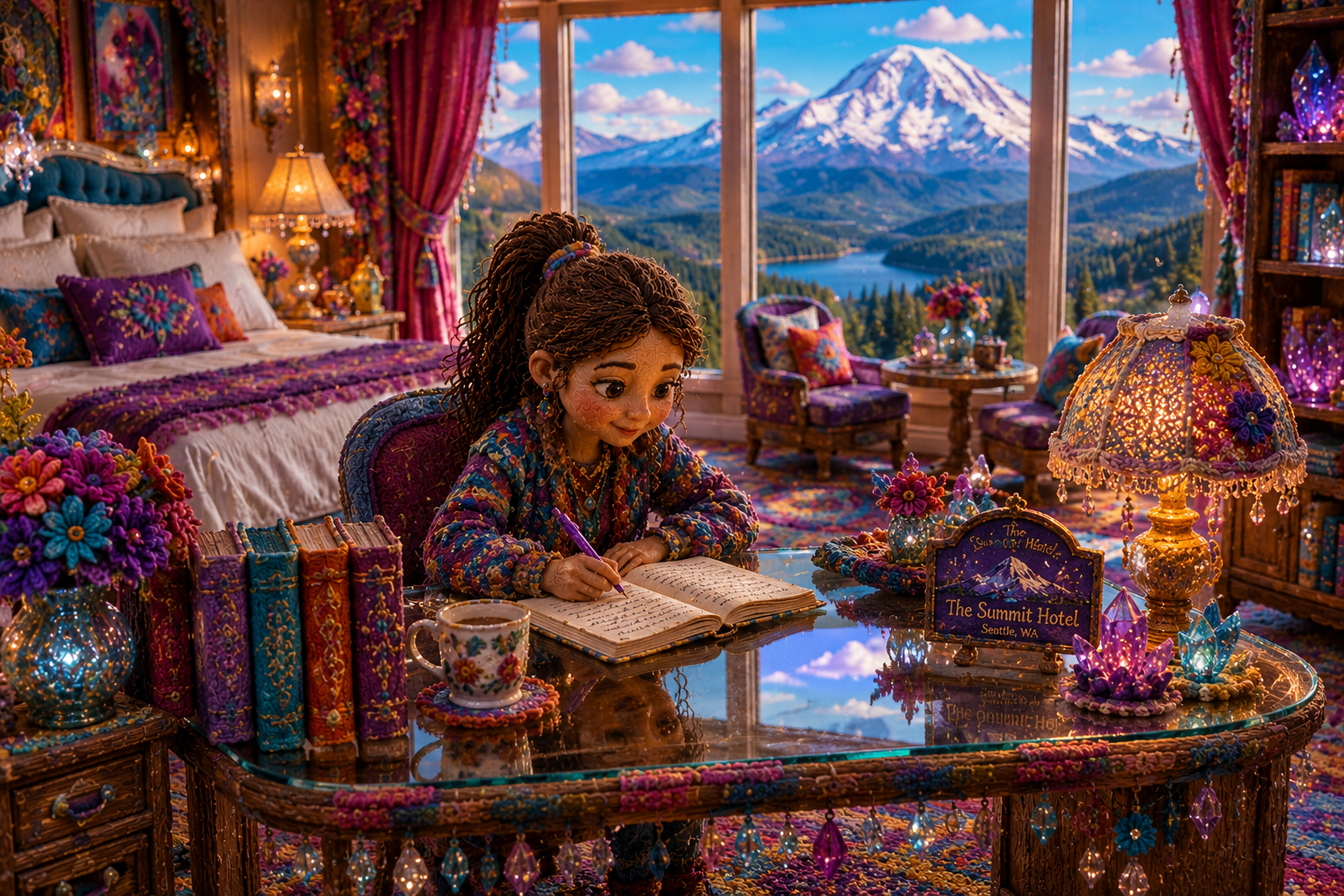
[00:01:45] I’ll put a link to that series in the show notes. But I really noticed a change in my process when I paid a little visit to Tacoma, Washington. Given that my vacation budget is currently zero dollars, I decided to tag along and turn my partner’s work-paid-for hotel room into a DIY writer’s retreat. Fun fact, this Tacoma trip took place in February of this year, and I started writing my first book in February of 2022, also in a hotel room while tagging along on one of my partner’s work trips.
[00:02:17] So note to self, always go along on these trips, at least in the month of February. They’re remarkably productive. Anyway, the week before the trip, I had just finished draft five and another read-through of the manuscript, so it was really tempting to turn my week in Tacoma into this mad race to the finish line, seeing how many draft six revisions I could cram into five days.
[00:02:40] And me of last year would have absolutely done this, but a tiny voice within, a voice that sounded very calm and maybe even a little bit wise, suggested that perhaps, just maybe, I might want to use this time in Tacoma for a different purpose. I had an entire week away from my normal routine, so what better chance to do something that at home I’d find it really, really difficult to give myself permission to do?
[00:03:07]
[00:03:09] So Air asks, what tools did I bring to help solve this week’s craft problem? The day before our Tacoma trip, I went to the grocery store and I bought a cheap three-subject notebook. I didn’t fully know what that tiny voice wanted from me, but I had a sense that I’d need plenty of paper. I also brought two books for the plane, one of which was a sexy novel that I’d already read and loved, but I wanted to do a close reading of.
[00:03:35] So maybe my notebook was for that. I wasn’t sure. But I packed all three books in my carry-on with two fresh pens just in case. As it turns out, the first of these books, which I’ll reveal the title of next week when we do a big old deep dive, that book ended up taking up my entire flight. I read that thing cover to cover.
[00:03:54] And as a result, I was thinking a lot about what characters really want in a scene, what they want but are hiding from other characters, and what they want but are hiding even from themselves. So all of this was brewing away in my mind as we arrowed through the skies from Missouri to Washington. The next morning, I had my notebook and all my pens all arranged on the hotel desk just the way I wanted them.
[00:04:20] It was still dark out, so I had yet to learn that our room actually had a view of Mount Rainier. Nor did I know that this mountain would become an arresting touch point that I return to every time the gears of my mind ground to a halt. But for now, there was nothing but pre-dawn rain outside the windows and my notebook.
[00:04:40] The very first thing I wrote on the very first page was, and I quote, “Notes on receiving love.” This is underlined, by the way. This feels like a pretty great way to start a notebook, doesn’t it? Looking back, it’s almost prophetic. Like, whatever comes after that is destined to be juicy. And as it turns out, it was.
[00:05:02]
[00:05:04] What this heading was getting at, my quote unquote, “Notes on receiving love,” was something I’d been mulling over in the weeks leading up to this trip. Something that I had a lot of time to think about in the airport and on the plane. Two planes. We had a connecting flight at O’Hare. And that is, I feel like a major part of reading romance, a major part of the fantasy of those stories, is not seeing the couple or throuple or whoever fall in love.
[00:05:29] I mean, yes, that’s a big part of it for sure. But I wonder if for many of us, an equally big part is getting to vicariously experience being someone who can receive that love. In real life, even though we might want love, so many things can get in the way of feeling safe enough to receive it, to let it really sink in, to relish the experience of being loved.
[00:05:52] Maybe it feels selfish, so we snap ourselves out of receiving and figure out how we can hurry up and give instead. Or maybe past wounding has created emotional scar tissue, and no matter how many times someone says or shows that they care, we just can’t feel it, or at least not as fully as we’d like. But in romance, we get to see flawed characters who initially suck at receiving love, getting their happily ever after with a cherry on top.
[00:06:21] But back to my notebook. I began to free write, musing on how my main character, Ev, struggles to receive love and what it would look like for her to break through that block. I wrote down, quote, “Specific experiences that challenge Ev’s intimacy norms,” end quote. And underneath that, I started listing things like being pursued and cherished even when she doesn’t, quote, “have it all together” and being met when she’s emotionally vulnerable.
[00:06:47] I drew an arrow from that last one and asked the question, how can I show Peyton, that’s Ev’s boyfriend, not doing that? This went on for pages, and what slowly emerged was a form of call and response, question and answer, a process that I use in my regular journaling, but for some reason had never thought to use for revisions.
[00:07:06] And I slowly began to develop a consistent format. Questions would be surrounded in these large brackets, followed by rambling answers, often bulleted lists of them, which would then lead to deeper questions. Here are some more notes pulled at random. “Over the course of the book, we should first see Ev defending against and not risking intimacy, and then we see her sometimes risking intimacy, and finally she’s initiating it.”
[00:07:30] A couple of pages later, I clarified that her biggest fear is becoming a burden, and I asked myself all kinds of questions like, “What is she afraid will happen if people see her as a burden? And how does she defend against feeling like a burden?” The latter of which I answered with a long bulleted list that included things like not asking for help and being really supportive of others, but not expecting reciprocation.
[00:07:55] Something magical was happening in this notebook. I wasn’t trying to force the book to give me actionable answers right away. I was asking better and better questions until the answers started surfacing on their own, and that, I think, was the real breakthrough. I stopped treating revision like a command, fix this scene, fix this arc, make it better, and I started treating it like a conversation with a lived-in world.
[00:08:21] Since that trip to Tacoma, this has become my absolute favorite revision tool, the ratty scribbled-in notebook. I’ve since added a fancy set of colored pens, so I can underline key points in different colors. For instance, like one color for plot mechanics, another for character arc, and another for the haunting subplot.
[00:08:40] But let’s look at what comes next. Once I’d mapped out Ev’s interior terrain over pages and pages of messy notes, I took the sections I’d underlined with my colored pens, and I figured out how to layer them into my draft six revision checklist. For instance, knowing that Ev was arcing from avoiding intimacy to initiating it, I looked over her interactions with other characters, and especially with the love interest, Matt, and I fine-tuned her progression from avoidance to initiating.
[00:09:11] My revision checklist divides tasks by scene, so I’d find a relevant scene, and I’d add a specific note so I knew precisely what to change during my revision process. I have to be a little vague here to avoid spoilers, but in the opening chapter, for instance, when Ev is stressing about her finances, I tied that in with her fear of being a burden and her avoidance of intimacy by not letting her talk openly about her stress.
[00:09:37] At that early stage, she’s not gonna come out and ask for help. That would feel way too vulnerable for her, and this avoidance creates all sorts of opportunities for zingy subtext and juicy conflict.
[00:09:50]
[00:09:52] Our water segment asks the question: What does this craft lesson reveal about me personally? Well, aside from pretty much everything I wrote about my character Ev being something I’ve struggled with, aside from that, you mean? What this reveals is that it took traveling 2,453 miles to give myself permission to do something that didn’t immediately feel productive.
[00:10:15] I had this thing, or I should say I did have this thing before my Tacoma, Washington trip, where unless I’m directly working on my manuscript, as in drafting new pages or revising already existing pages, then whatever I’m doing doesn’t count in a writing sense. Before Tacoma, taking time to open a notebook and journal on, quote, “notes on receiving love” would not count, and so I didn’t let myself do it.
[00:10:42] Now, after a week of filling an entire notebook with stupendously useful insights to my story and my characters, I realize how bonkers that restriction was. My work in progress is unquestionably better after spending a week with that beat-up purple notebook. And not only did I solve problems for my current manuscript, I learned a new strategy for solving craft problems in general.
[00:11:05] But guess what? What I’ve learned here isn’t just relevant to my writing, but for that, we need to move on to the earth segment.
[00:11:12]
[00:11:14] Earth asks, “How did the fix go? And what do these craft insights ask of me in real life?” The answer to the first question is, the fix was rad. See the rest of this episode for details. But as for the second question, well, there are two things actually that this craft discovery asks of me in real life. The first is, I’m a grown-ass adult.
[00:11:35] Doing quality work is not about looking busy. This isn’t my after-school video store job where there was often fuck all nothing to do, but my boss wasn’t paying me to just stand there, so I’d better find something. I have an inner part though that acts like my video store boss, checking to make sure I’m, quote-unquote, “being productive,” even if all that frenetic activity really just amounts to moving some commas around.
[00:11:58] But my time and energy are finite, and they are precious. I want to use them on things that actually make a difference. If that means taking a week away from revisions to ask myself a million questions in a notebook, then damn it, that’s what I’m gonna do. The second thing is, I have to find what works for me.
[00:12:16] This journaling technique is like chocolate cake to my brain, but it might be a heap of Brussels sprouts to yours. Actually, I love Brussels sprouts, so that’s maybe not the best analogy. But the point is, you have to find what works for you, and it might not be a thing you’ll ever see in a writing craft book.
[00:12:32] Those character questionnaires where you fill out worksheet after worksheet with what’s your character’s favorite color, what’s in their fridge, what are their hobbies, ugh, those are to my brain like a heap of Brussels sprouts that a troll just shat out. I hate them so much. But asking myself questions that poke into all the nooks and crannies of my unique story, sign me up.
[00:12:56] Side note, I don’t just use this journaling technique on budget writer’s retreats, by the way. I now use it for any revision problem that I can’t immediately solve sitting at my computer. I’ll just pop into the living room to simulate flying to Tacoma, and I ask questions about the problem and answer them until I’ve figured it out.
[00:13:14] For my brain, this time is infinitely more productive than staring at my screen or writing out 10 false attempts without a clear idea of what I’m aiming for. Also, can we just take a moment to appreciate how satisfying it will be to look back, I don’t know, maybe 10 years from now, on all of these color-coded notebooks?
[00:13:32] They’re basically like a spiral-bound time capsule of my creative life. And maybe that’s part of what finishing a book requires, not just the finished pages, but a record of all the strange little questions that helped you find your way there
[00:13:47]
[00:13:55] Thanks for listening to Will I Ever Finish This Fucking Book? If you enjoyed hearing me break down my revision process in exquisite detail, be sure to head over to my mailing list, because every year, I do a series of essays exploring all the writing craft shit I learned since my last book. And if you’ve made it this far, something tells me you’ll love those roundups.[00:14:13] So head on over to twinflames.life/freebies. No matter which freebie you sign up for, that’ll get you on my list, and you won’t miss a single essay. Next week, I’ll share how doing a close reading of a smutty novel triggered the biggest craft breakthrough I’ve had in three years. See you next time.
Episode 3 of Will I Ever Finish This F#@king Book? is live!
This week, in addition to renovating my haunted-house subplot that wasn’t nearly as haunted as I’d hoped, we’re meeting one of my inner parts whom I’ve affectionately nicknamed Fuck It, Let’s Quit.
This part likes to pop in and “help” whenever a writing and/or life problem feels unwieldy (meaning: all problems that can’t be addressed in 5 seconds or less).
We’ll also explore how a busted-up stove from my childhood became the key to figuring out seemingly unfigureoutable problems.
[00:00:00] What if that feeling of revision overwhelm is hiding your personal creativity kryptonite, and staring it straight in the face is what finally makes you invincible? Or at least slightly less likely to delete your entire manuscript and take up goat herding.
[00:00:20] If you’ve ever devoted yourself to a creative project that ended up consuming your entire fucking life, this one’s for you. I’m Aven Winslow, romance writer and Jungian witch. Join me in the final stretch of writing my second romantasy novel. Craft breakthroughs, perfectionism spirals, and all the eerie little ways that fiction can start bleeding into real life.
[00:00:43] Welcome back, friends. We start, as always, with our fire segment, the element that asks, what’s our craft issue for the week?
[00:00:51]
[00:00:53] The craft issue for this week is pretty simple. Well, not simple to fix, just simple enough to tell you about. After doing a full read-through of my second book, The Magician and the Labyrinth of Yesterdays, prior to starting draft six, I realized that my haunting subplot wasn’t very haunted.
[00:01:12] But the deeper problem wasn’t just that the creepy scenes needed to be creepier. It was that the haunting was staying contained nicely, politely, inside the scenes where haunting stuff was obviously happening. But that’s not how dread works. Like, that shit leaks. It seeps behind the wallpaper and erupts into this black mold infestation that you can never fully root out.
[00:01:35] So the question I was really grappling with was, how do I make the haunting feel like this claustrophobic atmosphere, not an isolated event? I have a feeling that figuring out how to talk about this problem without giving you any spoilers for my book is going to be almost as tricky as fixing that subplot, but we’ll get through this together.
[00:01:57] So what did I do to dial up the creepiness? Let’s find out.
[00:02:01]
[00:02:03] Air asks, “What tools did I bring to help solve this week’s craft issue?” So, in my work in progress, there are multiple ghosts. Technically, they’re not all ghost ghosts, but explaining more would be spoiler central, and it’s not really necessary to get into the craft angle. So, when I did my read-through and realized the haunting subplot was falling a bit flat, I had just so happened to listen to a podcast.
[00:02:29] It’s called On The Road with Penguin Classics, because I’ve been on this classics reading kick for the last six months or so. And there was an episode on The Haunting of Hill House. I couldn’t remember if I’d read that book in high school or if all of my memories were from the film adaptations, but I decided to give it another read, and specifically, to take notes on how Shirley Jackson built a sense of menace and foreboding.
[00:02:54] I actually have my journal right here with my notes, and I remember I was at my monthly Shut Up and Write meeting, which is held at the library, so it was really handy. I just ran upstairs, I grabbed the book, and I spent that writing hour reading and taking notes. So I’m not gonna read you pages and pages from my journal, but there are a few themes that jump out at me.
[00:03:15] For starters, I really loved how Jackson built up Hill House as an entity with malicious intent, not just your run-of-the-mill haunted house. There was something about the house itself having motive and agency being even creepier to me than there just being ghosts in the house. Part of it was the feeling of entering this entity, of being entirely contained within this malevolency.
[00:03:39] And while not all of that was relevant for my book’s plot, in draft six, as a result of these notes, I did try to elevate that sense of Ev, my main character, encountering Harrowfell Hall, which is the haunted castle where her book’s film adaptation is being shot. I tried to elevate her spidey sense of Harrowfell watching her, of the castle having certain rules regarding how she behaved, and conveying this uneasy pressure if she broke those rules.
[00:04:07] I also did things like playing with how sound traveled within the castle, using it to make Ev feel much more isolated. For instance, she might be right down the hall from the rest of the film crew, but it’s totally silent. And I like the idea of Harrowfell doing that on purpose, the castle being able to muffle sound or otherwise control her surroundings because, like, she’s inside it.
[00:04:30] She’s trapped in its domain. She’s not at the top of the food chain in this place. The other big takeaway from The Haunting of Hill House was the page time Jackson devoted to Eleanor, her main character, and her journey to Hill House. We don’t start the book with Eleanor walking up to the front door. We tag along on her drive, and we get a strong sense of the frankly miserable life that she’s left behind, the recent death of her mother, whom she took care of, and her fraught relationship with her controlling sister.
[00:05:02] And we see her fantasies about how this stay at Hill House could change her life Before she sees the house for the first time, we even get a fantasy about, ooh, maybe there are secret tunnels on the grounds, and she’ll meet this handsome smuggler. And then this fantasy is rudely shattered the instant she lays eyes on the house, and her first reaction is, and I quote, “The house was vile.”
[00:05:27] Ugh, it’s so good. That’s so good. So in thinking about these elements in the context of my story, this led to revamping my character Ev’s journey from her ordinary world to Harrowfell Hall. In the previous draft, I didn’t just have her sitting in the car twiddling her thumbs, but after reading Hill House, I had specific ideas on how I could make that drive work a lot harder.
[00:05:51] And specifically, I revamped it so that not only are we getting teasers about the romance that will blossom over the course of the story, but relative to my haunting subplot, the drive serves much more effectively as a descent into the underworld. Interestingly, I had started reading a paranormal romance at the time.
[00:06:11] Actually, I don’t remember the name, but it just so happened that the main character of that book was also traveling to a haunted house, and I remember being so bored. The book had opened with this prologue that was actually pretty creepy, though it did come right out and show the ghost at the end of the prologue, which I felt wasn’t the most effective tactic.
[00:06:31] Sort of like a horror movie revealing the monster in the opening credits, and it’s just the neighbor in a handmade Bigfoot costume. But anyway, after that eerie prologue, we’re dumped into a car with a guy on his phone just trying to ignore the chatty Uber driver, and that’s basically it. And I knew that I didn’t wanna do that in my book.
[00:06:50] I wanted the drive to Harrowfell to build both romantic suspense and elevate the haunted vibe. So everything I’ve just talked about is one strategy that I used. I read Hill House, I took notes, and I used that material to help brainstorm ways to improve my own story. But let’s get into how I actually carried out these revisions.
[00:07:11]
[00:07:14] So I am passionately in love with checklists, and if you’re not that way, everything I’m about to say might sound like your personal hell, and I apologize. But I love using either pen and paper or Google Docs, specifically with the checkbox style of list, so I have the intense satisfaction of checking things off it.
[00:07:33] I love it. So okay, what went on my list? I tackled this from two fronts, the haunting scenes themselves and the scenes in between the hauntings. So first, I listed out all of the haunting scenes, so I knew exactly what I was working with. This led to the realization that I actually needed to map out the progression of the villain.
[00:07:56] I’m using villain as a sort of placeholder here, because as I mentioned earlier, the haunting is more complicated than, “Oh, there’s this big, bad ghost, and they have to defeat the ghost to win the day.” There’s, there’s more going on. But to avoid spoilers, let’s just call the haunting elements altogether the villain.
[00:08:12] So I knew I needed to map a progression of the villain so that its presence was felt from the start, but there was a definite sense of that presence ramping up and reaching a climax. Once I had this progression mapped out, I could then go over my haunting scenes and figure out how to layer that progression in.
[00:08:32] As a side note, I’ve since read a book called Action by Robert McKee, and I’m so excited to take those principles to help me build an even better villain in my next book. But that will be a topic, who knows, maybe for the next season of this podcast. Okay, so that takes care of one of the two angles. The other angle was tackling the scenes in between the haunting events, and this is where in the previous draft I’d really let the haunting tension fall away, and this was a real missed opportunity to keep that string taut so the reader is wondering when it will be plucked again.
[00:09:06] I treated these haunting and in-between scenes as mini arcs. First, there’s building dread, the dread comes to a climax in the haunting, and then these mini arcs keep spilling over into the next one until the actual climax of the book. So this whole process has taken me, what? Like, four minutes to describe to you?
[00:09:24] Suffice it to say, it did not take me four minutes to carry it out, and this brings us to our next segment, where we paddle into the backwaters of my psyche and see what happens in my head when I’m faced with a messy pile of revisions.
[00:09:38]
[00:09:40] So Water asks, “What do these craft insights reveal about me personally?”
[00:09:45] When I was preparing for this episode and I asked myself that question, something jumped out immediately. Like, in 1/10 of a second, the answer was fully formed. So you might say that my unconscious has some thoughts on the matter. When it comes to revisions, unless you’re dealing with typos or fairly simple line edits, the process is often a bit of a mess, but even still, there is a mess spectrum, if you will.
[00:10:11] Some messes might be contained within a single scene. Others, like my haunting subplot, reach their slimy little tentacles throughout your entire story, and it’s these types of revisions that can really get my inner parts twisted up in knots. And I’m using inner parts in internal family system sense, meaning parts of my psyche that behave a lot like independent characters in a story, with their own hopes and dreams and their own very strong opinions on how I should be living my life.
[00:10:39] So what happens in my inner system when faced with high-mess revisions is a feeling of overwhelm, which makes sense, but for a long time, I didn’t realize there was something hiding behind the overwhelm, something that was tripping me up in writing and in life It wasn’t just that the problem felt unwieldy or that I imagined it would take a lot of time and effort to fix.
[00:11:02] I mean, those were factors to be sure, but they were factors that felt figure-out-able. I could whip up one of my beloved checklists, develop a schedule, and just get to work. But it was the thing hiding behind the overwhelm that made all of my usual tools and strategies evaporate, and that was the more messy a problem was, the more it confronted me with the reality that this thing I’m creating will never, ever be perfect.
[00:11:29] When I’m just humming along, checking off my to-do list, I don’t often realize it, but this sort of everything according to plan level of awareness lulls one of my inner parts into thinking that it really is possible to s- do things perfectly. See? Everything’s unfolding to plan. It’s only when I’m staring down a hairy tangle of revisions that I’m reminded of how silly that is, that nothing can ever be perfect.
[00:11:53] Now, that realization in and of itself is not that life-shattering, but I have another inner part. Seriously, there’s like a whole city in my head with suburbs and new subdivisions under construction every week. But this other part, when faced with the knowledge that this thing can never be perfect, tries to convince me to just give up.
[00:12:13] Maybe it kicks up this urge to procrastinate, or it tries to send me down side trails where, instead of finishing my book, I’m picking out a new template for my website, even though the current one is just fine. In working with this part, a memory surfaced from childhood, or really a series of memories that are emblematic of a familiar dynamic for me growing up.
[00:12:35] So the stove in my grandparents’ house had a burner that stopped working when I was a kid, and for whatever reason, it was never fixed, and at some point later, a second burner went out. The oven door also wouldn’t stay shut, so there was this really thick wad of aluminum foil that we’d wedge into the door so it wouldn’t just, like, hinge open while you’re trying to bake cookies.
[00:12:58] And then a third burner went out, leaving only one working burner on the stove. This was a common occurrence growing up, a relatively simple problem, whether it was a stove burner or a conversation that needed to be had, was ignored until suddenly you have no way to cook your dinner. I have an inner part that thinks the safest thing I can do is survive on granola bars instead of fixing the stove, and you better believe that this part has no idea how to tackle messy revisions.
[00:13:28] So if I’m letting that part take charge, it makes more sense to just walk away from a project I’ve devoted a year of my life to, and not only that, but a project that fills me with toe-curling joy that I cannot wait to share with you. But this part would be just fine hitting delete on the whole damn thing.
[00:13:48] Just saying that out loud right now when I’m not merged with my fuck it, let’s quit part feels like a sword jab to the heart. Oh my God, I cannot imagine giving up on this book. This is why it’s very, very useful to start learning your own tells so you can spot, well before you do anything drastic like deleting your entire manuscript, when inner parts are getting activated and trying to wrestle away the steering wheel.
[00:14:14] When my fuck it, let’s quit part is waking up, I start feeling this… It’s like a buzzing in my chest. I might be looking over my revision notes, and the buzzing gets louder until it feels like I have ants crawling under my skin. If I stay merged with that part, my impulse is to sit there and try to figure everything out while I’m in that ants crawling phase, which works about as well as you’d expect, and I get more and more frustrated until, guess what?
[00:14:45] I wanna give up. On the other hand, if I notice the buzzing and I step away from my computer and give myself time to just calm and center myself, I can just come back to my revision notes and start developing a plan. Sometimes I need to sleep on it, and other times, I just need a 10-minute reset. When I’m not blended with my fuck it part, I start to see messy revisions as an intriguing challenge, a fun and, yes, sometimes annoying puzzle that I, I get to solve, and I know that in solving it, I’ll learn so much about writing and about myself.
[00:15:23] I don’t wanna treat my books like a busted up stove. I want to treat them like an exciting puzzle that is guaranteed to reveal amazing things if I just slow down, pour myself a nice cup of tea, and settle in to put it together one piece at a time.
[00:15:40]
[00:15:42] So Earth asks, how did the fix go? And what do these insights ask of me in real life? Honestly, I think it worked. I mean, not in a, “I have now solved fiction forever” kind of way, but as I read through my manuscript, the story now feels way more like the book I set out to write. The haunting no longer feels like a handful of random spooky incidents someone accidentally dropped on the floor.
[00:16:07] I can see more of a progression from Ev journeying to Harrowfaul Hall, to her first encounter with the castle, and to a building sense of pressure as we approach the book’s c- climax. So here in our Practical Earth segment of the show, this is where ideas either become real or they don’t, and when it comes to revisions, if you set out with a foggy umbrella task like, “Make the haunting better,” this is frankly not a great task.
[00:16:34] What actually are you going to do the next time you sit down to write? This umbrella task is only a vague notion of many, many things that you could do, but to actually get them done, you have to choose your next concrete step. In my case, that looked like listing the haunting scenes, mapping the progression for the villain, layering that onto the haunting scenes, looking at the scenes in between the hauntings, and figuring out ways to keep the dread alive.
[00:17:02] That’s when the problem stopped being a big old mess and became an actual path. Still a long path, still a very annoying path in places, but a path, and that, I think, is what this asks of me in real life. Because my busted stove part wants to treat problems as if looking at them too directly will make them worse.
[00:17:21] Don’t touch it. Don’t name it. Just keep working around that broken thing until your whole life is an obstacle course of avoidance. But actually revising, actually living asks for the opposite. It asks me to look at that broken burner and say, “Okay, that one, that’s the thing we’re fixing today.” Not the whole kitchen, not my entire childhood, not the fate of my writing career, just this burner, this scene, this one place where the dread goes slack, and weirdly, that’s where the joy comes back.
[00:17:54] Because when I’m merged with my fuck it, let’s quit part, the mess feels like proof that I’ve failed, but when I slow down enough to make the problem concrete, the mess becomes evidence that the book is alive. It’s pushing back. It’s asking for things. It’s saying, “Not here. Not like this. Try again.” Don’t let the mess stay foggy.
[00:18:14] Foggy problems become monsters under the bed. Specific problems become tasks, and tasks can be handled one scene, one tiny repair at a time. That’s how the haunting subplot got stronger, and unfortunately for my fuck it, let’s quit part, that’s also how books get finished.
[00:18:34] Thanks for listening to Will I Ever Finish This Fucking Book? If you enjoyed hearing me break down my revision process in exquisite detail, be sure to head over to my mailing list, because every year, I send out a series of essays exploring all the writing craft shit I learned since my last book. And if you’ve made it this far, something tells me you’ll love those roundups.[00:18:54] So head over to twinflames.life/freebies. No matter which freebie you sign up for, that’ll get you on my list, and you won’t miss a single lessons learned essay. Next week, I’ll share how a little old trip to Tacoma, Washington, ended up fixing my book. See you then.
Episode 2 of Will I Ever Finish This F#@king Book? is here and ready for ear consumption.👂🎧
This week we’re talking about the Ouroboros Problem, which is a term I totally made up, but it’s faster than saying: How do you begin a book when the beginning depends on the ending, and the ending depends on the beginning?
And really, this applies to anything—embarking on a relationship, planting a garden, letting yourself rest—where your inner parts have you trapped in the maddening Möbius strip of: “I obviously can’t do A until I do B, but I clearly can’t do B until I do A!”
Also known as my psyche’s favorite strategy to keep me from taking potentially scary creative risks.
Along with this week’s writing problem, we talk about perfectionism, the fantasy of the unblemished book, and a personal reveal that I almost edited out of this episode—no joke—three separate times.
Listen here:
P.S. Do you know someone who’d enjoy this podcast? I’d be so very grateful if you shared it with them! 🙏
Start reading my first book, The Fool & the Threads of Time for free!
Episode 2 Transcript
[00:00:00] What if the reason you can’t start your project isn’t that you don’t know enough or haven’t planned enough, but because starting it would make it real?
[00:00:13] If you’ve ever devoted yourself to a creative project that ended up consuming your entire fucking life, this one’s for you. I’m Aven Winslow, romance writer and Jungian witch. Join me in the final stretch of writing my second romantasy novel. Craft breakthroughs, perfectionism spirals, and all the eerie little ways that fiction can start bleeding into real life.
[00:00:39] Welcome back, friends. So we’re starting with our fire segment, the element that asks, what is our craft issue for the week?
[00:00:46]
[00:00:48] Last week, I mentioned that we’d be exploring the problem of beginning a writing project when the beginning depends on the ending, and the ending depends on the beginning. In other words, the Ouroboros problem.
[00:00:59] So before we dive into particulars, this would be a great place for me to read off the blurb from my work in progress, The Magician and the Labyrinth of Yesterday, so you have some idea of what the book is about. That would be a fantastic idea if the blurb were actually written. But this gets into the funky chicken and egg nature of writing and how my brain works.
[00:01:19] It’s super hard for me to start writing a book until I’m crystal clear on what’s happening in chapter one. But at the same time, it’s easier to write chapter one after the rest of the book exists, and I know precisely what’s needed to properly set up the ending from page one. I know some people can skip writing chapter one and just come back to it, and if that works for you, awesome.
[00:01:40] I’ve tried, and my brain is like, “Hell no.” Anyway, back to the blurb, or rather the lack of blurb. So in hunting through my files, I realized I’d actually written a sort of proto-blurb months ago for a blog post and then forgot all about it. It’s not the official version, far from it, but it’s at least some words strung into sentences that have to do with my book.
[00:02:02] So let’s hear it. Oh, and by the way, for maximum ridiculousness, you won’t be hearing me read this. Oh, no. We’ve got Grandfather Joe, who’s volunteered to tell you all about my book. So take it away, Grandpa.
[00:02:17] Ev Knox’s debut novel is an overnight sensation. And Matt Byrne, the internet’s smoking-hot boyfriend, has just been cast as the love interest in the film adaptation. Unfortunately for Ev, a professional introvert, they’re not filming on some boring old soundstage where she can lurk safely in the wings.
[00:02:41] Instead, her overnight success has landed her a one-month stay at Harrowfell Hall, a secluded, centuries-old estate built by the infamous Finneas Thorne, coal fortune heir, obsessive painter, and rumored dabbler in sex magic. Forget only one bed, only one haunted castle, baby. And stepping outside? Not any safer.
[00:03:09] The castle sits deep in the northern woods, where hikers have been vanishing for hundreds of years. According to Margot Takada, local expert on Harrowfell’s hauntings, the disappearances follow an unmistakable pattern: certain moon phases, certain trails, and bizarrely oversized hoofprints disappearing into the trees.
[00:03:30] Which is inconvenient, given that the next cycle starts now. Naturally, that means only one thing. Ev is trapped inside a haunted castle with Matt Byrne, doing her level best to remember she has a boyfriend back home and that it really shouldn’t matter that her celebrity crush is even hotter and sweeter in person.
[00:03:56] Easier said than done when Matt, famous for guarding his love life like a state secret, suddenly acts like the only thing he wants to keep all to himself is her.
[00:04:09]
[00:04:11] So there you have it, my blurb that is not yet a blurb read to you by your friendly robot grandfather. At any rate, in the same way that chapter one is hard to write until I’ve written the book, that’s hard to write until I’ve written chapter one, I likely won’t be able to finish this blurb until the book is also finished.
[00:04:29] The creative thorn of how to begin when the beginning depends on the end can keep many a well-intentioned writer in limbo. So let’s break it down, first by calling in the power of air.
[00:04:40]
[00:04:42] So Air asks, “What tools did I bring to help solve this week’s craft issue?” One of the issues we run into with first chapters and book blurbs is that both of these are promise-making devices.
[00:04:55] They tug on the reader’s sleeve and say, “Hey, here’s why you might want to read this book.” They establish genre, stakes, main characters, tone, all of which go into making an emotional promise to the reader. Essentially, here’s how you’re going to feel if you read this. And because first chapters and blurbs are promises, they’re typically easier to write once you know what the book actually delivers.
[00:05:18] Which brings us back to the Ouroboros problem. The beginning depends on the ending. The ending depends on the beginning. The snake is eating its own tail, and somehow, I’m supposed to get a marketable description out of this. Here’s the thing, though. I lied in the last segment just a little bit. I said I can’t write a blurb until the book is done, and that used to be true, and the reason it used to be true sheds light on a bigger shift in how I think about storytelling.
[00:05:45] And exploring this will help us figure out how to start a thing that feels impossible to start without knowing how it’s going to end. So, I used to approach plot in a much more linear, mechanistic way. I’d think up a sequence of events, then move my characters through those events like little chess pieces.
[00:06:03] From that POV, a blurb felt like an itemized list of every plot point I spent three years inventing and therefore felt contractually obligated to mention. But that’s not what a blurb is, or at least it shouldn’t be. And in fact, when I start reading a blurb like this, my eyes glaze over in .2 nanoseconds.
[00:06:24] I see this a lot in fantasy novels.
[00:06:27] In the Third Age of Valcor, the Empire of Karaz-Tul stands divided, and the Kingdom of Arundel teeters on the brink of war as the thirteen houses of Valef maneuver against
[00:06:44]
[00:06:45] Okay. I’m sure all of that is super important, but my brain has already left the building and will not be coming back, not for that book, at least.
[00:06:53] To be clear, I still care deeply about plot. I love plot. But I don’t think of scenes anymore as merely the machinery that gets the characters from point A to point B. Increasingly, I’m trying to understand the deeper forces that make a story move, and relative to the blurb, two of the most important forces are the central dramatic question and the emotional promise.
[00:07:18] Once I understand these two things, I have a kind of North Star. For example, in my work in progress, even though the actual plot details of the first chapter are very different from draft one to draft six, which is my current draft, I already knew what central dramatic question I was aiming for, and I had at least a hazy idea of the emotional notes that the beginning needed to strike.
[00:07:41] So what do I mean by central dramatic question? The central dramatic question is the big question the reader is waiting to see answered, the thing that if you ended the book and didn’t answer it- Readers would be royally pissed. But the emotional promise is why we care about the answer. It signals how we’re going to feel by going on this journey.
[00:08:02] In Star Wars: A New Hope, the central dramatic question is, will Luke and the rebels destroy the Death Star before the Empire crushes the rebellion? But the emotional promise is bigger than space battles and lightsabers. It’s the fantasy of discovering that your ordinary overlooked life was secretly the threshold to a mythic destiny.
[00:08:22] It promises adventure, courage, found family, moral clarity, spiritual awakening, and the thrill of watching a farm boy become someone who can help save the whole damn galaxy. In The Wizard of Oz, the central dramatic question is, will Dorothy find her way back to Kansas? But the emotional promise is not merely will a young woman complete a magical travel itinerary.
[00:08:45] It’s the aching journey of wanting to belong somewhere, then discovering that wisdom, heart, courage, and home were never as far away as they seemed. The promise is wonder, homesickness, friendship, and the soul comfort of realizing you already carried something powerful within you. In Finding Nemo, the central dramatic question is, will Marlin find Nemo and bring him home?
[00:09:09] But the emotional promise is the transformation of fear into love. We’re not just watching a fish swim across the ocean. We’re watching an anxious parent learn that love cannot mean controlling every possible danger, and a sheltered child discover his own courage and capability. The promise is humor, tenderness, panic, release, and the exquisite, painful beauty of setting someone you love free If I were writing The Wizard of Oz and I’m sitting down to draft chapter one, I might not know yet that Dorothy is going to meet a scarecrow, a tin man, and a lion.
[00:09:45] The flying monkeys might not have swooped into my imagination yet. The ruby slippers might not exist. But if I have this kernel of an idea about a girl getting swept into a magical land, chances are there’s a question emerging from my unconscious that feels more charged than all the rest. Will she find her way home?
[00:10:04] That question gives me a direction before I have a map. And to be clear, it’s not the only question to orient the story around. Another writer might be more interested in, will this girl become the queen of this magical land? But regardless, a central dramatic question gives me a way into the story, and this is where the Ouroboros problem starts to loosen its grip.
[00:10:27] Because no, I may not know every single plot point yet. I may not know every reversal, every reveal, every exact sequence of events, but I can often sense the dramatic question. And sometimes it works the other way around. Maybe I don’t start with the dramatic question. I could start with the emotional promise instead.
[00:10:47] Maybe I want to explore the feeling of not belonging, of life being too small and too gray, of no one around you recognizing who you really are. And from there, a story starts to unfold. A girl in a drab black and white world is swept into a realm of impossible color, only to discover that what she needed was not escape exactly, but a transformed relationship to the home she already has.
[00:11:13] Either way, I don’t need to know the entire story in order to begin. I need enough of the emotional promise to carve a provisional doorway in the ether. That, to me, is the air answer to the Ouroboros problem. We might want total certainty before we begin, but this is generally impossible to obtain. And really, we don’t need it all.
[00:11:37] We just need enough: a question, a promise, a temporary scaffold strong enough to let us take the next step.
[00:11:44]
[00:11:46] Water asks, “What do these craft insights reveal about me personally?” Good writing isn’t about craft, or it’s not only about craft. You can know all the plotting frameworks in the world. Actually, I take that back.
[00:12:00] There are so many plot systems out there, way more than you could ever possibly need, that it’s probably impossible to know them all. It’s certainly pointless. But suffice it to say, you can have a toolbox brimming with plot frameworks, character arc strategies, grammar know-how, and your writing could still fail to engage a single reader.
[00:12:21] How? Because you never finish it, or if you do, you never share it with a soul. I’m a big fan of internal family systems, or IFS for short, which is a way of relating to your inner world, not as a monolithic entity, a capital I, but as an ecosystem of inner parts or characters. With writing, we might have an inner part who wholeheartedly believes that we cannot share our writing with a single soul until we’re an absolute expert on writing.
[00:12:51] But we’ll never refine our writing skills unless we finish stuff and put it out in the world. In my experience, whenever we notice the Möbius strip of, “Well, I can’t do A until I do B, but I can’t do B until I do A,” this is a really good time to slow down and get curious, because nine times out of 10, we have inner parts who are trying to protect us by keeping us locked in never never land, never taking real risks in our creative life, or in our life-life, for that matter.
[00:13:24] It’s like psyching yourself up to dive into those fast slapping ropes of a Double Dutch game, something that as a kid would almost make me throw up with anxiety. But we all have to start somewhere, and I guarantee no matter which starting point you choose, no matter how much deliberation you do, it will be a bit of a mess.
[00:13:44] But if we’re waiting for that perfect opportunity, the moment when we’re guaranteed not to make a mistake, we’ll be standing on the sidelines literally forever. You just gotta jump in there and fuck things up for a while. Learning how to spot, “Well, I can’t do A until I do B, but I can’t do B until I do A,” is huge.
[00:14:03] It’s the first step in breaking out of tail chasing so you can get some writing done. Here are some examples. “I can’t launch my book until I build my mailing list, but I can’t build my mailing list until I have a book to launch.” “Well, I can’t rest until I catch up, but I can’t catch up because I’m so exhausted I can barely think.”
[00:14:22] “I can’t let myself draft messily because I’ll create too much revision work later, but I can’t discover the interesting version of the story without giving myself permission to write messy drafts first.” These are all variations on the same so-called logic. I can’t choose a direction until I know it’s the right one, but I can’t know whether it’s right until I start walking down the path.
[00:14:44] The Ouroboros problem can sound very reasonable from the outside. Of course, I need to know where the book is going before I write the beginning. Of course, I need a mailing list before I launch. There’s often a little kernel of truth, which is what makes it so sneaky. If it were total nonsense, we’d spot it immediately.
[00:15:02] But underneath the so-called logic, there’s often an emotional bargain. When we submerge the Ouroboros problem in the element of water, the question becomes: What secret emotional payoff do I get from staying inside the Ouroboros? That’s not a comfortable question. It’s much easier to believe I’m simply being thoughtful, strategic, professional, and all the other words my inner parts like to embroider over the fear.
[00:15:31] But often the payoff is that if I stay in the loop, I get to feel like I’m working without putting anything on the line. I get to preserve the fantasy of the perfect book, the one that forever exists as pure potential, unblemished by reader reactions or launch numbers or typos There’s also the pesky reminder of limitations.
[00:15:55] Choosing a starting point means giving up every other possible starting point. Drafting the blurb means this book starts to become this book, not the shimmering cloud of everything it could theoretically still become. Revising chapter one means committing to one particular portal into this particular story.
[00:16:16] Publishing means the book stops being an enchanted possibility and becomes an object in the world that other people might not like. The Ouroboros problem might look like logic from the outside, but underneath, it’s often a fear of choosing, because choosing means losing the protection of pure possibility, the protection of fantasy.
[00:16:37] And here’s the thing. The solution to this is not to bully those protective parts into surrendering. If some part of me is trying to keep the book in Never Never Land, it’s not doing that because it derives deep pleasure from ruining my life. It thoroughly believes it’s helping. It’s doing that because completion has consequences.
[00:16:56] Being seen has consequences. Letting the work become real has consequences. So water asked me to swim below the surface and listen to the murmurings carried on unconscious currents, not just, “How do I solve this craft problem?” But, “What part of me benefits from this problem remaining unsolved?” That means looking at my blurb or chapter one and admitting that the difficulty is not merely technical.
[00:17:24] Yes, there are craft questions. What emotional promise am I making? What central dramatic question am I opening? But there’s also the deeper truth. As long as the beginning is still unsettled, the book is not quite done, and as long as the book is not quite done, I don’t have to face the terrifying intimacy of letting someone else read it.
[00:17:44]
[00:17:46] Last week I mentioned that this final segment, where we look at the week’s craft problem through the element of earth, asks, “What does this artistic conundrum require of me in real life?” And here’s what I’m taking away from the Ouroboros problem of blurbs and first chapters. Starting a creative project requires tolerating provisionality.
[00:18:07] A book becomes real only by moving through imperfect forms. And to be clear, it doesn’t simply move through imperfect forms on its way to some luminous state of perfection. No. It ends as imperfectly as it began, just imperfect in a different way. Maybe a more intentional way, a way that asks a clearer dramatic question, or delivers more fully on its emotional promise, but still very much imperfect.
[00:18:35] The real Ouroboros kicker, I can only release this book if it’s perfect, but nothing I release will ever be perfect. I know this loop very well. With my first book, The Fool and the Threads of Time, I was super anxious about the fact that I couldn’t afford to hire an editor. Honestly, I feel nervous even saying that out loud, and I cut this part from the episode outline, mm, about three times.
[00:19:01] There’s still a part of me that wants to build a little defensive fort around it, but I feel like that might be exactly the reason why I need to share it with you. The thing is, not having an editor became a placeholder for everything I was afraid of, and I didn’t realize that for months. It was only through journaling around and around this loop of, “I can’t release this book without an editor, and I can’t afford an editor.
[00:19:25] I can’t release this book without an editor.” And around and around it went, until I noticed something under the surface. It was really subtle at first, but one morning before I sat down to write, I was standing in my kitchen. I was staring at my back window, watching these really soft-looking doves motor around underneath the bird feeder, which is what I often do while I’m eating my breakfast.
[00:19:48] Seriously, most days I eat my leftover whatever from the night before, and I stare at the doves, wishing I could pet them, because I know deep in my heart that they’re probably the softest things on the planet, aside from maybe chinchillas. Anyway, I’m watching the doves and this thought pops into my head.
[00:20:07] The thought was, “What if I can’t figure out how to fix the meet cute scene?” And something interesting happened. Immediately after that thought arose, another one swooped in and took its place, a very familiar thought. It was, wait for it, “I can’t release this book without an editor, and I can’t afford an editor, and I can’t release this book without an editor.”
[00:20:29] Okay, so maybe you’re thinking, “What’s interesting about that, Aiden? Seriously, what are you talking about?” Well, the thing is, once I noticed this thought loop take over that morning while I was watching the doves, I started noticing how it did that again and again and again, immediately overtaking whatever little anxieties I had about the book.
[00:20:49] Will I be able to learn enough Photoshop in order to design my book cover in time? Can I revise this scene so the emotional impact lands harder? Will I meet my book launch Kickstarter funding goal, or will people watch me fail in public? This and dozens more questions were immediately gobbled up by the thought loop.
[00:21:06] I can’t release this book without an editor, and I can’t afford an editor. I can’t release this book without an editor. And I realized that this editor thought loop had essentially become a bucket, an anxiety catch-all, and it came with a deceptive promise. If I could just find a way to scrounge up thousands of dollars to pay an editor, then all of my anxieties would magically go away.
[00:21:28] And here was the secret, secret promise: I would be safe from all criticism. I would no longer have to face the prospect of someone might not like this book. Find the right editor, the right stamp of legitimacy, and I could finally release the book without risk. I’d be safe. But of course, that isn’t how art works.
[00:21:51] I could hire 12 editors. I mean, I can’t. I can’t even afford one. But regardless, if I did, there would still be people who hate my book. There would still be people who never read it in the first place. There is no process, no professional stamp of approval, no ritual purification in a mountain spring that will make a creative work universally beloved.
[00:22:13] Logically, most of us know this, but then it’s our book, our art, and suddenly perfection starts sounding less like, “Maybe if I work hard enough, I can get it perfect,” and it starts sounding like, “Maybe I have to get it perfect.” Remember what I said before. Starting and finishing a creative project requires tolerating provisionality.
[00:22:36] A book becomes real only by moving through imperfect forms. So if I can’t tolerate imperfection, that book never gets to exist. And let me tell you, without giving any spoilers, this book I’m writing is a rip-roaring good time. It has a haunted castle with a twisted history. It has a smoking hot movie star swooning after a nerdy writer.
[00:23:00] Wish fulfillment, anyone? It has Hieronymus Bosch, and the Holy Grail, and hot, hot sex. I have absolutely loved living in this story for the past year of my life, and I would be so sad if it didn’t exist. If you’ve made it this far into the episode, I’m going to guess there’s something in you that’s seeking permission to exist.
[00:23:21] Some project, some longing, some strange little soul object that wants to live in the world. And I know the world is noisy, and confusing, and frequently terrible, but I also believe it becomes a little brighter every time someone makes something honest and releases it with love. So let’s cast a little spell together.
[00:23:44] Here’s our intention. I make the most beautiful art I can make, and I release it into the world with love. Say it with me. I make the most beautiful art I can make, and I release it into the world with love. One more time. I make the most beautiful art I can make, and I release it into the world with love. So mote it be.
[00:24:16] Next time on Will I Ever Finish This Fucking Book? We’ll look at what’s a writer to do when you realize an entire subplot that touches nearly every scene of your book is actually a mess of hot garbage. I’ll tell you how Shirley Jackson saved my bacon and how not to give up when you’re certain your project is utterly fucked.[00:24:35] In the meantime, did you know you can start reading The Fool and the Threads of Time for free? You totally can. Just head over to twinflames.life/freebies to download your free chapters, and I’ll see you next time.
Remember last week when I told you my spirit guides gave me a podcast-making assignment that I promptly ignored?
Well.
My guides won. As usual. I actually made the podcast, and it was so ridonculouslyfun. Who would have thought?? Not me!!
The first episode of Will I Ever Finish This F#@king Book? is officially live. 🥳 🎉 🎁
We’re starting with another case of my guides bossing me around, aka the origin story of my Twin Flames romantasy series.
Being a Human Design Projector with limited energy reserves, this podcast is snappy and scrappy. Eight episodes, 20-ish minutes a piece. Over and out.
Is this podcast for you?
If either of the following apply, my answer is an enthusiastic hell yes:
You’re a fellow writer who wants to hear me grapple with a new craft problem each week.
You’re nosy, like I am, and want to peel back the curtain to reveal the hidden fears and many, many neuroses connected to each week’s craft problem.
If you’ve been with me for a while, you know I’ve always gotta dig through my psychic closets to figure out why I’m struggling with whatever it is I’m struggling with.
🧠 So a problem with revisions ends up being a problem with needing to look busy for my stickler Inner Boss, even if all that busyness gets diddly squat done.
🧠 Or a boring case of perfectionism ends up hiding an incredibly specific fear that, once I uncover it, makes SO MANY THINGS in my life make sense.
Multiply that by eight episodes, and you’ve got the idea.
Episode 1 is called “What If the Weird Idea Is the Right One?” and I cannotget over how excited I am to share it with you.
Here…we…goooo!
Episode 1 Transcript
[00:00:00] What if that creative idea you’ve been dismissing as totally bonkers is actually the one that will change your life?
[00:00:08] If you’ve ever devoted yourself to a creative project that ended up consuming your entire fucking life, this one’s for you. I’m Aven Winslow, romance writer and Jungian witch. Join me in the final stretch of writing my second romantasy novel. Craft breakthroughs, perfectionism spirals, and all the eerie little ways that fiction can start bleeding into real life.
[00:00:36] So here’s the situation. I’m currently revising my second novel, The Magician and the Labyrinth of Yesterdays, which is part of my Twin Flames romantasy series. Specifically, I’m in draft six out of seven, not counting copy edits, meaning I’ve officially entered the phase of the writing process where the finish line is so damn close, but every unresolved weakness on the page and in my psyche is now a flashing neon light.
[00:01:04] A pivotal scene that I swear was working in draft five is totally flaccid because, whoops, there’s no subtext. This then rouses my perfectionism beastie, who’s convinced we should ditch revisions entirely and tinker with the font size on the copyright page for three weeks instead. A subplot I thought was good to go turns out to be a moth-eaten rag full of plot holes, and this inspires my fear of being seen gremlin to try and convince me that actually, we never planned to let other people read this thing.
[00:01:35] The dream was to die surrounded by 17 slightly different versions of chapter one So the question of the season, which you probably already guessed from the name of this podcast, is whether I can drag this book out of my mind, off my hard drive, and put it into other people’s hands, maybe even yours, without losing the magic that made this story so special to me in the first place.
[00:01:59] But that question opens into something weirder, and that is the uncanny way my craft problems and the problems my characters are wrestling with on the page start mirroring things I need to face in my actual life. Maybe that’s just because those problems were already bubbling away in my psyche before I ever put them in the book.
[00:02:19] I think that’s true. But life is strange, the creative process is even stranger, and I think there’s something more going on. I think, and this is entirely anecdotal, that the unconscious sets up little creative laboratories for us, knowing that if we do our homework, that stuff will really come in handy outside the classroom The reason I think this has to do with a weird thing that happened to me in the fall of 2021.
[00:02:49] And to tell you this story, I have to admit something that might make some of you turn this podcast off. In fairness though, I did warn you. I mentioned right at the top that I’m a Jungian witch. So if you didn’t come into this expecting at least a sprinkling of strange, I don’t know what to tell you, friend.
[00:03:09] So it’s 2021, and one night before bed, I decide to meditate. Sometimes I do the type of meditation where you clear your mind, simply observing your thoughts as they float by like fluffy clouds. Those meditations are great, but to be honest, I do them pretty rarely. What I like to do instead is visit my inner sanctuary on the astral plane.
[00:03:32] Is this a real place? Is this a corner of my psyche? I don’t know, and honestly, I kinda don’t care. All I know is that when I go there, I figure out how to handle very real problems in my very real life Whenever I go to my inner sanctuary, which looks like an old farmhouse at night, it’s always night there, I go inside, I plop down on the couch, and I hang out with my spirit guides.
[00:03:57] So on this particular night in the fall of 2021, we were chilling in the astral living room when my guide said, “Hey, you should write a romance.” To give you an idea of how big of a dork I am, my astral self literally looked behind me like they’re clearly talking to someone else, which is absurd, I know.
[00:04:16] And then I laughed in my guides’ faces, because apparently that’s the kind of person I am. But seriously, that advice sounded totally bananas, because at that point, I’d never even read a romance, much less did I know the first thing about writing one. Someday, perhaps even in this podcast season, I’ll tell you the very first romance-adjacent book I ever read back in my teens.
[00:04:40] I still have it. I still read it every few years, and the spine falls open right to the scene in question, which is very, uh, handy.
[00:04:51] Aside from a few short stories, I hadn’t attempted fiction writing since I was a kid. This was when I was working on my magnum opus, which was titled Monkey and Me. Destined for the bestseller list, let me tell you. But I desperately wanted to be a novelist when I grew up, but somewhere along the way, that dream was hacked into little pieces and buried in the backyard because it just didn’t feel, quote-unquote, “serious enough.”
[00:05:16] So back to my astral hangout with my guides. What did I do? Well, I proceeded to ignore their advice for months. I am so glad I’m not my spirit guides because oh my God, it must be so frustrating. Their advice kept nagging at me, though, and every time I thought about writing a romance, there was like this one-two punch of excited flappy stomach butterflies and this chest-clenching gut drop of who the hell am I to write a romance?
[00:05:46] Fast forward to February 9th, 2022, in a hotel room in Oklahoma City. I tagged along while my partner was taking a week-long class, and I had the room to myself all day long. I remember it was raining, because I was super bummed that I couldn’t drive out to the Wichita Mountains to meet some prairie dogs.
[00:06:03] I did see them later that week, by the way, and oh my God, there were so many of them, and they would stand up and, like, throw their little prairie dog heads back and let out this little tiny squeak yell. Seriously, it was pretty much the cutest thing I have ever seen. But okay, back to my hotel room, where I was trapped by the rain.
[00:06:24] So leading up to this Oklahoma trip, I’d been having really bizarre dreams that felt strangely urgent. The point being, I could not stop thinking about writing a romance. So at 6:51 AM, according to my Google Docs timestamp, I created a blank document and I started to write. This is where, if we were making the movie, we’d fire up the montage of me frantically typing in my sweatpants as day turns to night turns to day, surrounded by half-drunk mugs of tea and takeout containers, so that neither of us would have to sit through the longest three years of my life, during which I wrote the longest book of my life, a book that, after over 60 drafts, became The Fool and the Threads of Time.
[00:07:11] That’s book zero of my Twin Flame series. Holy hell, I will never, and I mean never, write a book without an outline again. But that is a topic for another episode. The point is, whether my spirit guides are independent entities or parts of my psyche, or who knows, maybe both, the result is the same. An idea that seemed 100% bonkers to my conscious mind ended up changing my life.
[00:07:40] Do you wanna know what finally tipped me from heel-digging resistance to a very begrudging surrender? When my guide said, “Hey, you should write a romance,” and I laughed in their faces, their response, it was really simple. They said, “It will change your life.
[00:07:59] While playing around with ways to structure this episode, it occurred to me, why not use the organizing force of my entire romance series? And that is the Four Hallows. If you’ve ever picked up a tarot deck, you’ve already seen them hiding in plain sight. The Four Hallows correspond to the four suits: wands, swords, cups, and pentacles.
[00:08:21] The Hallows are also linked to the four classical elements: fire, air, water, and earth. In my romantasy books, the Hallows are the fundamental building blocks of creation. They’re gob-smackingly powerful magical artifacts, capable of unmaking and remaking reality according to the will of whoever possesses them.
[00:08:41] Which, hey, sounds a lot like writing a book now that I think of it. But this power is why my characters must find and protect the Four Hallows before the big baddie gets his hands on them and ruins the entire universe. In this podcast, I’ll be working on a slightly smaller scale, using the Hallows as a way to move through the creative problems I’m facing as I finish my second book.
[00:09:03] So let’s start with fire, which is embodied by the Hallow of the wand.
[00:09:09] Fire is the spark, that ineffable something that ignites a creative work. Without it, humans, being the energy-conserving creatures that we are, would never do something as time-intensive, as brain-crunching, and as generally thankless as writing a book. Fire is what spurs us to translate what’s in our hearts and our minds into something we can actually share with other people.
[00:09:33] During the creative process, fire also alerts us to the presence of problems we might otherwise miss. So think of a Matchbox car that, for magical reasons, can drive around on its own. So it’s zipping along this dollhouse-sized track at top speed, and you, feeling like a capricious deity today, reach down and pinch the car between your god fingers.
[00:09:55] The wheels are still whirring away, but the car can’t go anywhere, and all that pent-up energy generates heat. This is what I feel when something in my book is backing up the energy flow. It carries a particular heat signature. So in the context of these episodes, the element of fire illuminates the creative problem of the week, the part of the manuscript or the creative process that we’ll be sliding under the microscope This brings us to our next element, air, which is the hallow of the sword.
[00:10:29] Air is the realm of the mind. It takes that initial spark, that flicker of inspiration, and breathes it into a fully fledged fire, using the intellect to conjure a rich network of connections that becomes the project’s scaffolding. Without air, an idea might be super sparkly, but it’s stuck in the realm of pure potential, capable only of being admired from afar.
[00:10:51] The element of air helps us coax that ineffable spark, ineffable meaning something that’s incapable of being described or uttered into something decidedly effable. It captures it on a stack of index cards, spreads them over the entire dining room table, and becomes highly argumentative when someone suggests clearing a spot for breakfast.
[00:11:12] Air is structure, language, analysis, mind maps, outlines. So this segment of the show is where I bring in whatever tools I’m using to understand the problem at hand. Usually, tools of writing craft and patterns I’ve noticed in other stories that I’m reading.
[00:11:28] Next up is the element of water and the hallow of the cup.
[00:11:35] Water is the realm of emotions, dreams, the unconscious, all the unpredictable currents that infuse art with juiciness and depth. If we’re thinking in Jungian magic terms, air is ego, AKA the conscious mind, and water is the unconscious. We can’t function, much less make soul-stirring art, without these two functions working in concert.
[00:11:57] Air without water is a dry, intellectual exercise incapable of moving anyone. But water without air might sweep us away on a tide of emotion, only to leave us on the shore asking, “But what does it mean? What was the point?” For our purposes, water is the segment where the craft issue gets personal. It starts with a surface problem floating on the pond, like, “Why is this emotional transition between scenes so clunky?”
[00:12:25] But the closer I look, the more I see things flitting below the surface. Through my own reflection, I notice that, hmm, my characters often veer wildly from grief to humor, something that I might perhaps, I don’t know, maybe have a slight tendency to do in my own life. So if air asks, “How do I fix this on the page?” Water asks, “What is this revealing about me?”
[00:12:51] Finally, we have the element of earth, which is embodied by the hallow of the pentacle.
[00:12:58] Earth is a manifestation, the act of dragging something intangible into physical reality, maybe a finished draft or a beautiful book with sprayed edges. Earth is the culmination of the creative process, a necessary end before another spark of fire lands in our laps and we’re off chasing the next shiny thing.
[00:13:17] But earth is also where the creative vision has to survive contact with matter. In the imagination, my book is positively luminous. It contains the most perfect prose ever committed to language and every unfettered plot possibility in existence. In earth, it has a trim size. It has margins. It has printing costs and launch dates and typos that somehow evade 14 separate read-throughs.
[00:13:43] In our context, earth brings us back to the overarching aim of the show. Will I ever finish this fucking book? Based on our explorations in fire, air, and water, earth is a chance to check in. Did these insights get me closer to finishing? Where are we in the actual process of making this book real? But earth also asks a deeper question: What has to change in the real world because of what I’ve learned through this artistic grappling?
[00:14:12] In other words, what does this ask of me in real life?
[00:14:19] Fire, air, water, earth. The four elements, the four hallows, and the four gates we’ll pass through each and every episode as I try to finish this fucking book. Next time, we’ll actually step through them, and appropriately enough, we’re starting with one of the most annoying pitfalls in the entire creative process.
[00:14:42] How do you begin something when the beginning depends on the ending, and the ending depends on the beginning? In other words, the Ouroboros problem.
[00:14:54] Thanks for listening to Will I Ever Finish This Fucking Book? If today’s episode left you wondering which of the four hallows is your secret superpower, guess what? I totally made you a quiz. You can find it at twinflames.life/freebies. Take the quiz, hop on my mailing list, and I’ll send you occasional notes about magic and creativity and the swoony little world I’m building inside my books.[00:15:20] See you next week
Which of the Four Hallows is your creative superpower?
One of my favorite books as a baby witch was Energy Essentials for Witches and Spellcasters by Mya Om.
It’s been over a decade since I’ve read it, so I think I got the following exercise from that book? Anyway, I clearly remember sitting in my dining room with a rock, an orange, and a plastic toy lined up on the table.
I was determined not to leave my chair until I could feel the energy emitted by each item—and bonus, until I could sense the difference between them with my eyes closed.
I remember racing into the other room, scaring the crap out of my partner with “Oh holy shit you are not going to freakin’ believe what just happened the energy of an orange feels totally different than the energy of a rock and you can like actually feel it with your actual hands oh my god.” 😲
Turns out, that simple exercise flipped a deeply buried switch in my brain. Within days, I was seeing energy whenever people talked. Not with my literal eyeballs—that came later—but in my mind. Colors and densities and textures flowed along precise channels, slamming into roadblocks and finding workarounds (or not).
And with those pictures came insights:
“Their creative energy keeps trying to flow into Project A, but they reroute it into that other ‘acceptable’ thing where it completely fizzles out.”
“They’re trying to force an entire ocean’s worth of energy through a garden hose, and that thing’s about to burst.”
“Until they talk to their partner about That Thing, their energy bubbles up whenever they’re together, and they instigate a fight about something else to release the pressure.”
My First Year of Witch School
A couple years later when I enrolled in a four-year witch school, one of our “undergrad” exercises was learning to see auras. A friend and I went to an empty pavilion overlooking a wetland, unrolled a picnic blanket, and took turns staring at each other very, very hard.
And eventually…it worked! I was shocked!
We both saw blotches and smears and ribbons of color within and around each other’s auras.
Unlike with my mind pictures, these colors felt more external, like I was maybe actually seeing them with my eyeballs. 👀 But it took so much concentration—like, headache-inducing effort—that it didn’t feel worth it, especially when my mind pictures were readily available. The aura juice just wasn’t worth the squeeze.
Just Add Tarot?
Around this time, I met a Roma woman at a friend’s party who eventually became a close friend—and my first tarot teacher.
What I hadn’t expected was how tarot would interact with my mind pictures. The shift wasn’t noticeable right away; I was too bogged down in homemade tarot flashcards and trying to learn the “correct” meanings.
But the more I did readings for friends, and as I expanded to do readings for strangers, my mind pictures kicked into overdrive, specifically when the querent was describing the situation they wanted a reading on. As they spoke, the energy flow would appear, but in a very specific form: a tarot card spread.
For instance, “They’re trying to force an entire ocean’s worth of energy through a garden hose, and that thing’s about to burst,” would appear as a hose-like column of cards, followed by a row of cards blocking that energy from going where the querent wanted it to go.
Each card within the spread was a portal of understanding, revealing why it was so tempting to fall into the garden-hose pattern and how to unkink it.
When I was viewing tarot cards as glorified flashcards, as mnemonic devices to trigger remembrance of the “correct” meanings, this dynamic layer was hidden from me. But all along, the cards were capable of mapping those energy flows in my mind, allowing me to literally spread them out on the table and explore the flows from every possible angle.
(Btw, I show you how to do this—how to translate reading questions into energy-mapping spreads—in The Art of Intuitive Tarot.)
My Spidey Sense Deepens
Creating a spread based on a question’s energy was just the teaser, apparently, because the cards had another surprise in store for me.
Once I was using tailor-made spreads, I began to notice how the energy flowed within a single card and how it flowed between cards within a spread. This unlocked an entire secret garden of insights! Not only were these super handy for my clients, they made readings so freakin’ fun for me. I felt like Indiana Jones, discovering lost energy temples! Minus the snakes!
If you’re new to seeing energy, tarot cards are a fantastic way to practice reading these flows, because they don’t move around like humans do, and they’re not offended if you stare at them for lengthy periods of time with a constipated look of concentration.
There’s actually a reason I’m telling you this now, and it’s not just that I love to talk about tarot and energy.
A few weeks ago, I hit a concrete wall with my romance revisions. I am sooooo damn close to the finish line on The Magician and the Labyrinth of Yesterdays, but I found my energy pooling and stagnating in a scene right before the climax sequence. 😩
I tried revising it four different ways, but none of them had that special spark that tells me the scene is working. I tried skipping it, intending to revisit it in the next and final draft, but the scene was too load bearing.
Until I figured out how I was going to fix it, too many things downstream would have to change, and saving all of that for my last draft felt like a tangled-up mess.
Cue: My Spirit Guides
It became clear that my energy wanted—needed—to flow into something else, just for a short while, and one night after work, I dropped into meditation and put out an SOS to my spirit guides. We gathered in the cozy study of my astral sanctuary, and my guides laid it all out on the table.
Ninety percent of their advice made total sense. I could roughly sum it up as follows: STOP TRYING TO DO ALL THE GODDAMN THINGS.
Which, fair. So I took a weed whacker to my to-do list.
But their last idea seemed completely counterintuitive, literally the last thing I would ever do if I wanted to trim down my tasks. They told me to create a podcast.
Granted, not a forever podcast that would wreak havoc on my short-burst Human Design Projector energy stores. Just a limited series with a very specific focus, one that I could, if I wanted to, repeat each time I neared the sloggy home stretch of a book.
They even tempted me with a title: Will I Ever Finish This F@#king Book?
What did I do?
As is often the case when my guides give me a good idea, I proceeded to ignore it for a week. A podcast? Me?! Now?!?
But the idea had me by the collar and wouldn’t set me down.
I was wary—oh my god, so wary—that my perfectionism would kick in and I’d turn it into A Massive Thing, one that would have me finishing my book in the summer of 2035.
I dug my heels in harder.
Me vs. My Guides
My guides are nothing if not persistent (guess they’d have to be after working with me for 10+ years 😅).
So did I do it? Did I create a limited run, super focused podcast without rousing my Perfectionism Beastie?
In our final installment of the Tarot & Tesseracts Creative Season, Margot breaks down some mind-bending magical theory. Grab a cup of tea…
Research Journal of Margot Takada
February 18
I was at Germaine’s last night for my Wednesday lessons, and of course I told him about the Freaky Light Web. He’s probably the only person I can tell. Maybe Ev, but I’m not quite ready to test that theory. We probably need to hang out a couple more times before I reveal just how strange the skeletons in my closet are.
Germaine, true to form, didn’t even blink as I described actual lines of light streaming out of my tarot cards. But he was surprised when I told him this only happened after doing Hinton’s higher-dimensional exercises. Since he was the one who turned me on to Hinton in the first place, I’m guessing he was a little put out that he hadn’t made the discovery himself.
At any rate, we decided to ditch my normal lessons so Germaine could tell me about mnemonic devices. And we’re not talking the grade school variety. You know the kind—Please Excuse My Dear Aunt Sally. I can’t even remember what that stood for. Something to do with math?
Anyhow, according to Germaine, a true mnemonic device is far more powerful than a memory tool, though it is related to memory.
Let me back up.
First things first: Giordano Bruno. Back in the Italian Renaissance, Bruno developed the concept of a memory palace to help him retain large amounts of information.
Let’s say you’re giving a long-ass lecture at Oxford, and you don’t want to read off a stack of notes. (Because if you’re Bruno, you’d rather spend your energy antagonizing the Oxford scholars in attendance, accusing them of being stodgy old farts, stuck in the intellectual past. Smooth move, Bruno.)
You might associate the first part of your speech to a statue in your memory palace’s entryway and the second part to a table in the dining room. Then, when it’s time to give the speech, you mentally walk through the rooms of your palace, retrieving information in sequence, sort of like an imaginary teleprompter.
One of the (many) things that got Bruno in trouble with the Church was his suggestion that the memory palace wasn’t entirely imaginary.
To be clear, it wasn’t a physical place in the way we think of chairs and tables as physical, but Bruno came to believe that you could actually travel to your memory palace. Further, he claimed that your personal memory palace was linked to other people’s memory palaces, and also the memory palace of the cosmos—maybe even god’s. (Gee, I can’t imagine why the Church had it out for him.) The trained initiate could piggyback from their personal memory palace to…well, just about anywhere, including the divine realms.
Here’s the part that really lights up my circuit boards: Bruno never fully explained how the memory palace could be non-material, yet still a place you could physically travel to. At least, not in any of his surviving works.
What I can’t help thinking about is a possible connection to my buddy Charles Howard Hinton. What if Bruno’s memory palace is a physical place, but it exists on a higher dimension than we’re accustomed to perceiving? It’s like having a fourth-dimensional tesseract sitting in your living room, but all you can see from your limited 3D point of view is a boring ol’ cube.
Maybe the memory palace is right there—we just can’t see it. Unless, that is, we train our minds using something like Hinton’s perceptual exercises.
This brings me to Germaine’s mnemonic device, and interestingly enough, it overlaps with that Twin Flames website I found. After the essay on synchronicity, there was another one on sympathetic magic.
Here’s a quote:
“If psyche and matter participate in a shared field, then material objects are not dead props. They are condensations of relationship. They occupy positions within that field—positions that encode time, physical coordinates, meaning, and other data.”
The essay suggests this is a possible mechanism for sympathetic magic. If you want to affect the field over at Point Z, you can use an object that energetically matches that point. Even though you’re stuck at Point A, this energetic link allows you to affect far-off Point Z.
What Germaine says is with the proper ritual technology (which he sure as hell better teach me) and a mnemonic device, you can do more than affect Point Z‚ you can travel to it. All without taking a single step in ordinary physical reality.
As soon as I learn how, journal, you’ll be the first to know. Assuming I make it back. (Just kidding. Sort of.)
If you’ve enjoyed nerding out with me and Margot, my forthcoming novel The Magician & the Labyrinth of Yesterdays is full of metaphysical mysteries—along with a haunted film set, tarot cards that refuse to behave, and a swoony, spicy romance.
I’m nearing the revision finish line, slowly but surely, and aiming for an early summer release.
To be the first to know, hop on my list. You’ll also get free chapters from the first book, The Fool & the Threads of Time, if you haven’t read it yet!
Margot’s trippy magical experiment continues! If you’ve ever wondered whether effective magic really needs a clear intention, you won’t want to miss this…
Research Journal of Margot Takada
February 11
I was reading this essay about Jung’s theory of synchronicity on a website called Twin Flames. The author, Aven Winslow, proposed a set of four “ingredients” that constitute a synchronistic event.
An activated archetype
A mental effect
A physical event
Heightened emotions
This got me thinking about my tarot card experience, what I’m officially calling the Freaky Light Web.
I can’t prove it, but intuitively, it seems like I had an activated archetype on my hands, and I definitely had heightened emotions. Add to that the physical event of the tarot card being surrounded by said Freaky Light Web, and that just leaves the mental effect—an example of which, according to the Twin Flames essay, is an intention, like something you’d use when casting a spell.
Or when doing a tarot reading, perhaps??
The way I see it, a question posed to the cards is also a mental effect, and that was the only thing missing when I experienced the Freaky Light Web. I wasn’t doing an actual reading, so I hadn’t asked anything before drawing a card.
Damn it. Someone’s at the door. To be continued…
February 12
I’ve apparently unlocked the Pandora’s box of weird, because there was no one at my door last night. What I did find, however, was a shoddily wrapped package tied up with twine, sitting on my doormat. Oh, and with a white feather stuck in the crooked-ass bow because why not.
Inside was a kindergartner’s art project: a fingerpainted rainbow, complete with cotton ball clouds. Someone had written underneath the arch “See you at the center,” signed M.
Who the hell is M? At this point, things have gone so far off the rails, I wouldn’t be surprised if I sent it to myself. At any rate, that’ll have to be a mystery for another day, because I need to record what happened when I asked a question before drawing a tarot card, testing out my intention theory.
Just like last time, I did Hinton’s rotating cube exercise first. Then I asked a question I normally wouldn’t pose to the tarot, but I had a hunch I wanted to test. The question was, “Where’s my copy of Temporal Slippage and Botanical Memory?” I misplaced it a couple weeks ago, and I’m planning to head back to Harrowfell Hall to make some measurements of the labyrinth and could really use that damn book.
Wouldn’t you know, I drew the Magician card again. Hello there, friend.
Sure enough, the Freaky Light Web appeared, but this time, there was an unmistakable densification of the web—leading straight to my bedroom. When I say “leading,” I mean the thickened threads formed a clear path, emanating from the card and heading down the hall before turning into my room.
I followed the threads down the hall, and I’m surprised I didn’t choke on my own heart, which had apparently set up shop in my throat. The threads curved around the mattress, and on the other side of the bed they dipped behind the headboard.
Wedged between the box spring and the wall was—wait for it—my copy of Temporal Slippage and Botanical Memory.
I’m never one to leave a good anomaly alone. Finding a misplaced book is one thing, but the real question is: could an intention carry me further than down the hall?