
Last week, we sat in on a Thursday night book club, ending with the question: If a complex can severely narrow your perception—if it can bend every path to the same conclusion—are you trapped inside it?
Jung’s answer is more complicated than “just change how you think!”
A complex isn’t a psychological glitch; it’s an organizational hub within the psyche. Without such hubs, the psyche would be an undifferentiated blob. Without structure, there’d be no way for psychic energy to gather and move, and those “movements” are what we experience as life itself: thoughts and feelings, inspiration and ideas, creative impulses, philosophical reflections, awe, dread, longing.
Complexes make experience possible.
Pop psychology misses this entirely when it reduces complexes to “daddy issues” or limiting beliefs. A complex isn’t merely a wound; it’s an organizational center.
To unpack this, we need to understand how Jung viewed complexes, starting with one that we all have: the ego.
Yep. In a Jungian framework, the ego itself is a complex. But the “I” you experience as continuous and coherent is not the whole of the psyche. It’s one organized cluster of memory, affect, and beliefs among others. It functions as a center of gravity for waking consciousness—but, as we saw in our book club example, it’s not the only one.
When another gravitational center activates—for instance, one organized around “If I’m not exceptional, I’m disposable”—our psychic movements (thoughts, feelings, interpretations) organize around that center instead. Everything funnels through it, and neutral cues acquire a specific charge. Ambiguous smiles become assessments of our worth, innocuous comments morph into passive-aggressive threats.
Jung adds another crucial piece, one especially important for magical practitioners.
At the heart of every complex lies something deeper than personal history. Complexes constellate around archetypal patterns—fundamental elements that recur across human life.
Let’s go back to Thrusday night book club for a minute.
On a personal level, the activated complex sounds something like: “If I’m not exceptional, I’m not safe.” In therapy, you might trace it back to childhood. The athletic superstar sibling who left you to corner the market on intellect unless you wanted to fade into the wallpaper. The day you brought home a B+ and your dad’s proud smile flickered—just for a second.
Huh. Come to think of it, his expression looked a lot like Lana’s at book club. 🤔
That personal belief is simultaneously plugged into something older, something shared by humanity.
Belonging and exile. Hierarchy and status. Recognition and invisibility.
Your biography gives the archetypal pattern a particular flavor, but the pattern itself isn’t private property. It recurs across families, workplaces, mythologies, and cultures. A complex always knits the personal and the collective together.
So far so good? Now, let’s widen the lens.
If the ego is one complex among many—one center of gravity within a larger system—then the psyche is not organized around a single point. It’s polycentric. Multiple hubs coexist, each capable of gathering experience around itself.
When the “If I’m not exceptional, I’m disposable” complex activated, Thursday night book club became a battleground. One node in the psychic field seized control.
But what if the same evening could organize itself around another pattern?
Not around hierarchy, but around connection.
Not around status, but around curiosity.
Not around safety, but around growth.
For that, we would need a different archetype, one that could serve as a different organizational hub within the psyche. Handily enough, esoteric systems have been providing us with rich archetypal systems for millennia, and one of my personal favorites is the Qabalistic Tree of Life.
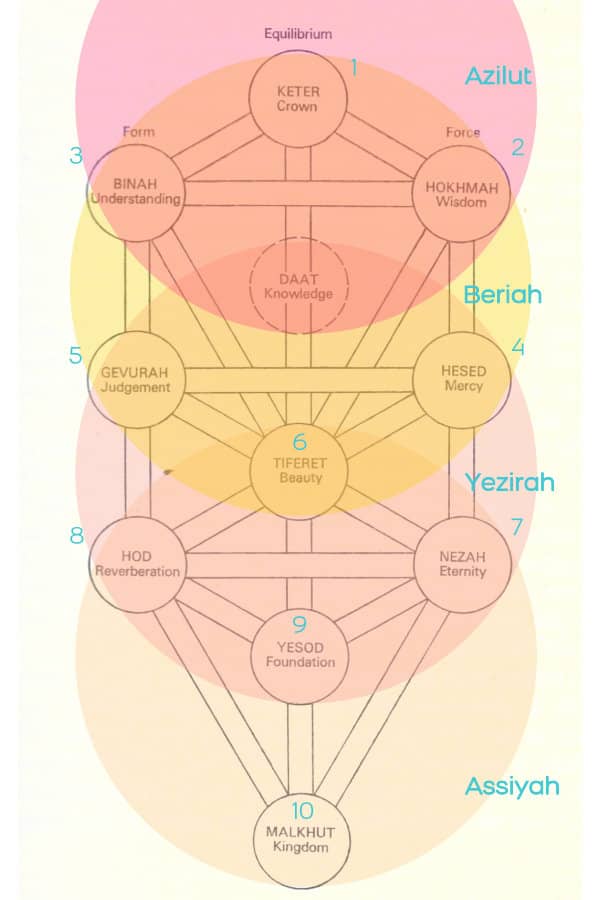
Here we have a network of archetypal nodes, connected by archetypal paths. It’s an archetypal buffet! Instead of attempting the impossible task of eliminating a complex, the Tree suggests a different move: repositioning.
Through which archetype am I currently viewing this experience? And what might it look like from another POV? Instead of seeing book club through the lens of “If I’m not exceptional, I’m disposable,” what might it look like from the vantage of Netzach? Or Tiphereth?
That, my magical friend, is where we’ll pick up next week.