Last week, we climbed the Tree of Life, viewing the same situation—Thursday night book club—from different vantage points. The Tree of Life is a precise arrangement of archetypes, and our ascent was a psychic one, not literal travel.
Today, I want to explore how archetypes are more than mental constructs. They can affect the physical world, and learning how is a powerful tool in our practical magic bag.
Let’s start with a strange little book by Jung’s colleague, Marie-Louise von Franz, called On Divination and Synchronicity.
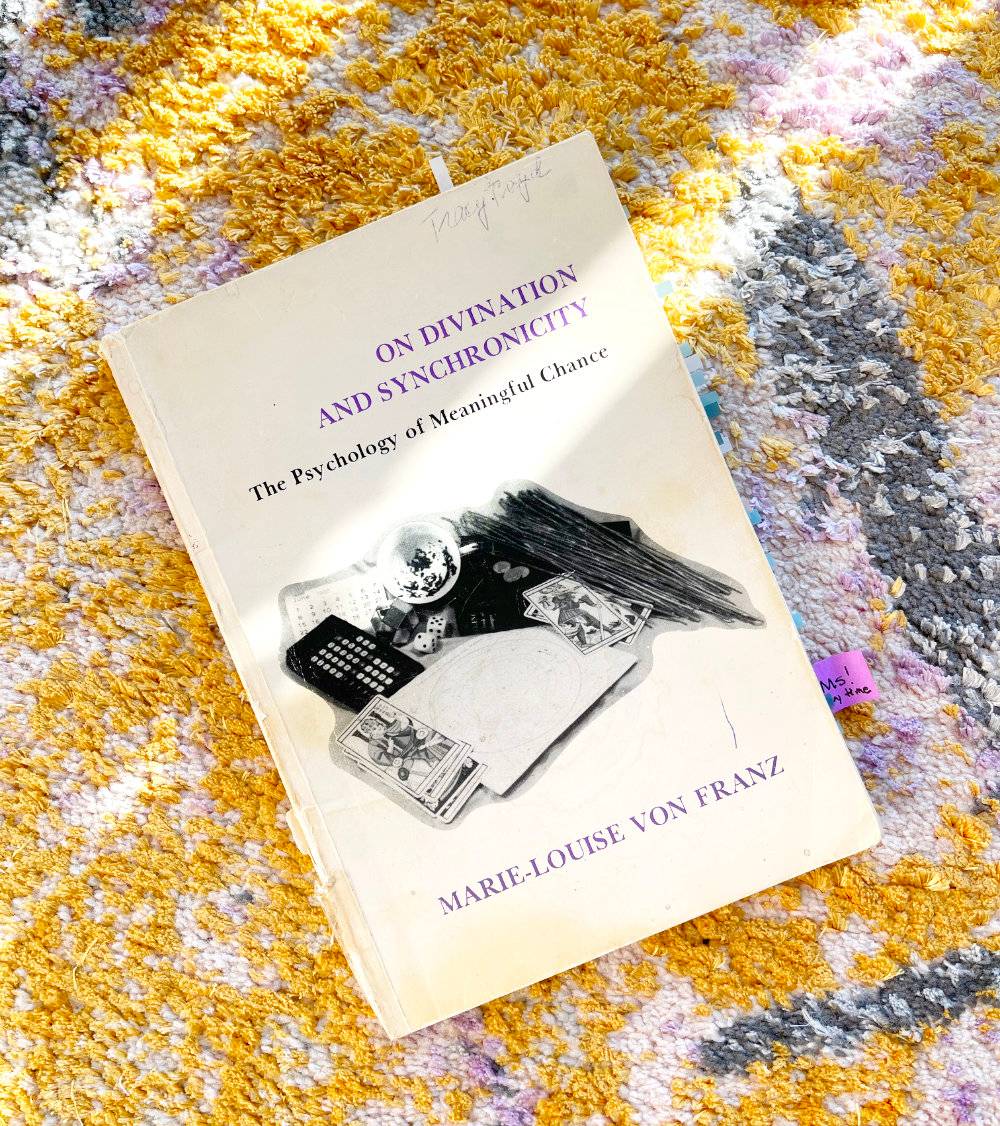
Von Franz writes:
“The relationships and the facts of the [I Ching] could be compared with the network of an electric circuit, which penetrates all things. It has the possibility of being lit up but it does not light up unless the person who puts a question has established contact with a definite question. One should therefore not throw an I Ching without first asking, ‘What question do I really have in mind? What do I really want to ask?’ By that one makes contact with one’s unconscious, and asks it to suggest the [solution to] the question.” (p. 58-59)
This mirrors my stance on the tarot: by posing a question before drawing a card, you “light up” the relevant answers in the energetic field that connects your individual psyche, the collective unconscious, and the cards.
Last week, when we used the Tree of Life to reinterpret book club, we were doing something similar. We posed the scenario as a “question” and watched different sephiroth light up. Netzach illuminated raw emotion at the scene level, Tiphareth illuminated larger patterns at the level of character arc, and Binah illuminated archetypal themes.
Back to von Franz:
“I want to now introduce a new idea, which Jung has not used…the idea or the concept of a field to explore what Jung calls the collective unconscious, a field in which the archetype would be the single activated point. [Theoretical physicist, John Archibald] Wheeler, for instance, defines matter as an electro-dynamic field in which the particles are the excited points. Now I propose…that the collective unconscious is a field of psychic energy, the excited points of which are archetypes.” (p. 61)
This is fascinating. Here, archetypes are described as excited points of energy in a field—in this case, the field of the collective unconscious—just as matter is described as excited points in an electrodynamic field.
But what if those fields were actually the same?
This is what Jung’s theory of synchronicity claims.
Synchronicity describes a meaningful coincidence—an inner psychic event and an outer physical event aligning in a way that feels charged with significance, yet cannot be explained through ordinary cause and effect. The famous example involves one of Jung’s patients recounting a dream of a scarab beetle, only to be interrupted by a scarab-like beetle tapping at the window pane.
Jung wasn’t suggesting that the patient’s mind summoned or created the beetle. Instead, he proposed that both the mental effect (the dream) and the outer event (the window-tapping beetle) arise from a shared underlying pattern—an activated archetype strong enough to organize energy on both sides of the mind/matter divide.
More precisely, he posited the existence of a unified field—an unus mundus—in which psyche and matter aren’t nearly as separate as they seem.
If we combine this with von Franz’s suggestion that archetypes are excited points in the psychic field, we arrive at a compelling possibility: archetypes are excited points in a field that is both psychic and physical—the field in which synchronicity occurs.
Now, here’s where my thinking departs from Jung. He would certainly accuse me of magical thinking—and he’d be right. I just happen to believe that magic is real. 😉
Remember, for Jung, the mind does not create synchronistic events. The underlying archetype generates both the mental effect and the outer world event. But as a magical practitioner, this begs the question: what if the mind could participate in this process more intentionally?
Jung gives us another juicy clue.
He observed, time and time again, that whenever a synchronicity occurs, heightened emotions are present. A magical point of view might say that heightened emotions cause the synchronicity. In fact, Jung quotes a 13th-century magical text by pseudo-Albertus Magnus, De mirabilibus mundi, that makes precisely this claim—though Jung presents the passage in order to dispute it.
In my witchy estimation, however, pseudo-Albertus offers a compelling argument:
“When therefore the soul of man falls into a great excess of any passion, it can be proved by experiment that [the excess] binds things [magically] and alters them in the way it wants, and for a long time I did not believe it, but…I found that the emotionality of the human soul is the chief cause of these things…Thus it is the soul who desires a thing more intensely, who makes things more effective…Everything [the soul] does with that aim in view possesses motive power and efficacy for what the soul desires.” (CW 8, para. 859)
So we know that during a synchronistic event, four things tend to cluster together:
• An activated archetype
• A mental effect
• A physical event
• Heightened emotions
The question is: do they need to occur in a particular order?
Activated archetype → mental effect → physical event → heightened emotions
Or could we swap things around?
Heightened emotions → mental effect → activated archetype → physical event
Or perhaps:
Heightened emotions → activated archetype → mental effect → physical event
If we think synchronistically, as von Franz suggests, the order may matter less than the clustering together. She writes:
“Synchronistic thinking…is thinking in fields, so to speak…The question is not why has this come about, or what factor caused this effect, but what likes to happen together in a meaningful way in the same moment…What tends to happen together in time?” (p. 8; emphasis mine)
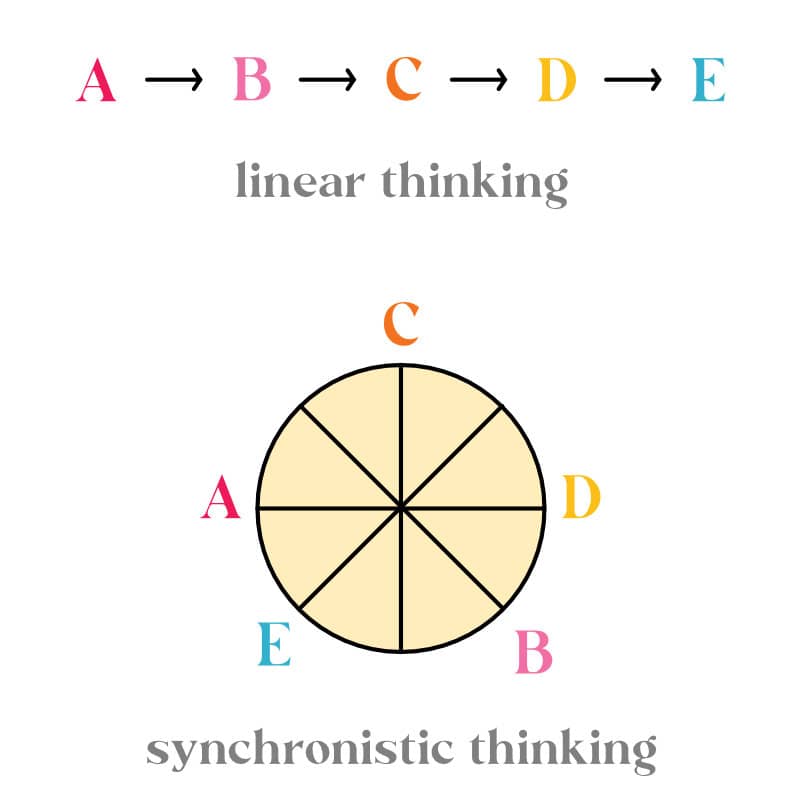
So if the order is less important, and we’re thinking in fields rather than tumbling dominos, then we’re no longer asking what causes what. We’re asking which variables we have the power to influence.
Of course, magic already makes a claim here:
That you can change your internal state and affect the outer world. But I’m perennially interested in the how. Instead of a theoretical physicist, you might call me a theoretical witchicist. I want to understand how magic works, and this field-based model feels like one plausible explanation.
We can raise emotional energy. We can generate a focused mental effect. We can attempt to activate archetypal imagery.
We might not be able to orchestrate a synchronistic dream on command, but we can consciously amplify intention (the mental effect). This is precisely what we do when drafting a spellcasting intention: we focus awareness and raise energy to empower a thought.
That’s two factors successfully dialed up—what about the archetypal activation?
This is tricky, because, by definition, archetypes are unconscious. The archetypes discussed in pop psychology and much magical discourse (things like the Great Mother or the Magician) are actually archetypal images; they’re not the archetypes themselves.
This isn’t just semantics.
Going back to our field model in which archetypes are activated nodes in the field, an archetypal image is like a flickering candle compared to the solar flare of the underlying archetype. We can ignite archetypal images fairly easily—perhaps by placing the Magician tarot card or a sculpture of the Great Mother on our altar and meditating on those images—but this is a far cry from firing up the deeper archetype.
For that, we need ritual technology.
Techniques like chanting, drumming, and meditating, or tools like sigils and other efficacious symbols that bypass the limitations of the conscious mind, have a better shot at penetrating those deeper layers.
There’s no guarantee that fiddling with any of these dials will result in the outer world change/physical event we’re aiming for, but this is a viable framework for creating optimal magical conditions.
Magic + Complexes
Throughout this Creative Season, we’ve described psychological complexes as hubs within the psyche, and you might have noticed the parallels with our four synchronistic-magical ingredients.
At the core of every complex is an archetype, which lights up when the complex is activated, thus coloring our perception of ourselves and the world around us.
Mental effects and heightened emotions are two hallmarks of an activated complex, as we’ve seen in the book club scenario. You’re more likely to think your fellow book clubbers are excluding you when the complex is lit up (mental effect), and you’ll feel anxious, competitive, and self-conscious as a result (heightened emotions). These changes precipitate in the outer world, too, because the complex alters how you behave (physical event).
Magically, by tweaking the levels of heightened emotions and mental effects, and using ritual tech to activate an archetype, we’re essentially building a complex. Only this time, we’re choosing which ingredients go in the cauldron.
Add a Pinch of Black Hole Energy
Remember, too, that if a complex gets powerful enough it behaves like a black hole. Every possible path leads to the complex’s foregone conclusion. Instead of adaptively choosing how to respond based on the situation at hand, the complex churns out habitual responses, often established in childhood.
When we’re under the spell of an unwanted complex, this blows. But if we’re trying to set up our own magical “complex,” this very same mechanism becomes a superpower, making it more likely that events will lead to our desired outcome.
This mirrors Theorem 18 in Aleister Crowley’s Magick in Theory and Practice:
“[The magician] may attract to himself any force of the Universe by making himself a fit receptacle for it, establishing a connection with it, and arranging conditions so that its nature compels it to flow toward him.” (xviii; emphasis mine)
Crowley’s example is digging a well. You choose a suitable location, prevent leakage, and work with physical laws governing water flow. You don’t dig at the peak of a desert mountain and demand that water appear. You optimize conditions. Magic, in this sense, is optimization within a structured field.
You may have noticed that I’ve barely touched on the fourth ingredient in our archetypal activation soup: the physical event.
Typically, that’s what we’re aiming for—a change in the external world. So we tinker with the other variables, like an algebra problem, hoping to influence the physical factor.
But there’s another way to tweak the physical-event dial. It’s called sympathetic magic—and that’s where we’ll pick up next week.