Last week, I named one of the key archetypes animating my work: people coming together. Today, I want to show you what it looked like to actually build that on the page.
After all, just because people coming together opens the floodgates for me doesn’t mean I’m automatically translating that depth of emotion into my story. There are scenes in my first novel, The Fool & the Threads of Time, I’d now revise, knowing what I know about building group dynamics—but that’s a task for another day!
✂️ Today, I want to show you how I divided this problem into manageable chunks, so I wasn’t trying to juggle a circus tent of details all at once.
My exact process might not work for you, but the underlying principle still applies: once you identify the archetype you want to channel through your writing, you can break the work into doable, focused tasks.
Coming up with a Game Plan
Given that my chosen archetype was people coming together, I began by researching what other smart people already knew about group dynamics. This led me to improv theater, anthropology, ritual behavior, and a framework called Tuckman’s stages of group formation (among other cool stuff).
I’d just finished Draft Three of The Magician & the Labyrinth of Yesterdays, and based on my research, I created a Draft Four outline focused entirely on group dynamics. Importantly, I didn’t aim to fix anything else in this draft.
I wasn’t polishing the haunting subplot and fixing the opening chapter and tightening Ev’s character arc.
💡 Draft Four was about group dynamics—full stop. This constraint kept me from getting overwhelmed and throwing in the towel.
If you find yourself spinning, it may be time to narrow your focus. Trying to revise everything at once is a reliable way to do nothing—or to redo scattered efforts later, which can be pretty demoralizing.
Mapping the Arc of the Group
I approached the outline in two phases: mapping the arc of the group as a whole, and mapping the arcs of individual characters within it.
✍️ Using Tuckman’s stages—forming, storming, norming, performing, and adjourning—I mapped the emotional trajectory of the group across the story, relative to the main plot beats. This immediately solved a recurring problem: scenes where characters were technically present, but nothing progressed relationally.
Once I started asking, What stage is the group in right now?, the scene-level choices became clearer. I didn’t force scenes to match the stages mechanically, but holding them in mind helped me figure out which seeds needed to be planted where and kept me from rushing emotional payoffs the story hadn’t earned.
This became especially important when building the climax sequence, which we’ll talk about next week.
Defining Roles Without Erasing Difference
Once I’d mapped the group’s arc, it was time to define each character’s role within it. Some of this work existed in earlier outlines or was already on the page, but studying group dynamics pushed me to go further, especially around contrast and conflict.
It made little sense to have multiple characters performing the same function, like several people diffusing tension with humor, but it’s not always easy to spot this overlap in your own story. You get attached to the characters’ personalities, overlooking that they’re functionally redundant.
I also knew—based on why the people coming together archetype hits so hard for me, personally—that unity without difference would drain the archetype of its numinous quality. To keep the magic alive, I had to build a group powered by contrasting personalities and conflict, showing why the characters chose to work together.
✍️ To make my job easier, I assigned Enneagram types as a shorthand for how each character would respond under stress. This helped me map each character’s arc in relation to the group.
For example, in The Magician & the Labyrinth of Yesterdays, Adrian is an Enneagram 8. Early in his arc, his reflex is to shut down vulnerability and take control, which puts him in direct conflict with Inés.
As an Enneagram 7, she’s oriented toward vision and possibility; she wants to steer the group because she’s already living a few steps ahead, impatient with anything that feels like stagnation or constraint.
Over time, they learn how to use those same instincts in service of the group. Adrian’s impulse to take control evolves into an ability to steady the group under pressure, while Inés’ vision and forward momentum helps them push through fear that might otherwise stall their quest.
And crucially, when individual strategies break down, this creates space for someone else to step in. When Inés spirals, it’s Margot, whom Inés has dismissed as a hopeless nerd, who brings her back to the present. Those moments build trust and strengthen the group’s bonds—in other words, they channel that people coming together energy I’m after.
Keeping Track of Who’s Doing What
One of my biggest practical concerns with a large group was accidentally dropping threads, and in doing so, missing opportunities to earn the emotional impact of people coming together.
✍️ So, I did something unglamorous but effective: I listed every scene by character, creating a checklist of revisions specific to that character’s arc within the scene.
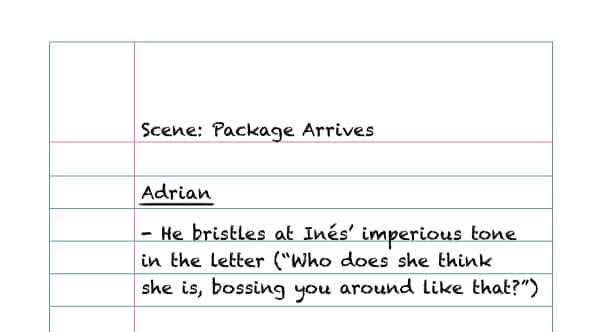
Even if a character only had a line or two, those lines needed to count. They needed to advance the character’s individual arc alongside that of the group, bringing to life a person with their own goals, hopes, and fears—someone who exists independently of the protagonist.
This isn’t just about avoiding cardboard cutouts.
It’s about making sure that when the group finally does come together, it feels earned. When a character steps up in a critical moment, the reader shouldn’t be thinking, Oh right, that person exists.
They should experience the swelling recognition of seeing someone they know choose differently, feeling, in their bones, that this is the moment the character has been growing toward.
It’s the person who’s always handled things solo—the fixer, the one who never wants to be a burden—realizing they can’t brute-force their way through this one. The plan is unraveling. Time is running out. And instead of pushing harder…they stop. They take a breath. And they finally admit, I can’t do this alone.
Someone leans in, noticing the tremor in their hand, and steadies the map before helping to find a new escape route. Someone else flips through the grimoire and finds the spell that changes everything. Another person doesn’t say anything at all; they simply move closer, anchoring with a quiet hand on a shoulder.
The character doesn’t become weaker for asking; they become part of something larger. And that—that shift from isolation to interdependence—is what turns on the people coming together waterworks for me, every single time. 😭
Untangling a Knotty Climax
Next time, I want to show you how I tackled revising a climax sequence that initially felt impossible to hold in my head—especially with the whole group in play—and how I transformed it into a puzzle I actually enjoyed solving, one piece at a time.
If you’re wrestling with scenes that feel too messy to revise, this one’s for you.
See you next week.