Last week, we left off with Dr. Josephine Ashcroft, who was hired to catalogue the paintings at Harrowfell Hall.
After seeing how outdated her bio on the Barton College website was, I didn’t expect to find much, but I was wrong—spectacularly wrong. Buried in the archives was a project spearheaded by Dr. Mira Halstead, a faculty member in Barton’s Art Conservation Department, and it included a digitized series of journal entries written by Ashcroft herself.
And get this: they chronicled her time at Harrowfell. Jackpot.

Because Dr. Ashcroft’s findings caused quite a stir, Barton College preserved all of her reports, along with her handwritten journal entries. There was even a photograph of Dr. Ashcroft beside the painting that would later become the subject of endless speculation.
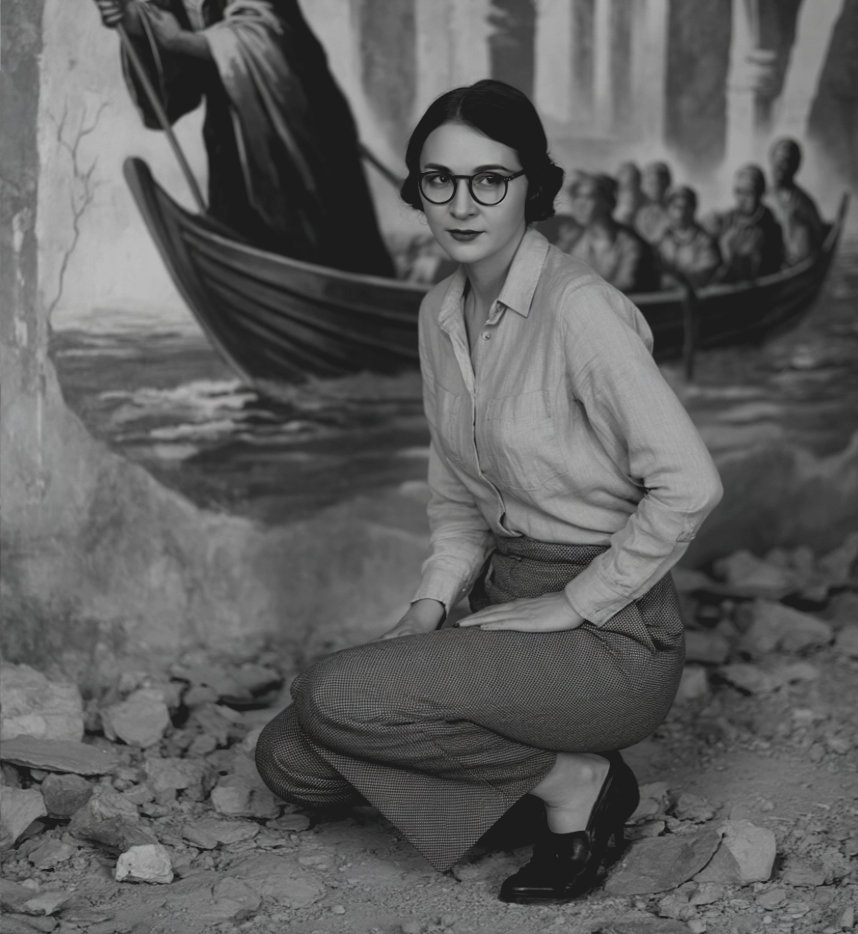
But I’m getting ahead of myself.
Let’s start with Dr. Ashcroft’s journal entry from her arrival at Harrowfell.
August 14, 1926 — Harrowfell Hall
I was well aware Harrowfell wasn’t in its prime, but the trustees vastly undersold its condition. The vestibule alone was nearly impassable: plaster hanging in jagged sheets, rain-warped boards sagging beneath my feet, stone fragments scattered like loose teeth across the floor. A once-grand space, reduced to ruin.
Thankfully, I had come prepared: flashlight, gloves, sturdy boots, and a well-fitting dust mask. One doesn’t step into a crumbling castle unarmed, after all.
To my right stretched a corridor, narrow and close, the walls crowded with frames. I could already tell I’d have my work cut out for me, the thought alone quickening my pulse. A conservator’s dream: a trove of neglected canvases, each one a case study in survival, every crack and layer of grime a clue to its past.
Testing each step before committing my weight, I approached a heavy oak door. To its left, a painting caught my attention, and the sweep of my flashlight revealed a landscape of jagged escarpments plunging into darkness. As the light steadied, more details surfaced: a cavernous pit littered with coal-black boulders, every plane modeled with remarkable control of shadow. Between the stones, what I first mistook for twisting weeds resolved into arms—scores of them—straining upward toward the surface.
Quite the macabre subject, though masterfully rendered.
Inside the adjoining room—the library—I could go no farther than the threshold. The floor had collapsed in places, beams yawning like broken ribs. Such a shame, for above the fireplace one canvas remained astonishingly intact: a portrait of young Finneas Thorne himself.
The museum holds a single authenticated painting of Thorne, and I recognized him at once. Strawberry-blond hair swept across his brow, his gaze shadowed, half brooding, half defiant. Byronic in its melancholy. He sat at a table strewn with books, an easel behind him bearing a half-finished version of the very portrait in which he sat.
The doubling effect unsettled me. It was technically clever, yes, but also disorienting, as though Thorne had painted himself into the act of painting, and then abandoned both canvases to watch from the walls.
I retraced my steps to the vestibule, turning this time toward the grand staircase. I did not dare climb it—the banisters leaned, and the treads sighed under the barest touch. From the ground floor, I craned my neck at the fresco soaring across the distant dome above.
Figures swirled upward in concentric rings of fire, each form twisted in torment. It was Dante’s Inferno rendered on a monumental scale—far grander than anything I have seen attempted in this country. Even at such a distance, I could make out bold brushwork, pigments laid down in broad, confident strokes, the colors startlingly vivid despite decades of neglect. My gaze followed the spirals until the whole dome seemed to spin above me, and I felt myself caught in the vortex of their suffering.
That was only the beginning of Dr. Ashcroft’s discoveries. In another entry, she described finding a partial blueprint tucked inside what she believed to be Finneas Thorne’s study. Two of the castle’s rooms were marked with curious names: Salon Nysa and Salon Lethe.
Perhaps you recognize the names?
Look at me, getting ahead of myself again. I’ll share what I uncovered about Nysa and Lethe next week.