Category: Twin Flames Lore

  • How to astral travel (with tarot cards)

    How to astral travel (with tarot cards)

    In our final installment of the Tarot & Tesseracts Creative Season, Margot breaks down some mind-bending magical theory. Grab a cup of tea…


    Research Journal of Margot Takada

    February 18

    I was at Germaine’s last night for my Wednesday lessons, and of course I told him about the ​Freaky Light Web​. He’s probably the only person I can tell. Maybe Ev, but I’m not quite ready to test that theory. We probably need to hang out a couple more times before I reveal just how strange the skeletons in my closet are.

    Germaine, true to form, didn’t even blink as I described actual lines of light streaming out of my tarot cards. But he was surprised when I told him this only happened after doing Hinton’s higher-dimensional exercises. Since he was the one who turned me on to Hinton in the first place, I’m guessing he was a little put out that he hadn’t made the discovery himself.

    At any rate, we decided to ditch my normal lessons so Germaine could tell me about mnemonic devices. And we’re not talking the grade school variety. You know the kind—Please Excuse My Dear Aunt Sally. I can’t even remember what that stood for. Something to do with math?

    Anyhow, according to Germaine, a true mnemonic device is far more powerful than a memory tool, though it is related to memory.

    Let me back up.

    First things first: Giordano Bruno. Back in the Italian Renaissance, Bruno developed the concept of a memory palace to help him retain large amounts of information.

    Let’s say you’re giving a long-ass lecture at Oxford, and you don’t want to read off a stack of notes. (Because if you’re Bruno, you’d rather spend your energy antagonizing the Oxford scholars in attendance, accusing them of being stodgy old farts, stuck in the intellectual past. Smooth move, Bruno.)

    You might associate the first part of your speech to a statue in your memory palace’s entryway and the second part to a table in the dining room. Then, when it’s time to give the speech, you mentally walk through the rooms of your palace, retrieving information in sequence, sort of like an imaginary teleprompter.

    One of the (many) things that got Bruno in trouble with the Church was his suggestion that the memory palace wasn’t entirely imaginary.

    To be clear, it wasn’t a physical place in the way we think of chairs and tables as physical, but Bruno came to believe that you could actually travel to your memory palace. Further, he claimed that your personal memory palace was linked to other people’s memory palaces, and also the memory palace of the cosmos—maybe even god’s. (Gee, I can’t imagine why the Church had it out for him.) The trained initiate could piggyback from their personal memory palace to…well, just about anywhere, including the divine realms.

    Here’s the part that really lights up my circuit boards: Bruno never fully explained how the memory palace could be non-material, yet still a place you could physically travel to. At least, not in any of his surviving works.

    What I can’t help thinking about is a possible connection to my buddy Charles Howard Hinton. What if Bruno’s memory palace is a physical place, but it exists on a higher dimension than we’re accustomed to perceiving? It’s like having a fourth-dimensional tesseract sitting in your living room, but all you can see from your limited 3D point of view is a boring ol’ cube.

    Maybe the memory palace is right there—we just can’t see it. Unless, that is, we train our minds using something like Hinton’s perceptual exercises.

    This brings me to Germaine’s mnemonic device, and interestingly enough, it overlaps with that Twin Flames website I found. After the essay on synchronicity, there was ​another one on sympathetic magic​.

    Here’s a quote:

    “If psyche and matter participate in a shared field, then material objects are not dead props. They are condensations of relationship. They occupy positions within that field—positions that encode time, physical coordinates, meaning, and other data.”

    The essay suggests this is a possible mechanism for sympathetic magic. If you want to affect the field over at Point Z, you can use an object that energetically matches that point. Even though you’re stuck at Point A, this energetic link allows you to affect far-off Point Z.

    What Germaine says is with the proper ritual technology (which he sure as hell better teach me) and a mnemonic device, you can do more than affect Point Z‚ you can travel to it. All without taking a single step in ordinary physical reality.

    As soon as I learn how, journal, you’ll be the first to know. Assuming I make it back. (Just kidding. Sort of.)


    If you’ve enjoyed nerding out with me and Margot, my forthcoming novel The Magician & the Labyrinth of Yesterdays is full of metaphysical mysteries—along with a haunted film set, tarot cards that refuse to behave, and a swoony, spicy romance.

    I’m nearing the revision finish line, slowly but surely, and aiming for an early summer release.

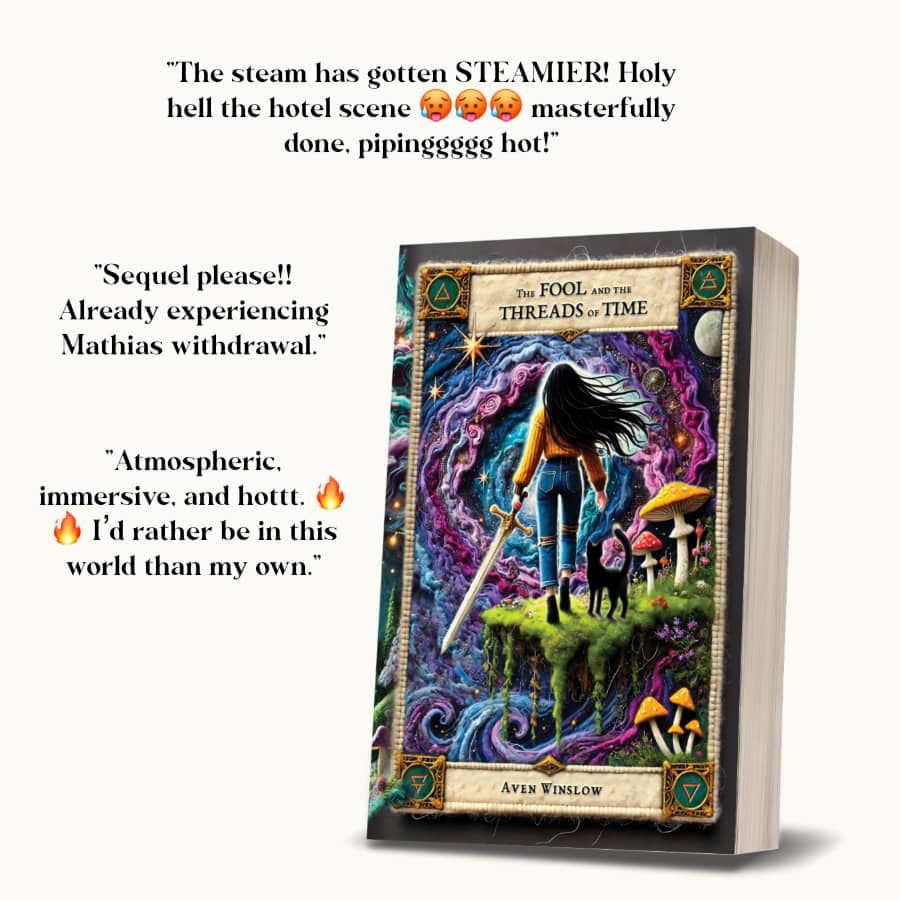
    To be the first to know, hop on my list. You’ll also get free chapters from the first book, The Fool & the Threads of Time, if you haven’t read it yet!
  • Casting a spell? Read this first.

    Casting a spell? Read this first.

    Margot’s trippy magical experiment continues! If you’ve ever wondered whether effective magic really needs a clear intention, you won’t want to miss this…


    Research Journal of Margot Takada

    February 11

    I was ​reading this essay​ about Jung’s theory of synchronicity on a website called Twin Flames. The author, Aven Winslow, proposed a set of four “ingredients” that constitute a synchronistic event.

    An activated archetype

    A mental effect

    A physical event

    Heightened emotions

    This got me thinking about my tarot card experience, what I’m officially calling the Freaky Light Web.

    I can’t prove it, but intuitively, it seems like I had an activated archetype on my hands, and I definitely had heightened emotions. Add to that the physical event of the tarot card being surrounded by said Freaky Light Web, and that just leaves the mental effect—an example of which, according to the Twin Flames essay, is an intention, like something you’d use when casting a spell.

    Or when doing a tarot reading, perhaps??

    The way I see it, a question posed to the cards is also a mental effect, and that was the only thing missing when I experienced the Freaky Light Web. I wasn’t doing an actual reading, so I hadn’t asked anything before drawing a card.

    Damn it. Someone’s at the door. To be continued…


    February 12

    I’ve apparently unlocked the Pandora’s box of weird, because there was no one at my door last night. What I did find, however, was a shoddily wrapped package tied up with twine, sitting on my doormat. Oh, and with a white feather stuck in the crooked-ass bow because why not.

    Inside was a kindergartner’s art project: a fingerpainted rainbow, complete with cotton ball clouds. Someone had written underneath the arch “See you at the center,” signed M.

    Who the hell is M? At this point, things have gone so far off the rails, I wouldn’t be surprised if I sent it to myself. At any rate, that’ll have to be a mystery for another day, because I need to record what happened when I asked a question before drawing a tarot card, testing out my intention theory.

    Just like last time, I did Hinton’s rotating cube exercise first. Then I asked a question I normally wouldn’t pose to the tarot, but I had a hunch I wanted to test. The question was, “Where’s my copy of Temporal Slippage and Botanical Memory?” I misplaced it a couple weeks ago, and I’m planning to head back to Harrowfell Hall to make some measurements of the labyrinth and could really use that damn book.

    Wouldn’t you know, I drew the Magician card again. Hello there, friend.

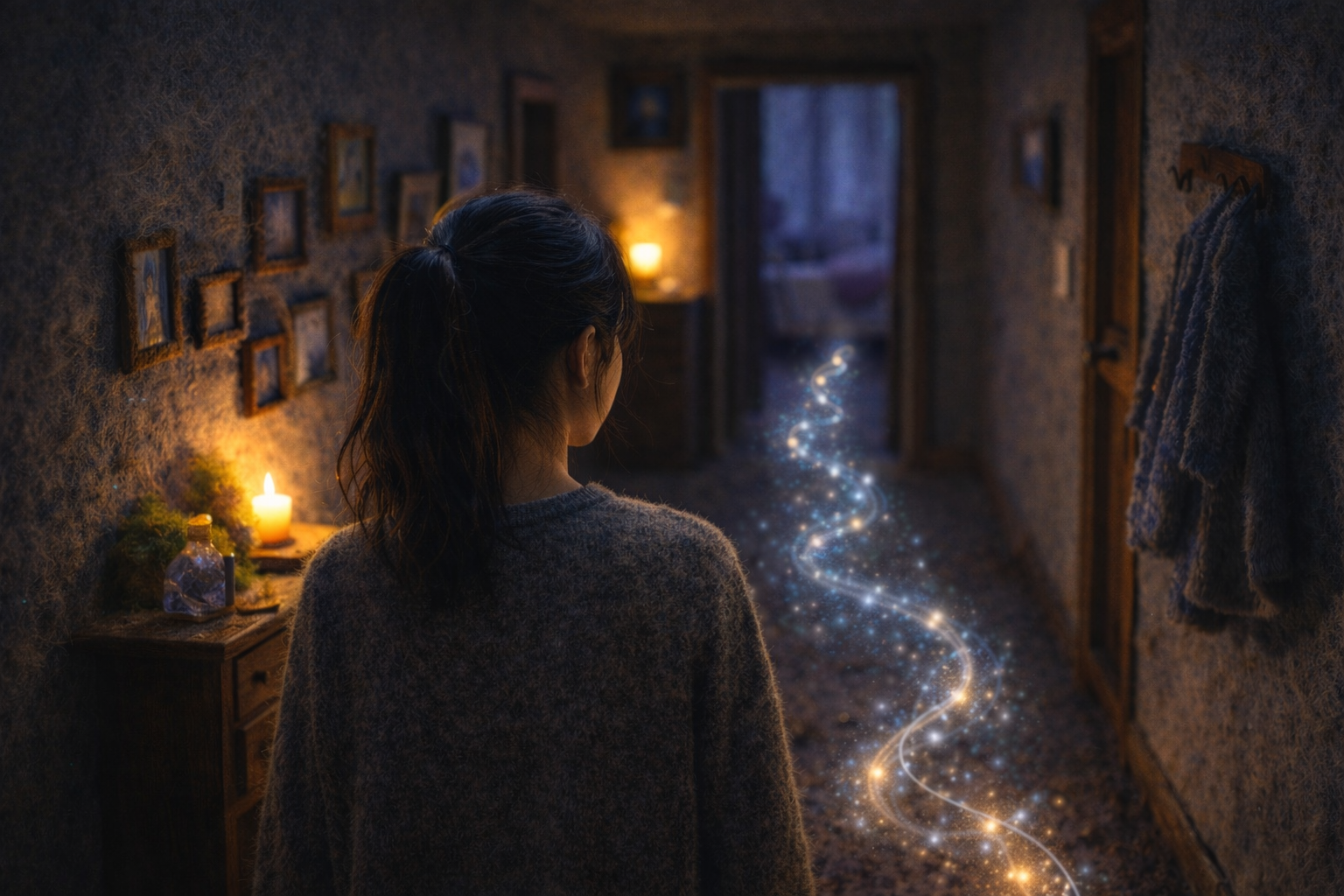
    Sure enough, the Freaky Light Web appeared, but this time, there was an unmistakable densification of the web—leading straight to my bedroom. When I say “leading,” I mean the thickened threads formed a clear path, emanating from the card and heading down the hall before turning into my room.

    I followed the threads down the hall, and I’m surprised I didn’t choke on my own heart, which had apparently set up shop in my throat. The threads curved around the mattress, and on the other side of the bed they dipped behind the headboard.

    Wedged between the box spring and the wall was—wait for it—my copy of Temporal Slippage and Botanical Memory.

    I’m never one to leave a good anomaly alone. Finding a misplaced book is one thing, but the real question is: could an intention carry me further than down the hall?

    See you next time.

  • Glimpsing the hidden matrix of reality

    Glimpsing the hidden matrix of reality

    Research Journal of Margot Takada

    February 2

    Today, I added a second cube to Hinton’s higher-dimensional perceptual exercises, and let me tell you, the difficulty increases exponentially. Holding one rotating cube in my mind is more or less manageable at this point; holding two borders on bonkers.

    But when it works—when my mind can maintain awareness of both cubes’ rotation—something strange happens. It’s like Hinton said: the cubes feel less like objects and more like coordinates in a field. It’s like a cube isn’t a thing, so much as a specific configuration of relationships.

    Which made me think of tarot.

    If a cube is less about faces and vertices just sitting there being a cube, and instead, it’s a relational “slice” of the field of reality, this is akin to a tarot card being more than an image printed on card stock.

    A tarot card isn’t meaningful in isolation. Meaning arises from the card’s relationship to so many things—for instance, the card’s symbols would be gibberish were it not for an entire web of cultural associations. Even on a prosaic level, what would a picture of a throne mean if thrones didn’t exist in real life?

    Not to mention the various meanings the card activates as my psyche—conscious and unconscious—interacts with it. A card’s meaning arises from its position in a complex field of information.

    I don’t know what to do with this insight yet, but I can feel something brewing in the back alleys of my brain.


    February 9

    Welp, tonight was the weirdest night of my life, and I’ve experienced some pretty strange shit in my 28 years on this planet.

    I was at the Barton College library, back in the stacks by the theoretical physics section. It was about an hour before closing, and it was just me and the mice in the walls. Lately I’ve been carrying my tarot cards everywhere, hoping inspiration will strike, and I decided to do Hinton’s rotating cube exercise before pulling a card, just for fun.

    Woah, nelly.

    I shuffled the deck, and I’m not 100% sure that something weird wasn’t already happening at that point. I wasn’t expecting it, so for all I know the web of light was already there, and it just didn’t register.

    I’m already getting ahead of myself.

    Right. So I shuffled and drew a card: the Magician. Whether or not the “light threads” were already there, all I know is when I laid the card flat on the desk, I could see them: faint, spiderweb tracings of some sort of semi-translucent…liquid? I’m not sure. I dragged my finger through them and they sort of wobbled. More like rippled before they reformed.

    There’s definitely a pattern, but it’s not entirely symmetrical like a fishing net, or anything immediately discernible like a spider’s web. But I stared at it for—well, nearly an hour, because the front desk person scared the crap out of me when they came through, flipping off lights. If they were seeing the web of light, too, they’d make a killing at poker—their expression didn’t change one iota, and I was too freaked to ask them.

    I slid the card back in the box, and the web faded away.

    The second I got home, I tried again. Nothing happened.

    My first thought was it had something to do with Barton College. No matter how normie the brochures try to paint that place, it’s straight up Bizarro World. But then I remembered Hinton. I pulled out my colored cubes and worked through the exercise—and then I pulled a card.

    The Magician. Again.

    And wouldn’t you know, Hinton and all his higher dimensional strangeness delivered. The web was back, and this time, I could discern a clearer pattern. The lines of light were thicker in some areas, almost like individual threads had been braided together, making the web denser in certain areas.

    Did it mean something? Was it somehow related to the card I’d drawn? I tried again, this time pulling the Lovers, and sure enough, a different section of the web “densified.” Talk about trippy.

    But that’s nothing compared to what happened next.

    See you soon.

  • WTF is a tesseract?

    WTF is a tesseract?

    Last week​, we treated the archetypal field as something we infer—a pattern we can read using tools like tarot and the I Ching.

    But then we asked: what if you could actually see that pattern?

    Margot Takada, a scholar of magic in my upcoming book, The Magician & the Labyrinth of Yesterdays, was experimenting with a series of bizarre perceptual exercises created by real-life mathematician Charles Howard Hinton.

    When she added tarot cards to the mix, things got weird—weird enough that I should probably let her tell it…


    Research Journal of Margot Takada

    January 14

    Well, Germaine was right (again). I’m already obsessed with Charles Howard Hinton.

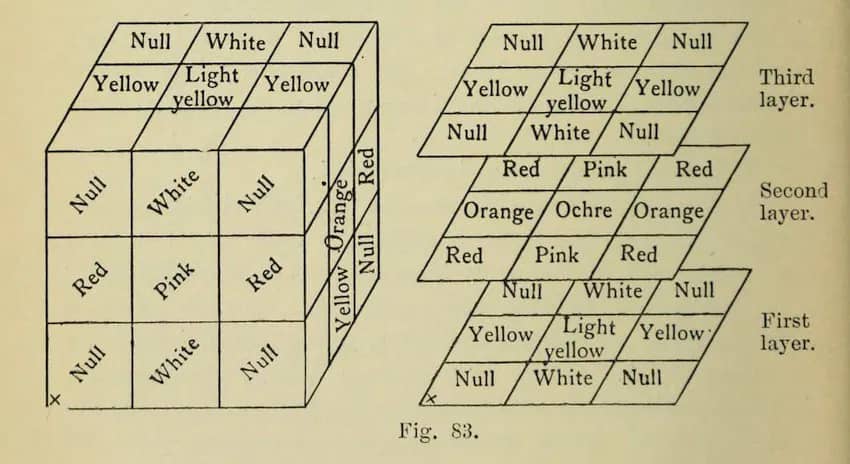
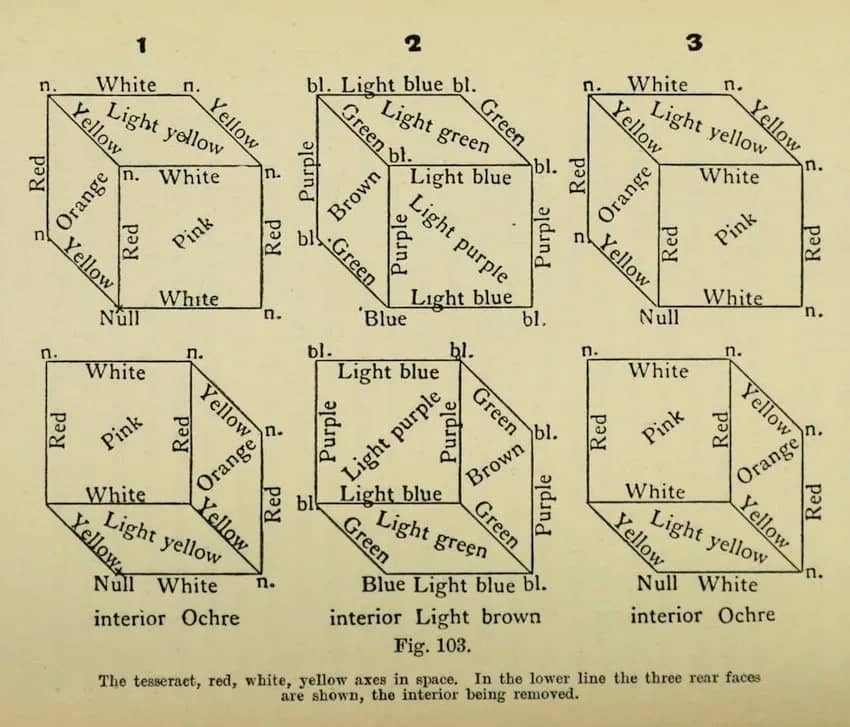
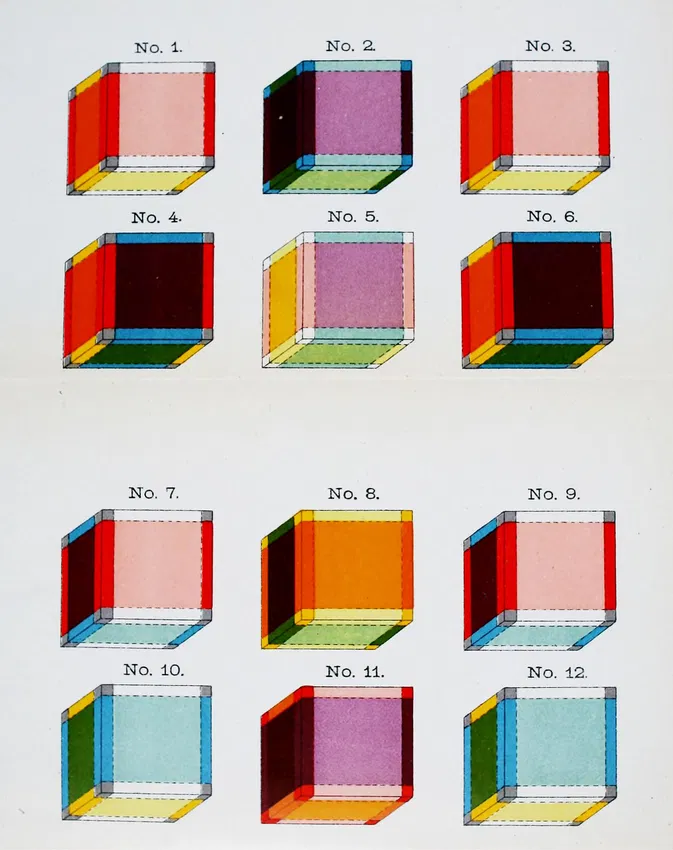
    Today I finally finished painting a set of wooden cubes so I can test drive his higher-dimensional perceptual exercises. The premise is pretty simple, even if painting those damn things was anything but. In his book, The Fourth Dimension (1904), Hinton outlines an exceedingly precise color scheme for the cubes.

    Seriously, the diagrams alone were enough to make my eyes bleed.

    ​source​

    The reason for the different colors is you’re meant to memorize their arrangement. Then, as you rotate the cubes, this allows you to keep track of all of the faces, not just the ones you can see. (Assuming your brain doesn’t explode first.)

    What’s the point? It’s pretty clever, actually.

    When we look at a cube, we don’t experience all six faces at once. Based on where we’re standing we’ll see a front, the top, and maybe a bit of one side. Our mind fills in the other faces, based on what it knows about cubes.

    The key point, though, is that we believe the cube is a predictable chunk of matter. Even though we can’t see the other faces, we assume they’re there, because we know how solid objects operate.

    What Hinton’s exercises attempt to do is loosen those assumptions.

    When you rotate the cube in your mind and consciously track the hidden faces (because you’ve memorized all those colors, right??), the object stops being just an object and it becomes a system of transformations. Instead of a boring block, the cube becomes a network of relationships.

    Hinton believed that once you can experience a cube this way, as something that exceeds any single viewpoint, you’re one step closer to thinking in higher dimensions.


    January 18

    I’m officially that kid on Christmas morning, ignoring the whole family to play with her new set of blocks. These cubes are taking up every spare moment of my time. No joke, I’m dreaming in goddamn cubes.

    I’m also starting to see why Hinton cautioned that higher-dimensional thinking has a way of unmooring your sense of what’s solid. What’s real.

    The more I practice rotating the cubes while maintaining an awareness of all the faces I can’t see, the more my mind is able to hold multiple orientations at once. I’m really starting to grok this idea of a cube as a series of relationships, not just a static thing.

    And this is just a springboard for the fun stuff, the stuff that would have blown my Wrinkle in Time loving little kid mind. Hell, it’s blowing my mind now.

    Hinton designed these exercises to help us visualize what higher dimensions might look like. Here’s the underlying logic:

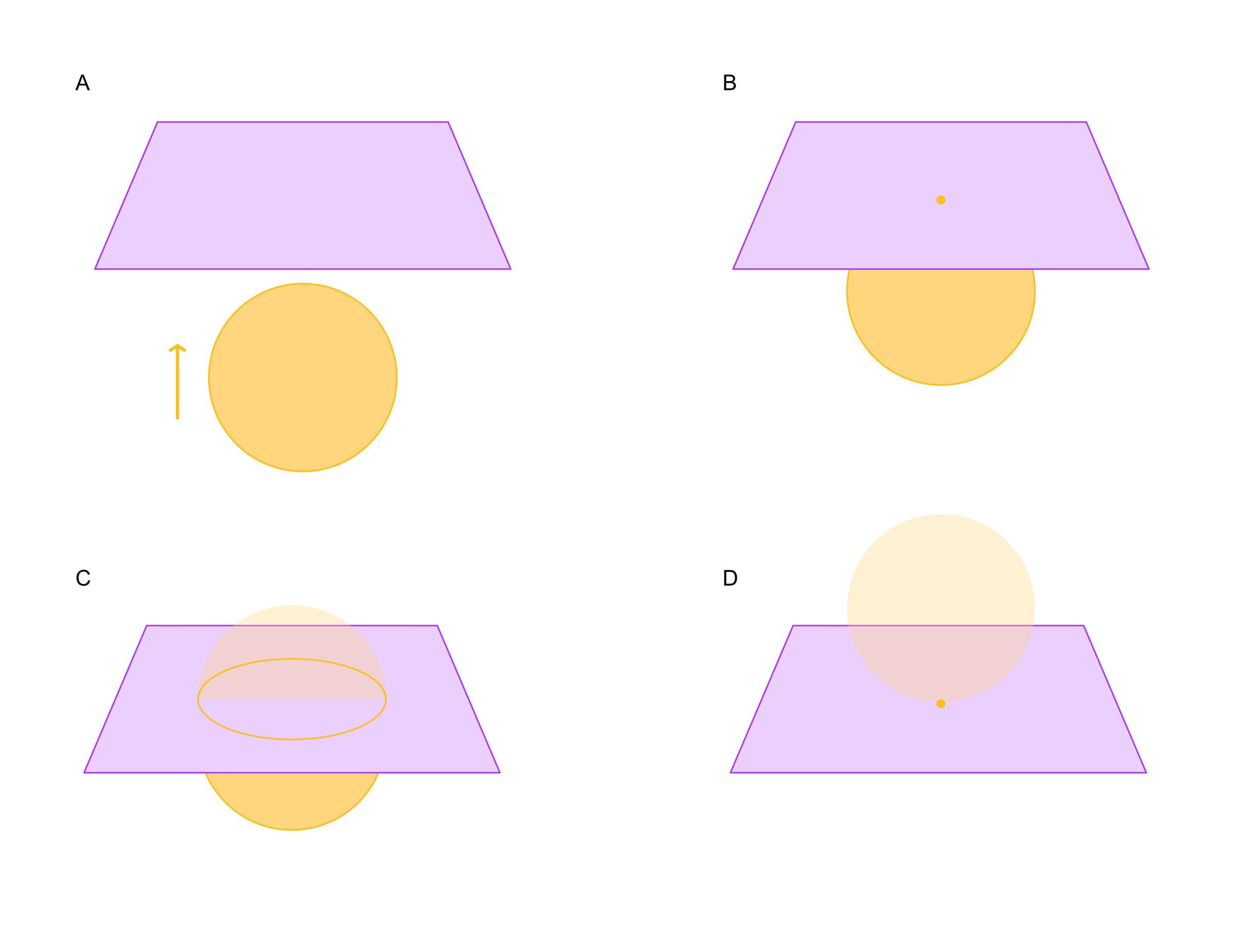
    A two-dimensional being (imagine a flat critter living on a sheet of paper) can only perceive length and width. If a three-dimensional sphere passed through its world, the 2D critter wouldn’t be able to see it, because the third dimension is beyond its perceptual purview.

    Instead, it would initially see a point. Imagine the sphere floating to touch the underside of the critter’s flat-paper world. Where the sphere kisses the paper, it creates a point.

    Then, as the sphere floats a little higher, the point morphs into a circle. The circle expands as the sphere floats higher, until it reaches the sphere’s midpoint (like a belt), at which point it starts shrinking, all the way back to a point. The 2D critter can only experience two-dimensional cross-sections of the three-dimensional sphere.

    Hinton is saying that we, with our three-dimensional viewpoint, are in an analogous situation. If a fourth-dimensional object were to pass through our world, we would mistakenly perceive it as a series of 3D cross sections.

    This is where the painted cubes come in—but I need to get some shut eye before I dive into that can of worms.

    Until then, sweet dreams (of cubes).


    January 19

    I’m finally ready to unpack the weirdness of tesseracts.

    A square is what a cube looks like in two dimensions.

    A cube is what that same structure looks like in three.

    And a tesseract is what it would look like in four.

    Just like the 2D critter’s experience of a sphere passing through its flat world as a point, a series of circles, and then a final point, if a tesseract were to pass through our world, we might see:

    A cube.

    Then a cube that appears to rotate or otherwise change its orientation.

    Then another cube, shifted again.

    And so on, changing as the higher-dimensional form moves through our three-dimensional realm.

    What looks like a boring ol’ cube to us might really be a cross-section of a higher-dimensional object: a tesseract.

    And it’s not just cubes. Anything around us could actually be a partial manifestation of a structure existing in more dimensions than we’re capable of seeing. Pretty trippy, huh?

    Turns out, things get a whole lot trippier when you use tarot cards instead of cubes.

    See you next time.

  • A Surprise Stash of Smexy Paintings

    A Surprise Stash of Smexy Paintings

    Last week​, while poring over Dr. Ashcroft’s journal entries and the spectroscopy scans of the River Styx mural, I learned why the cloaked figure found in the Styx underpainting caused such a stir.

    For starters, Dr. Halstead and Dr. Veyra were right—it was creepy. Tall and thin with stretched proportions that weren’t entirely human. Not to mention the glowing eyes.

    But it was the cloaked figure’s appearance in another set of paintings that catapulted it to fame—or infamy?

    For this, we need to look at Dr. Ashcroft’s inventory of a set of paintings that she found in Finneas Thorne’s study. She listed a total of seven works, all of them painted by Finneas himself. All seven depicted him with the cloaked figure, and in every painting the two of them were…How shall we say? They were totally boinking.

    Dr. Ashcroft phrased it a bit more delicately. From her notes:

    Figure: male, nude, seated. Cloaked figure positioned astride. Composition anatomically improbable though executed with notable skill.

    Recurring motif: elongated cloaked form entwined with subject. Facial expression: ambiguous—oscillating between resistance and abandon.

    There was also a mention of certain “proportions elongated beyond natural measure,” which cracked me up. Probably not a surprise that this room isn’t on the Harrowfell tour.

    Photo of Finneas Thorne’s study, artfully taken to crop out the wall of p$rn

    It wasn’t long before the docents and the local newspaper coined a name for the cloaked figure—The Dark Lover. Though at the time, none of them knew it was hiding beneath the River Styx mural.

    From The Dunsmere Gazette, May 12, 1932:

    “It has come to light that the late Mr. Finneas Thorne devoted a chamber of his ancestral home to paintings of the most scandalous and indecorous variety. Said canvases, which we decline to describe in detail out of respect for our readers, depict the young master in congress with a figure of grotesque and infernal mien. This ‘room of sin’ is an affront not only to propriety but to the good name of the Thorne family, once held in such esteem for their industrious contributions to the coal trade. We strongly urge that these abominations be covered, if not consigned to the flames.”

    Thankfully, the paintings were not consigned to the flames. But they do raise the question: was Finneas painting his fantasies or recording something that actually happened? I wasn’t able to find definitive proof, but I have to imagine that the discovery of these smexy images only fueled the rumors that Finneas dabbled in sex magic.

    It’s also strange that he was willing to cover one entire wall of his study with him and the Dark Lover going at it, but hid the other painting beneath the River Styx mural. Sadly, unless Finneas’ ghost truly is haunting Harrowfell and he sits for a séance interview, we’ll probably never know.

    Dr. Ashcroft was right about something else.

    You might recall that she was unable to go deeper into the concentric circular halls when she was investigating the murals. The crumbling stone she glimpsed through the fallen beams made her wonder whether Finneas had installed an artificial cave at Harrowfell’s heart.

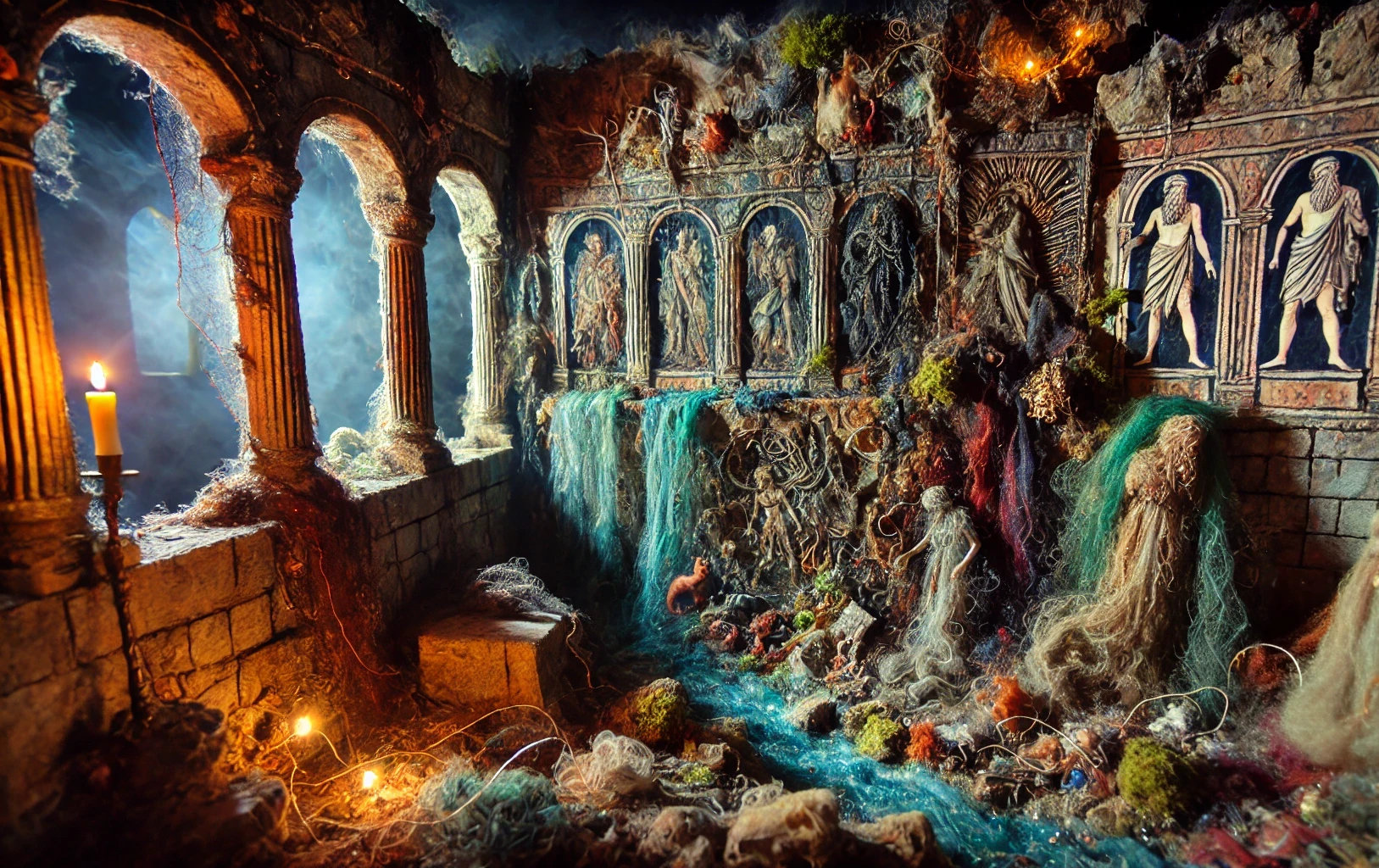
    Within her lifetime, the castle was restored, and that suspicion proved true: a grotto lay at the center, guarded by the Styx. But its purpose—decorative or something darker—remains as shadowed as the Dark Lover itself.

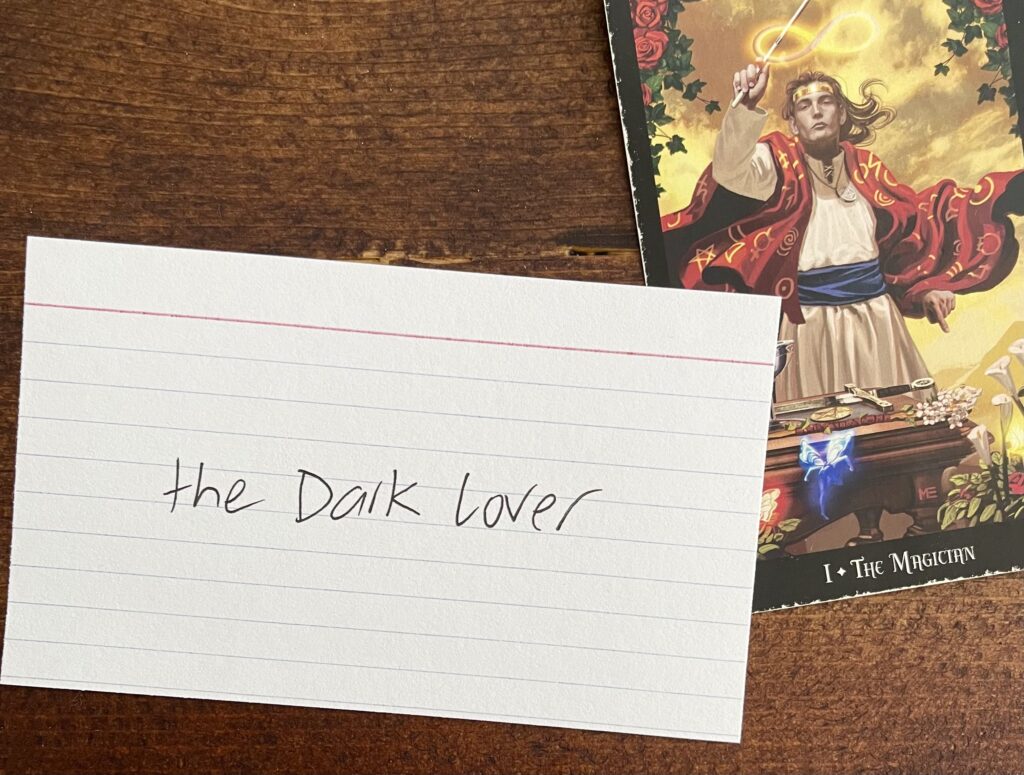
    And that brings us back to me, closing Dr. Ashcroft’s journal, sitting at my dining room table where this whole journey began. My notes and tarot cards are everywhere, index cards in messy stacks. Except now there’s one card that wasn’t there nine weeks ago, a single line scrawled across it.

    That’s the thing about stories—they have a way of sneaking out of the archives, bleeding into the in-between, daring you to follow.

    Which is exactly what Ev Knox will confront in The Magician and the Labyrinth of Yesterdays. Ev is an author, too, and she thinks she knows the boundary between fiction and reality. But Harrowfell Hall—and the figures lurking in its shadows—have other plans.

    If you want to know who (and what) the Dark Lover is, why Finneas disappeared, and what really happened that night when Levi “Lucky” Callahan’s luck finally ran out, you’ll have to follow Ev into the labyrinth.

    The book is slated to release on the Spring Equinox (2026), which means it’s time for me to get back to writing. The next draft isn’t going to write itself!

    I’ll see you next time, when we launch into a brand new Creative Season.

  • Charon’s Secrets Unveiled

    Charon’s Secrets Unveiled

    Last week​, we witnessed Dr. Ashcroft’s frustrations—she knew the River Styx mural concealed an underlayer, but the limits of 1920s technology prevented her from glimpsing more than a faint outline of what lay beneath.

    Nearly a century later, Dr. Mira Halstead returned to the mural with her colleague, art restoration specialist Dr. Niko Veyra. Here’s what they uncovered.


    Transcript: Voice Memo — Dr. Mira Halstead

    Location: Harrowfell Hall, Circular Mural #5 (River Styx)

    Date: April 4, 2009

    Participants: Dr. Mira Halstead, Dr. Niko Veyra (Barton Museum Conservation)

    Mira: Beginning scan. Surface reflectance spectroscopy. Niko, lock the lamp position. Let’s do the left quadrant first.

    Niko: All right, we’re pulling the top layer into false-color mode. First pass should give us outlines if anything’s underneath.

    Mira: The surface shows soft, horizontal motion—water. But below it, the transitions are abrupt, angular. Like folds of fabric dropping straight down.

    Niko: I’ll push the contrast. [keyboard clicks] There’s a sharper edge there. Could be a fabric fold.

    Mira: Hold on—yes. That’s a shoulder. Drapery falling from it. A cloak?

    Niko: I’ll zoom in on the upper section.

    Mira: The posture’s odd, don’t you think? Very…elongated. If it is Charon, it’s unlike any rendering I’ve seen.

    Niko: I’m on the hood—raising gamma now.

    Mira: Two points, deep in the recess. The eyes, I’m guessing.

    Niko: Yeah, the world’s creepiest eyes.

    Mira: [laughing] Is that the technical term?

    Niko: [laughing] All right—layered pigment with no scatter, edges tightened to a pinpoint. Whoever painted them wanted the effect of live embers burning in the dark.

    Mira: Yep, the world’s creepiest eyes. All right—background next. Rotate the frame.

    Niko: Filtering out the foreground.

    Mira: Hm. Do those look like lights to you?

    Niko: Yeah—string lights. Or no…lanterns?

    Mira: Lanterns underground…That’s not the Styx. Edge of the scan, bottom left. Niko, zoom.

    Niko: Tool shaft. Pickaxe.

    Mira: My god. Not a riverbank—it’s a mine.

    [02:44 — faint hissing noise]

    Mira: Did you hear that?

    Niko: Could be the fan in the lamp housing. [brief pause, rustle of movement] Everything looks fine, levels are steady.

    Mira: All right, let’s keep going. So, we have a cloaked figure with glowing eyes in what looks to be a mine.

    Niko: Finneas’ version of the Underworld? Mira, check out the angle of the grip—the cloaked figure. It’s pulling something behind it.

    Mira: Yes, there’s…another outline. Secondary figure, collapsed posture. Let’s bring up detail.

    Niko: Enhancing.

    Mira: A man, head tipped back, being dragged by one shoulder. Features faint but—hold. Stop there. Nose, strong bridge. Distinct brow.

    Niko: Clearer than I expected at this resolution.

    Mira: I know that face. That’s Finneas Thorne.

    [Recording ends.]

    The River Styx mural, restored in 2011

    If only time travel were a thing.

    Dr. Ashcroft could have had front-row seats when Dr. Halstead and Dr. Veyra uncovered what she could only speculate—beneath the surface of the Styx, a cloaked figure with eyes like burning coals was dragging Finneas Thorne, deep into the mine.

    If that were the only appearance of this figure in Harrowfell’s crumbling halls, the story might end here. But it isn’t.

    We’ll start there next time.

  • Beneath the River Styx

    Beneath the River Styx

    Last time, we left Dr. Josephine Ashcroft inside Harrowfell’s haunted halls where she’d spotted an unexpected hint of red pigment beneath the River Styx mural.

    Let’s see what she discovered next.

    August 27, 1926 — Harrowfell Hall

    At last! I was granted permission to conduct a closer examination of the mural in the innermost circular hall. I arrived just after sunrise, setting up two portable lamps at oblique angles against the plaster. The raking light revealed what my eyes had suspected: faint textures beneath the painted surface, inconsistent with the visible composition.

    The ridges suggested outlines—figures or forms, though indistinct, blurred by the thickness of the upper layer. I laid translucent paper against the wall and made several tracings, following the raised edges where the brushstrokes caught the light. The result was fragmentary, yet clear enough to convince me there is an underdrawing beneath the Styx.

    I also lifted the smallest possible sample from the broken edge. Under magnification, the layers were unmistakable: the black, indigo, and Prussian blue of the river above, and beneath them, the deep vermilion ground I noted earlier.

    And here lies my frustration. With present means, I can confirm only the existence of this hidden image, not its precise content. My tracings hint at two figures, one of them cloaked—though it may equally be some sort of water feature, the lines too faint to distinguish with certainty. Whatever Thorne buried beneath the surface remains beyond my grasp.

    It is a bitter thing to know the secret is there, and not be able to see it.

    September 2, 1926 — Harrowfell Hall

    In my frustration I attempted to push further into what appears to be the innermost of the circular halls. Fitting, I suppose, that this passage is guarded by the River Styx mural. I was grateful for my dust mask—the air was choked, and a mass of fallen beams barred my way—but through a narrow gap I glimpsed what appeared to be rough stone.

    I could not determine whether the stone was crumbled masonry from a structural collapse or whether the very heart of Harrowfell conceals something more primal, a cave at its core.

    It would not be without precedent. I have read of wealthy families in the last century commissioning grottoes and “natural chambers” within their estates, ornamented as fashionable curiosities. But here, amidst these labyrinthine murals and the ruin of Harrowfell pressing in on all sides, I’ll admit the effect is rather disquieting.


    That’s where the trail might have gone cold, if not for Dr. Mira Halstead.

    Nearly a century later, Dr. Halstead revisited Ashcroft’s journals and obtained permission to examine the mural with modern techniques Josephine could only dream of. High-resolution imaging and scanning techniques were able to “peel back” paint layers without disturbing a single brushstroke.

    What she discovered brought Dr. Ashcroft’s suspicions into unsettling focus.

    See you next week.

  • Dr. Ashcroft’s Tantalizing Clue

    Dr. Ashcroft’s Tantalizing Clue

    Last week, I left you with two curious names from Harrowfell’s blueprint: Salon Nysa and Salon Lethe.

    Naturally, I started tracing where those names intersect with Harrowfell’s history, and that’s when I stumbled across a blog called Beyond the Hedge.

    Here’s where the floor really dropped out: the blog was written by none other than Margot Takada, a character I’m pretty damn sure I invented.

    In The Magician and the Labyrinth of Yesterdays, Margot is an independent scholar investigating the hauntings at Harrowfell, along with the many hikers who have disappeared in the surrounding woods.

    Yet here she was, publishing essays on timeslips and local urban legends as if she’d been doing it for years. As if she actually existed.

    You better believe I emailed her. I haven’t heard back…but it’s only been twenty minutes, so I probably need to chill. (Easier said than done.)

    In one post, Margot explains the myths behind the names.

    Nysa was the secret grove where the god Dionysus was hidden and raised—a wild, vine-choked place set apart from the ordinary world, where divine and mortal boundaries blurred.

    Lethe, by contrast, was one of the rivers of the underworld. To drink its waters meant to forget—memories erased, identities dissolved—so your soul could be reborn unburdened by its past.

    Margot asked the question already burning in my mind:

    Why would Finneas Thorne name his salons Nysa and Lethe—one promising divine refuge, the other offering divine oblivion?

    The deeper I read, the stranger it became, because Margot’s blog also ​mentioned correspondence​ with none other than Dr. Mira Halstead of Barton College—the same archivist responsible for digitizing Josephine Ashcroft’s journals.

    Speaking of Dr. Ashcroft’s journals, let’s pick up with her next entry, following along as she wanders deeper into the castle.


    August 15, 1926 — Harrowfell Hall

    Beyond the grand staircase there was a remarkable structure, at the castle’s dead center if I’m not mistaken. Concentric circular hallways, guiding the viewer through ring after ring of elaborate murals. Finneas Thorne did not merely paint on the walls’ curvature; he exploited it to the full, so that the figures seemed to shift and flow as one walks past, the arc of the wall lending their gestures an uncanny momentum.

    The first showed Orpheus, glancing back at a fading Eurydice. His fingers curled desperately in thin air, the brushwork deft, almost cruel in its precision. A single glance unraveling what mattered most.

    Another turn revealed Persephone in a meadow, flowers blackened and dripping. A shadowed Hades gripped her wrist, while her eyes seemed to plead with me directly. Finneas had applied the pigment so it looked as if it were running off the canvas like a dripping hot candle. The choice was highly unorthodox, and all the more disturbing against Harrowfell’s backdrop of ruin.

    Next, Cassandra silhouetted against a city in flames, arms flung wide, her silent cry forever frozen. Faceless figures streamed past, deaf to her warning. Another curve: Medusa, her serpents coiling outward, dozens of black-slitted eyes meeting mine. Around her, men screamed, hands clawing at petrified faces.

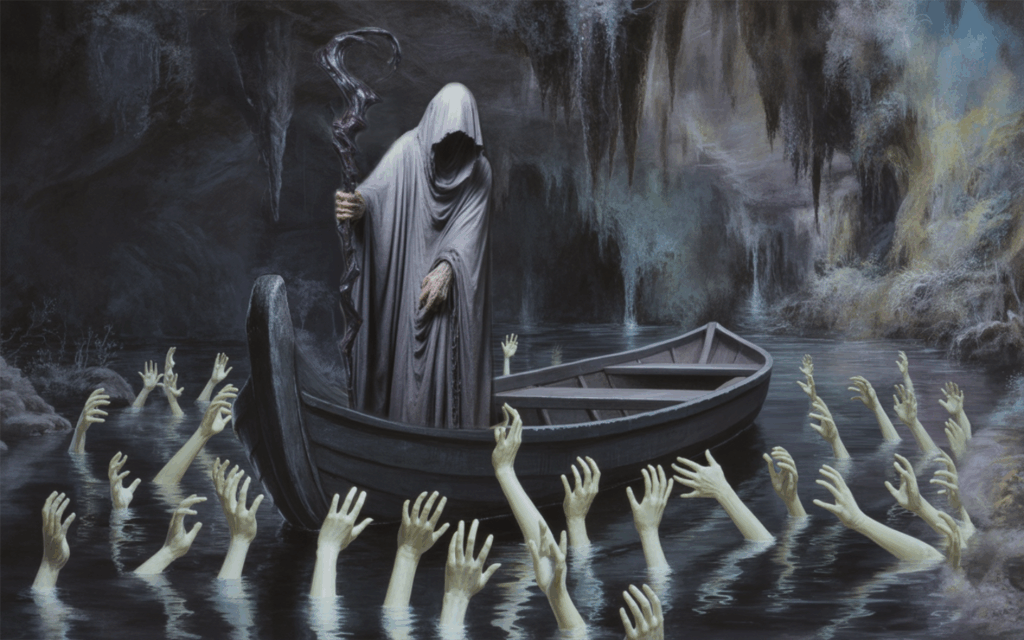
    The final mural was, quite fitting, the River Styx. A boat drifted through black water, its cloaked ferryman leaning on his pole. Pale hands broke the surface, fighting uselessly to clamber aboard. I could almost feel those cold wet fingertips clutching at my sleeves, dragging me under.

    At the lower edge of the wall, where the plaster had cracked away, I caught a glimpse of something unexpected: a layer of red pigment beneath the surface paint.

    The discovery puzzled me. Imprimatura is not uncommon, of course, but a red ground is typically used to lend depth or warmth to a composition. Here, beneath black water and pallid flesh, such an underlayer made no sense at all.

    I will need to secure permission to bring proper equipment. With lamps set at oblique angles, I might reveal textures hinting at an underdrawing. Better still, perhaps I would be permitted to lift a tiny sample of the plaster for analysis. Short of that, Thorne’s secret will remain sealed beneath the surface.

    Already, that glimpse of red has lodged in my mind like a splinter. I must know what lies beneath.

  • What Dr. Ashcroft Found in Haunted Harrowfell Hall

    What Dr. Ashcroft Found in Haunted Harrowfell Hall

    ​Last week​, we left off with Dr. Josephine Ashcroft, who was hired to catalogue the paintings at Harrowfell Hall.

    After seeing how outdated her bio on the Barton College website was, I didn’t expect to find much, but I was wrong—spectacularly wrong. Buried in the archives was a project spearheaded by ​Dr. Mira Halstead​, a faculty member in Barton’s Art Conservation Department, and it included a digitized series of journal entries written by Ashcroft herself.

    And get this: they chronicled her time at Harrowfell. Jackpot.

    Dr. Josephine Ashcroft

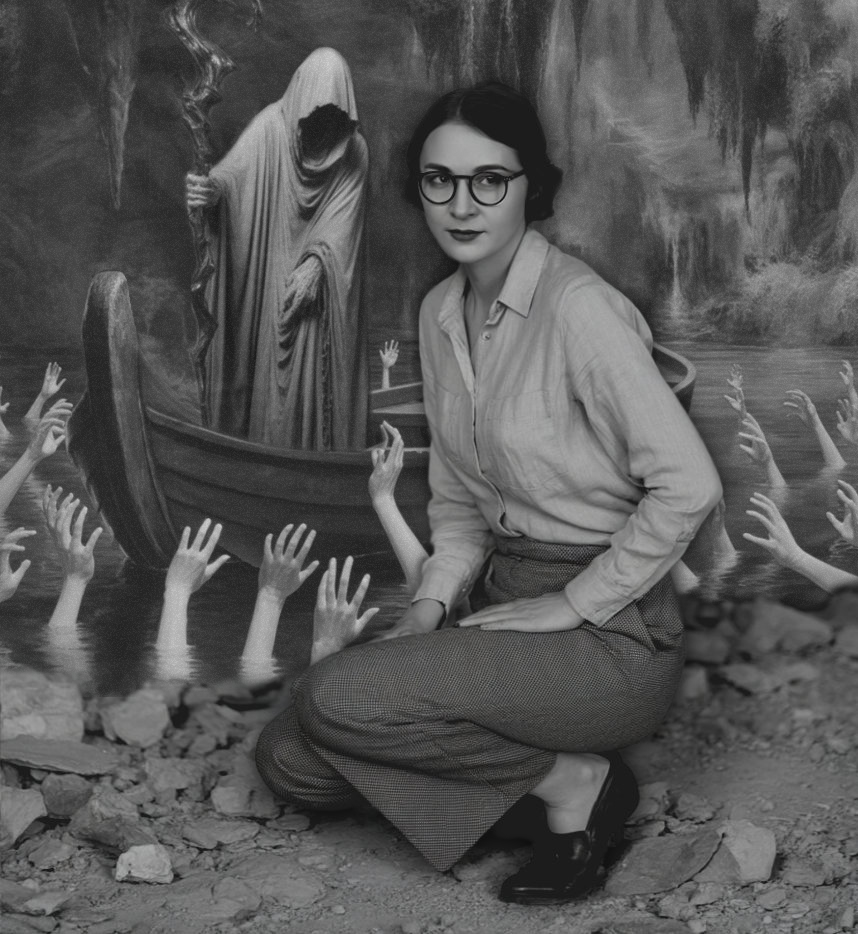
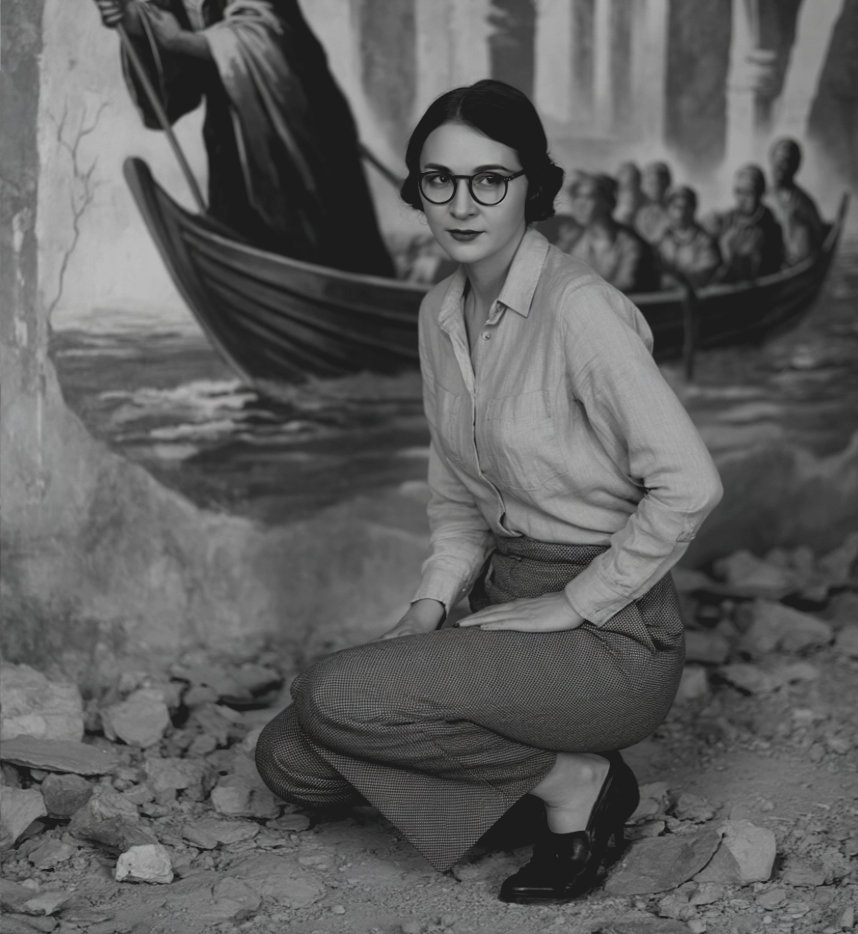
    Because Dr. Ashcroft’s findings caused quite a stir, Barton College preserved all of her reports, along with her handwritten journal entries. There was even a photograph of Dr. Ashcroft beside the painting that would later become the subject of endless speculation.

    But I’m getting ahead of myself.

    Let’s start with Dr. Ashcroft’s journal entry from her arrival at Harrowfell.


    August 14, 1926 — Harrowfell Hall

    I was well aware Harrowfell wasn’t in its prime, but the trustees vastly undersold its condition. The vestibule alone was nearly impassable: plaster hanging in jagged sheets, rain-warped boards sagging beneath my feet, stone fragments scattered like loose teeth across the floor. A once-grand space, reduced to ruin.

    Thankfully, I had come prepared: flashlight, gloves, sturdy boots, and a well-fitting dust mask. One doesn’t step into a crumbling castle unarmed, after all.

    To my right stretched a corridor, narrow and close, the walls crowded with frames. I could already tell I’d have my work cut out for me, the thought alone quickening my pulse. A conservator’s dream: a trove of neglected canvases, each one a case study in survival, every crack and layer of grime a clue to its past.

    Testing each step before committing my weight, I approached a heavy oak door. To its left, a painting caught my attention, and the sweep of my flashlight revealed a landscape of jagged escarpments plunging into darkness. As the light steadied, more details surfaced: a cavernous pit littered with coal-black boulders, every plane modeled with remarkable control of shadow. Between the stones, what I first mistook for twisting weeds resolved into arms—scores of them—straining upward toward the surface.

    Quite the macabre subject, though masterfully rendered.

    Inside the adjoining room—the library—I could go no farther than the threshold. The floor had collapsed in places, beams yawning like broken ribs. Such a shame, for above the fireplace one canvas remained astonishingly intact: a portrait of young Finneas Thorne himself.

    The museum holds a single authenticated painting of Thorne, and I recognized him at once. Strawberry-blond hair swept across his brow, his gaze shadowed, half brooding, half defiant. Byronic in its melancholy. He sat at a table strewn with books, an easel behind him bearing a half-finished version of the very portrait in which he sat.

    The doubling effect unsettled me. It was technically clever, yes, but also disorienting, as though Thorne had painted himself into the act of painting, and then abandoned both canvases to watch from the walls.

    I retraced my steps to the vestibule, turning this time toward the grand staircase. I did not dare climb it—the banisters leaned, and the treads sighed under the barest touch. From the ground floor, I craned my neck at the fresco soaring across the distant dome above.

    Figures swirled upward in concentric rings of fire, each form twisted in torment. It was Dante’s Inferno rendered on a monumental scale—far grander than anything I have seen attempted in this country. Even at such a distance, I could make out bold brushwork, pigments laid down in broad, confident strokes, the colors startlingly vivid despite decades of neglect. My gaze followed the spirals until the whole dome seemed to spin above me, and I felt myself caught in the vortex of their suffering.


    That was only the beginning of Dr. Ashcroft’s discoveries. In another entry, she described finding a partial blueprint tucked inside what she believed to be Finneas Thorne’s study. Two of the castle’s rooms were marked with curious names: Salon Nysa and Salon Lethe.

    Perhaps you recognize the names?

    Look at me, getting ahead of myself again. I’ll share what I uncovered about Nysa and Lethe next week.

  • The Corruption Deepens

    The Corruption Deepens

    Last time​, I told you about the strange newspaper clipping I found hidden under my armchair—the one about the bloody trail and the bootlegging ring? A newspaper clipping that shouldn’t exist.

    Here’s the thing about stories like this: you seize a thread, hoping it will guide you out, toward something that makes sense. Instead, it snakes into shadow, doubling back on itself, luring you deeper into the labyrinth.

    When I went looking for more about that Dunsmere Gazette article, what I found was chilling.

    The sheriff at the time, Sheriff Calloway, concluded that the cave had only recently been commandeered for bootlegging. To be honest, I couldn’t tell if this was just clever PR, a bid at placating the townspeople to save his own ass. People were understandably up in arms that Harrowfell had become a hideout for the mob, right under the sheriff’s nose.

    But what didn’t feel staged was Sheriff Conway’s fear.

    “I’ve seen what men can do to each other when liquor and guns are involved,” he told the reporter. “I’ve seen bullets tear through bone, knives leave a man in ribbons. But this…this wasn’t like that. The drag marks in the dirt, the blood on the crates, all over the walls—it looked more like an animal had been at them. But I can’t imagine what sort of animal would be big enough to do it, not around here.”

    I’m not sure they ever found out what it was, but the hubbub finally jolted the Harrowfell estate trustees out of their self-serving silence. Apparently, though the board had been hired to maintain the sprawling estate and its grounds—grounds that included a walled-in garden, a labyrinth, and the unfortunate cave—they’d let the property fall apart, skimming from the coffers all the while.

    Their excuse? Finneas Thorne—son of a coal magnate and the eccentric mind behind Harrowfell Hall—had left behind adamant instructions: not a stone was to be moved, not a hedge trimmed, without consulting the labyrinthine addendum to his will.

    For years, the trustees threw up their hands, hiding behind their paper shield while Harrowfell crumbled to ruins. But now, with the townsfolk outraged, the board was cornered. They could stall no longer—someone had to be sent inside.

    I would have thought they’d hire a contractor, someone to assess toppled walls and sagging beams. But here’s where the story takes another turn.

    Instead, the trustees brought in an art conservator from ​Barton College​, a Dr. Josephine Ashcroft.

    The decision shocked the townsfolk. One villager fumed to the Gazette: “It’s disgraceful, sending that young woman up there alone. Shows you what kind of people sit on that board—heartless, every one of them.”

    The trustees claimed that they needed Dr. Ashcroft to catalogue Finneas’ Thorne’s extensive art collection to ensure priceless works were protected before attempting major renovations. Thorne was a prolific painter, and apparently there were very few walls in Harrowfell not covered in paintings, many of them depicting nightmarish scenes of winged beings tumbling into pits of fire.

    I’d buy their story if the board had shown one iota of concern over the paintings during the 100-odd years when Harrowfell sat empty following Finneas’ disappearance.

    I don’t know, I might be biased because they referred to Dr. Ashcroft as “Josie,” even though none of them knew her personally, and her Barton College bio clearly indicated she’s a PhD. If you ask me, it was pure stalling tactic by the board, and given the safety hazards, a particularly unscrupulous one at that.

    Well, as it turned out, the joke was on them, because the board underestimated just how thorough Dr. Ashcroft was. While meticulously cataloging Finneas’ paintings, she found something none of them had bargained for.

    See you next week.