Last week, we treated the archetypal field as something we infer—a pattern we can read using tools like tarot and the I Ching.
But then we asked: what if you could actually see that pattern?
Margot Takada, a scholar of magic in my upcoming book, The Magician & the Labyrinth of Yesterdays, was experimenting with a series of bizarre perceptual exercises created by real-life mathematician Charles Howard Hinton.
When she added tarot cards to the mix, things got weird—weird enough that I should probably let her tell it…
Research Journal of Margot Takada
January 14
Well, Germaine was right (again). I’m already obsessed with Charles Howard Hinton.
Today I finally finished painting a set of wooden cubes so I can test drive his higher-dimensional perceptual exercises. The premise is pretty simple, even if painting those damn things was anything but. In his book, The Fourth Dimension (1904), Hinton outlines an exceedingly precise color scheme for the cubes.
Seriously, the diagrams alone were enough to make my eyes bleed.
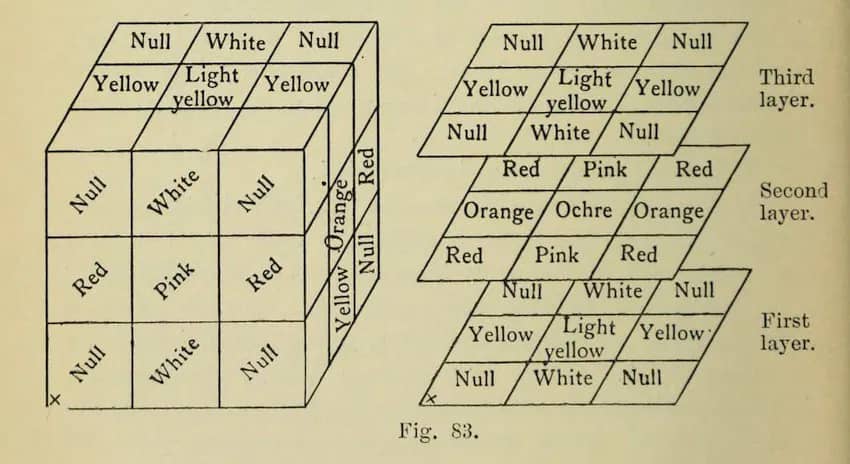
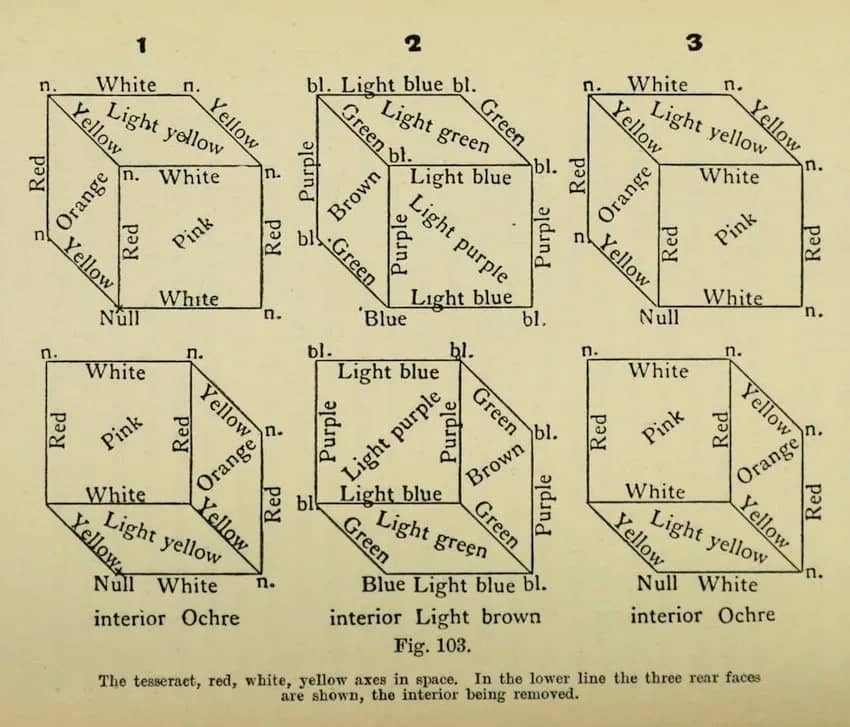
The reason for the different colors is you’re meant to memorize their arrangement. Then, as you rotate the cubes, this allows you to keep track of all of the faces, not just the ones you can see. (Assuming your brain doesn’t explode first.)
What’s the point? It’s pretty clever, actually.
When we look at a cube, we don’t experience all six faces at once. Based on where we’re standing we’ll see a front, the top, and maybe a bit of one side. Our mind fills in the other faces, based on what it knows about cubes.
The key point, though, is that we believe the cube is a predictable chunk of matter. Even though we can’t see the other faces, we assume they’re there, because we know how solid objects operate.
What Hinton’s exercises attempt to do is loosen those assumptions.
When you rotate the cube in your mind and consciously track the hidden faces (because you’ve memorized all those colors, right??), the object stops being just an object and it becomes a system of transformations. Instead of a boring block, the cube becomes a network of relationships.
Hinton believed that once you can experience a cube this way, as something that exceeds any single viewpoint, you’re one step closer to thinking in higher dimensions.
January 18
I’m officially that kid on Christmas morning, ignoring the whole family to play with her new set of blocks. These cubes are taking up every spare moment of my time. No joke, I’m dreaming in goddamn cubes.
I’m also starting to see why Hinton cautioned that higher-dimensional thinking has a way of unmooring your sense of what’s solid. What’s real.
The more I practice rotating the cubes while maintaining an awareness of all the faces I can’t see, the more my mind is able to hold multiple orientations at once. I’m really starting to grok this idea of a cube as a series of relationships, not just a static thing.
And this is just a springboard for the fun stuff, the stuff that would have blown my Wrinkle in Time loving little kid mind. Hell, it’s blowing my mind now.
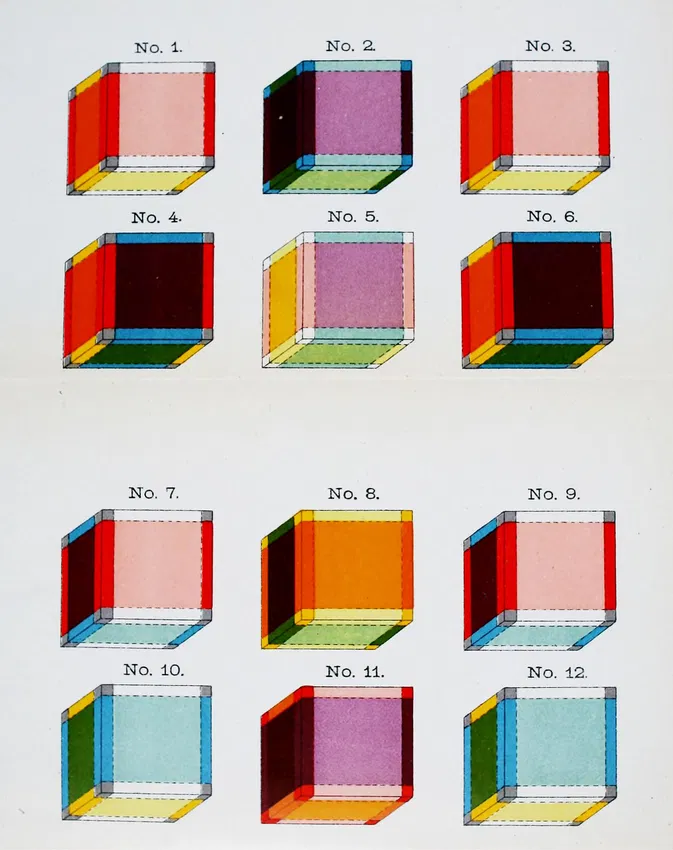
Hinton designed these exercises to help us visualize what higher dimensions might look like. Here’s the underlying logic:
A two-dimensional being (imagine a flat critter living on a sheet of paper) can only perceive length and width. If a three-dimensional sphere passed through its world, the 2D critter wouldn’t be able to see it, because the third dimension is beyond its perceptual purview.
Instead, it would initially see a point. Imagine the sphere floating to touch the underside of the critter’s flat-paper world. Where the sphere kisses the paper, it creates a point.
Then, as the sphere floats a little higher, the point morphs into a circle. The circle expands as the sphere floats higher, until it reaches the sphere’s midpoint (like a belt), at which point it starts shrinking, all the way back to a point. The 2D critter can only experience two-dimensional cross-sections of the three-dimensional sphere.
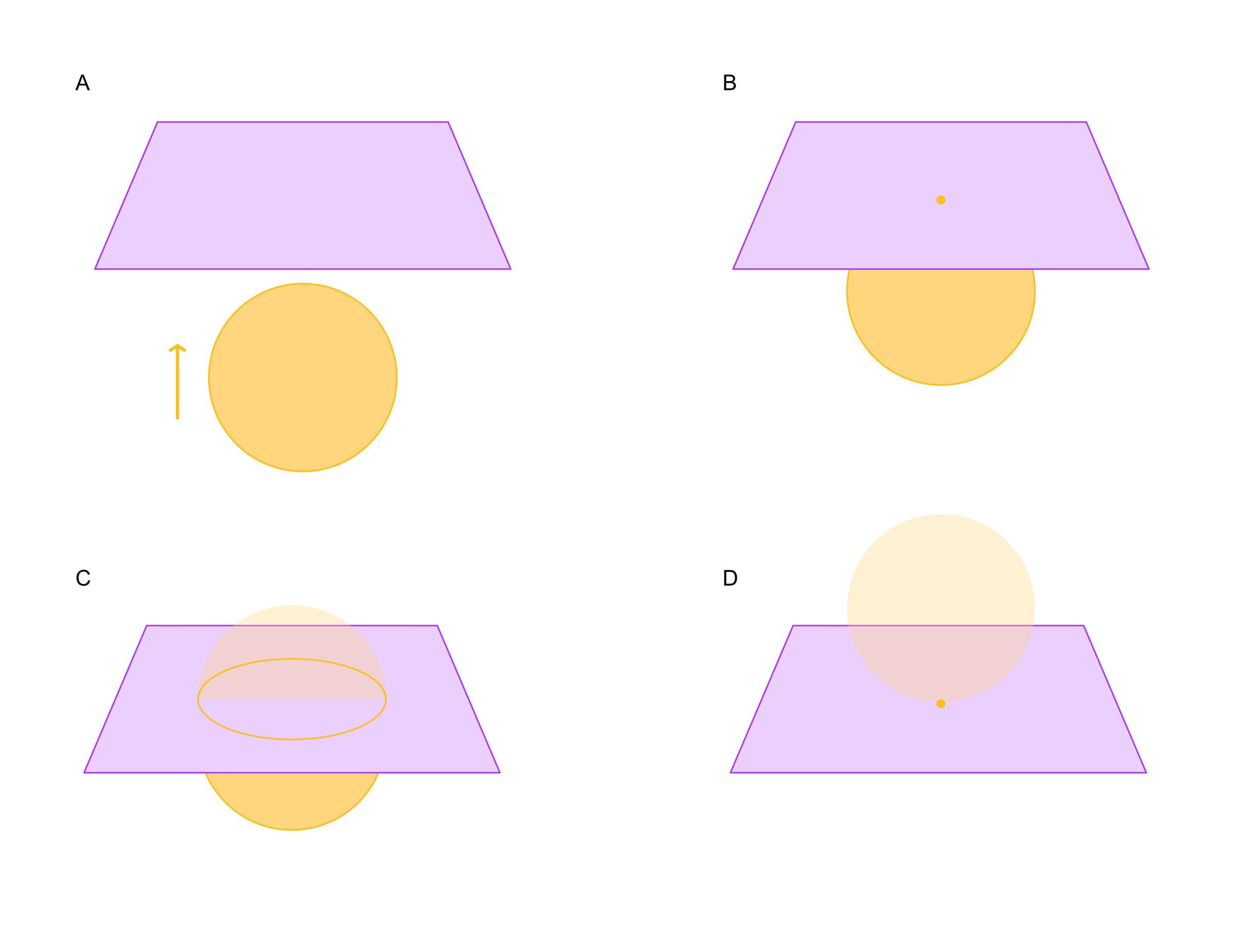
Hinton is saying that we, with our three-dimensional viewpoint, are in an analogous situation. If a fourth-dimensional object were to pass through our world, we would mistakenly perceive it as a series of 3D cross sections.
This is where the painted cubes come in—but I need to get some shut eye before I dive into that can of worms.
Until then, sweet dreams (of cubes).
January 19
I’m finally ready to unpack the weirdness of tesseracts.
A square is what a cube looks like in two dimensions.
A cube is what that same structure looks like in three.
And a tesseract is what it would look like in four.
Just like the 2D critter’s experience of a sphere passing through its flat world as a point, a series of circles, and then a final point, if a tesseract were to pass through our world, we might see:
A cube.
Then a cube that appears to rotate or otherwise change its orientation.
Then another cube, shifted again.
And so on, changing as the higher-dimensional form moves through our three-dimensional realm.
What looks like a boring ol’ cube to us might really be a cross-section of a higher-dimensional object: a tesseract.
And it’s not just cubes. Anything around us could actually be a partial manifestation of a structure existing in more dimensions than we’re capable of seeing. Pretty trippy, huh?
Turns out, things get a whole lot trippier when you use tarot cards instead of cubes.
See you next time.