
Last week, we ended with a question. If the psyche contains multiple organizing hubs—if the ego itself is but one complex among others—then perhaps the task is not the Sisyphean one of eliminating a complex, but switching which hub our psychic energy is gathering around.
Let’s return to our Thursday night book club example. From inside the activated complex, the evening organized itself around one conclusion: “If I’m not exceptional, I’m not safe.”
Seen through the complex’s goggles, every detail became “evidence.” Tia recounting a memorized passage like a veteran of the Shakespearean stage. Brent’s easy use of tongue-tangling terminology. Lana’s cryptic smile. All of it rolled downhill toward the same conclusion.
Now, instead of trying to annihilate that conclusion in head-to-head combat (“just overwrite those limiting beliefs, bro!”), let’s walk off the battlefield.
Let’s change vantage points using the Tree of Life.
Think of each sephira not as mystical realms (though they might be that as well), but as distinct modes of organizing experience—just like complexes.
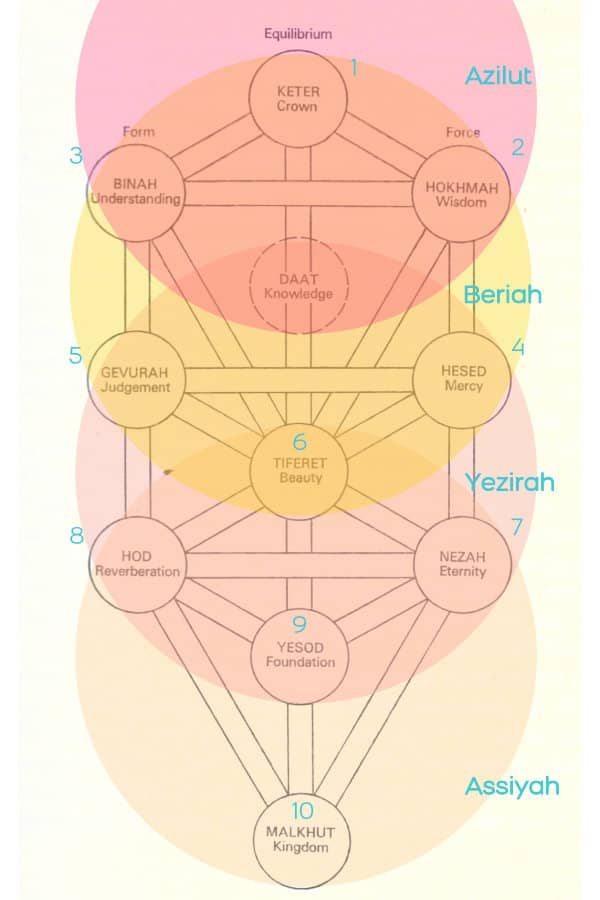
We’ll try on Netzach first.
Netzach corresponds to instinct, desire, and emotional immediacy…
It’s too damn hot in here. The espresso machine shrieks, punctuating the conversation with a banshee’s wail. Your chai is volcanically hot, but you keep lifting it to your lips so you have something to do with your hands.
Brent tilts back, elbow hooked over the chair. “Classic example of unreliable focalization,” he drawls, and everyone nods, your head bobbing right along, convinced everyone spots you for the phony you are.
A bead of sweat slips down your ribs. And then there’s a pause, and in you dive, words spilling out faster than the speed of thought.
You hear yourself drawing parallels to Madame Bovary, correcting someone’s reading of the cracked teacup symbolism. Is that really you, prattling on like a pompous ass?
You’re no longer a reader among readers. You are a defendant making a case.
This is one experience of Netzach: Immediate. Charged. You can feel the survival-level tension in the room—a tension that begins to shift when we view our fictional story from the perch of Tiphareth…
Tiphareth’s bird’s-eye view lifts us from isolated scene to character arc.
Here we see the pattern behind the pattern. Brent’s comment is no longer the whole story, but the trigger. A footnote in a bigger arc. From here, it’s easier to spot how quickly the main character—you—steps in with stories of worth and belonging.
Maybe Brent is trying to flex his intellectual prowess. ¯\_(ツ)_/¯ The deeper arc isn’t really about Brent’s character, though, which you can’t control; it’s about yours. The question shifts from Why is he making me feel this way? to Why does this pattern feel so familiar?
The espresso machine continue to wail, you still don’t understand everything Brent’s saying, but something inside you has more room to breathe. You can choose to release the pressure to be in the know and ask a question instead. Or you might sit back and chill until you have something to share.
More importantly, you can choose not to build your identity on intelligence as belonging. The “antagonist” shrinks. The true protagonist comes into focus.
And then, if we dare to climb higher still, the story shifts again.
From the vantage of Binah, we’re no longer watching a character wrestle with an old wound. We’re watching a theme unfold.
Now the question isn’t merely about your personal history with grades and praise, nor Brent’s tendency to flex in public. It’s about a pattern older than either of you: The desire to be recognized as competent. To earn your keep. The fear of being cast out of the tribe.
This scene has unfolded in monasteries and marriages, Parisian salons and political rallies. The book club isn’t charged because of your personal failings—it’s archetypal. It reveals recurring themes in our collective human story.
In fiction, theme is not that tidy thesis statement you bludgeoned essays with in elementary school, complete with three supporting points, double-spaced, Times New Roman. Theme is the author’s working hypothesis about how one is meant to live. It poses questions that the story then explores, things like:
Can belonging be granted or is it an inside job?
Who gets to take up space?
Is belonging more important than authenticity?
From the height of Binah, your humble Thursday night book club participates in this larger inquiry. From this altitude, the café is no longer a courtroom. It’s a chapter in an age-old story about belonging.
When the archetypal center shifts, meaning shifts. And when meaning shifts, behavior becomes less automatic. The black hole’s gravitational pull weakens—not because the complex has vanished, but because it’s no longer the only center of gravity.
Do Try This at Home
If you’re struggling with a conflict or question—at work, in a relationship, in your creative life—try a simple experiment.
Describe the situation from the level of emotion. Let it be reactive, immediate, personal. Don’t worry about sounding judgmental AF. Let ’er rip.
Bring your awareness to the “you” that exists within the limits of your body—feel the beating of your heart, the movement of your breath, the thoughts swirling “in” your head. Then, subtly shift your awareness right between your shoulder blades. Can you feel it gathering there? Maybe you notice the texture of your shirt against your skin.
Push that awareness further back, about a foot, like you’re stepping behind yourself. Notice the subtle detachment that arises. If you’re not feeling it, energetically step back another foot, “seeing” the back of your head.
Now, describe the situation again, this time imagining yourself as a character in a novel, and this situation is simply one scene designed to illustrate a larger character arc. What might that arc be? What is it arcing toward? If this character were to learn a valuable lesson by the book’s end, what is that lesson?
Finally, imagine your awareness lifting up, up, up to rest on the roof of your house, looking down at you sitting in your chair, writing about this situation. If you were to take that character’s lesson and extract an insight that others might use to live a full life, what would that be? How does this lesson relate to our shared human journey?
By shifting your perspective, you’ve traveled the Tree of Life, activating different levels of consciousness. In other words, you’ve just performed a potent act of magic, my friend.
Next week, we’ll look at how this process could be used to create changes, not only in the mind, but in the physical world.
See you then.