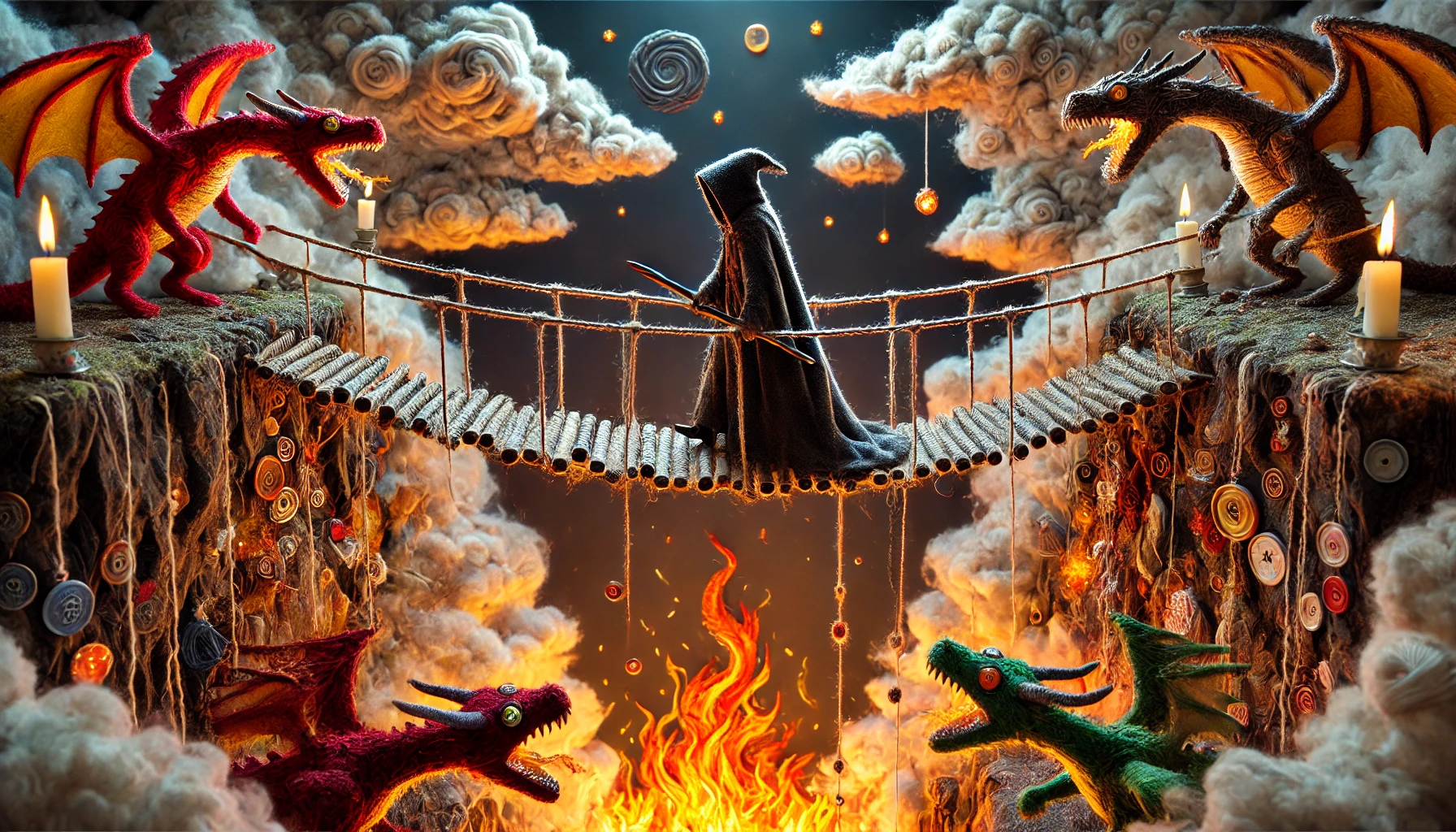
Today we’re talking about stakes. Not the kind you drive through Count McFang’s heart—the kind that keep readers turning pages.
Last time, we explored how clear goals orient the reader and create momentum, and while goals are necessary, they’re not sufficient.
You can know exactly what a character wants and still end up with a flatlining story if failure doesn’t cost anything meaningful, or if those costs never increase.
That’s where stakes come in.
What stakes actually do
At their core, stakes answer a simple question: What changes if the character succeeds or fails? And just as importantly: Is that change meaningful?
If failure mildly inconveniences the character or ends up helping them in the long run, the story trains the reader not to worry. Shh…it’s all good. Everything will be fine—you’ll see! (Except they won’t, because they stopped reading a long time ago.)
Let’s return to Sir RidesALot to see how this plays out.
Sir RidesALot needs to rescue his lover, Sir Beloved, from Count McFang’s castle. That’s a clear goal with obvious stakes: if he fails, Sir Beloved will be lost.
But let’s look at how an author might flub the obstacles Sir RidesALot encounters on his quest, steadily leaking air out of the balloon, resulting in a flaccid story.
Sir RidesALot takes a risky shortcut through the forest and is bitten by a wolf—curse ye, furred demon!—but the injury conveniently slows him down just enough to overhear crucial information.
He sneaks toward the castle and is spotted by guards—blast!—but manages to slip away unharmed. He interrogates a servant in search of another way in, but the servant lies—foul wretch!—only for him to stumble upon a forgotten drainage tunnel hidden behind a tangle of briars, which leads straight to the castle’s storage rooms.
On paper, plenty is happening—danger! Setbacks! But every failure resets the board. Nothing is truly lost. Each stumble either resolves cleanly or nets Sir RidesALot an unexpected boon. He ends every chapter with just as many tools, allies, and possibilities as he had before—sometimes more.
(If you think this only happens in my absurd examples, trust me…I had a stack of published books I could have used to illustrate the point.)
After enough repetitions, the reader knows the drill: he’ll be fine. Even if the story insists the danger is dire, the structure tells a different tale. The tension evaporates, the pace grinds to a halt, and the book inches ever closer to the DNF pile.
Be horrid to your character—like, really horrid
✍️ Let’s make things a whole lot worse for Sir RidesALot, shall we?
This time, that festering wolf bite on his ankle hurts like a bitch and he’s slowed to a stumble. He misses the guards’ shift change making the hidden route he planned to use no longer viable.
That sniveling servant not only lies but runs straight to Count McFang, hoping for a reward in exchange for their tattling, and now the Count is hip to the rescue attempt. Sir Beloved is dragged deeper into the castle, with four more hell hounds posted outside his cell.
Oh—and one thing the servant didn’t lie about? The reason Count McFang captured Sir Beloved in the first place.
The Count has learned Beloved’s true surname. As a descendant of the ancient Line of Aurelion, his blood amplifies magic like a match tossed into a barn full of gunpowder. If Count McFang completes the blood ritual on tomorrow’s full moon, turning Sir Beloved into a vampiric battery, he’ll be able to raise an undead army and turn the entire country into his personal feeding grounds, one ravaged village at a time.
Well, now.
Sir RidesALot is no longer leisurely regrouping and having another go whenever he damn well feels like it. One door after another slams in his face as the country careens toward a bloodbath, his Beloved standing squarely in the crossfire.
Now that’s escalation.
Why we tank our story’s stakes
Sometimes we fail to escalate the stakes, not because we don’t understand the importance, but because doing so makes the story harder to write. 😮💨
What began as a simple chess move—get Sir RidesALot from the forest to the castle’s hidden entrance—is now a jagged path through a vampiric hellscape. Escalation complicates everything. Plans break. Timelines tangle. Entire sections have to be rethought or trashed entirely.
And when that realization hits mid-draft, it’s tempting to postpone the reckoning. I’ll fix it in revision! Or maybe the next revision! Okay, the next, but for real this time! Until we’re so tired of looking at this story that it sadly flings itself onto the growing heap of abandoned drafts, just to save us the trouble.
Learning to escalate stakes often means working with the discomfort this escalation creates—on the page and in the writing process—because the moment you allow failure to truly blow up in your characters’ faces, the story stops behaving nicely. (To put it mildly.)
But hidden within that mess is vital story energy that paradoxically makes your job as a writer easier. Instead of trying to manufacture emotional impact with overwrought prose or contrived plot twists, your readers feel something because they’re dying to know whether your character succeeds at their goal.
And the energy now humming through your scenes? That’s the tug of a well-paced story.
Next time, we’ll look at one of the most powerful tools for managing that energy over the course of a book.
See you next week.