Perfectionism has no idea what it’s talking about.
Which is funny, because according to Perfectionism, the entire world would implode without its astute leadership.
Five years ago, my spirit guides told me that writing romance would change my life. They weren’t kidding. And one of the biggest makeovers has occurred in my relationship with Perfectionism.
But to tell that story, we need to talk about lentils…
A Tale of Two Lentils
You’re no doubt familiar with the Grimms’ version of “Cinderella.” In a nutshell, our heroine waits hand and foot on her asshole stepfamily, all while wearing the world’s shittiest shoes.
(They’re wooden shoes, folks = bring on the splinters and bunions.)
After months of cooking, cleaning, and sleeping on the floor, Cinderella finally gets a chance to cut loose: the king is hosting a festival so his son can pick the hottest lady in the land as his bride. Yay, patriarchy!
But—we all knew a night off was too much to ask—her stepmother dumps a bowl of lentils into the hearth (seriously??) and gives Cinderella two hours to pick them out of the ashes. If she fails, the festival is a no-go.
Honestly, a night at home, probably Cinderella’s first opportunity in months to kick off those wooden shoes and curl up with a good book, sounds vastly preferable to the prince’s meat market. But then again, I’m an introvert.
So what’s a soot-covered girl to do when the clock is ticking and the horny prince waits for no wo(man)? Call on her birdie friends, of course!
“O gentle doves, O turtle-doves, And all the birds that be, The lentils that in ashes lie Come and pick up for me! The good must be put in the dish, The bad you may eat if you wish.”
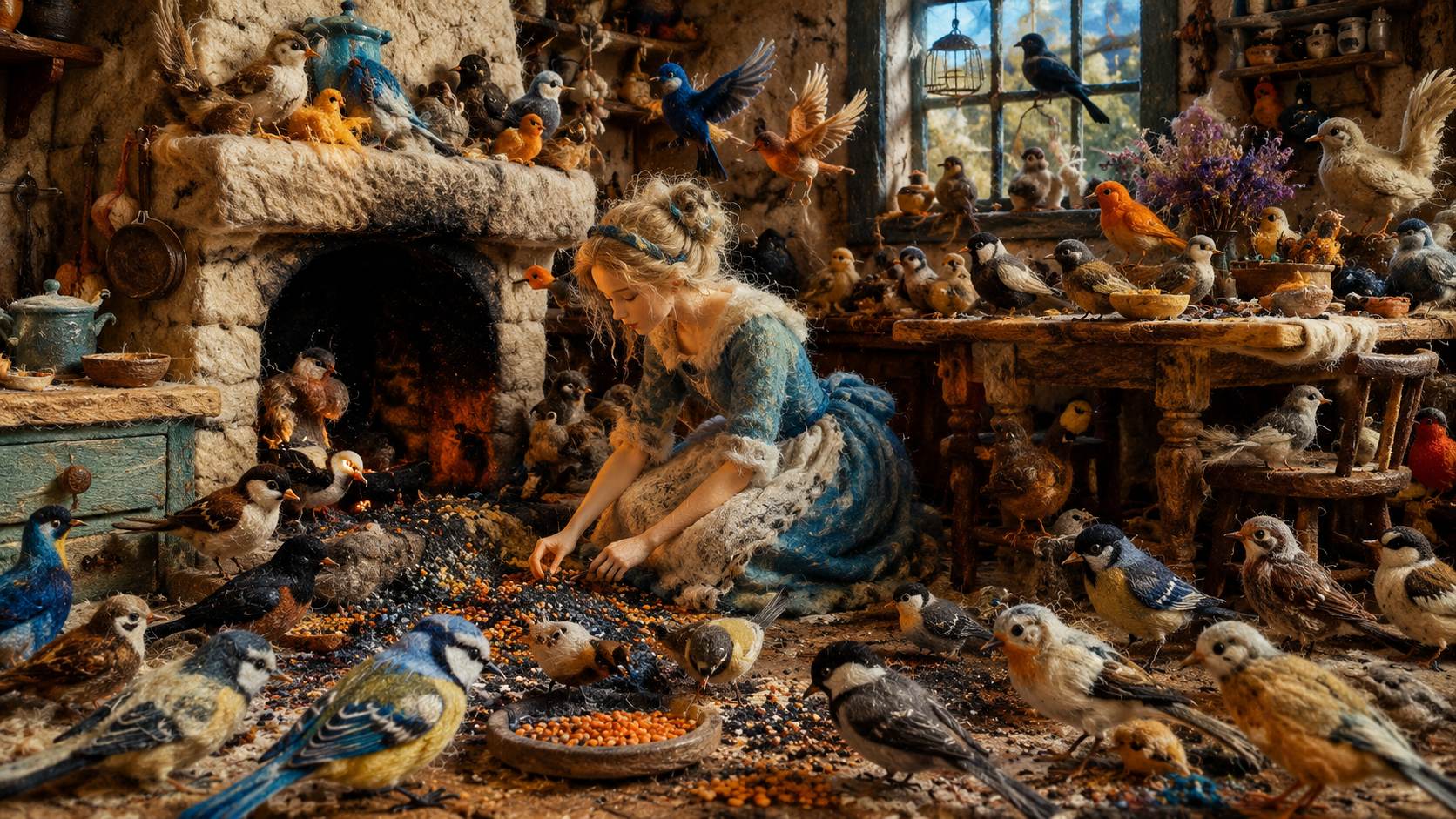
In through the kitchen window flaps a whole crapload of birds—“a crowd of all the birds under heaven,” to be precise.
Can you imagine the noise? Also, side note: I feel like this introduces an entirely new problem in the form of bird poop. So so much poop. But Cinderella gets a pass on account of fairy-tale logic.
And anyhow, the plan works! In under thirty minutes, the birds have handled the stepmother’s bullshit task.
We’re going to leave Cinderella here, because her stepmother has more shenanigans up her evil sleeve, and we, my friend, need to focus on those lentils.
Psychic Lentils
Cinderella’s task might look like nothing more than an annoying, unnecessary mess. But psychologically speaking, it’s about recognizing what’s nourishing and viable amid what’s dead or simply not useful.
The ashes represent the undifferentiated residue of experience: old emotions, inherited beliefs, defensive habits, and everything else that has accumulated in the hearth of the psyche. The lentils are the living material hidden among that residue—the parts worth sorting and hanging onto.
Cinderella’s feathered friends are significant too. She doesn’t check this task off the list through conscious ego alone. She has help from the instinctual and spiritual realms.
By separating the lentils from the ashes, Cinderella creates the possibility of choice. Unconscious repetition and all its frustrations depend, at least in part, on things remaining globbed together in the psyche.
Freedom begins when the psyche learns to say:
🫘 This belongs to the present; that belongs to the past.
🫘 This is intuition; that is fear repeating itself.
🫘 This desire is mine; that expectation was imposed on me.
🫘 This pattern once protected me; now it keeps me trapped.
Perfectionism’s Secret Weapon
You might assume that Perfectionism, with its reputation for being persnickety, would adore a Virgo-vibed task like lentil sorting. But Perfectionism often relies on things remaining frustratingly vague.
After all, if the objective were clear, Perfectionism would lose one of its most potent weapons: the Forever Moving Target.
Oh ho ho, you thought you were finished after preparing that forty-page presentation, reconciling quarterly figures, and obtaining approval from six separate departments?
Bwahahaha!
Cancel dinner, babe, because instead you’ll be redesigning the entire presentation in a slightly different shade of periwinkle, anticipating every question anyone might conceivably ask, and producing a supplementary report no one requested, needs, or wants. Yippeeeee!
“Just build a house!”
For years, Perfectionism had been giving me the same “useful” writing advice:
Be better.
Right. Got it.
Hang on—what? 🤔
When Perfectionism dumps the lentils in the hearth, writing looks like a monolithic skill, but this is akin to treating “building a house” as a single skill. Forget plumbing and wiring and roofing and painting. Just get better at house-building!
Uh, sure. I’ll get right on that.
While I was working on Draft Six of my forthcoming novel, The Magician & the Labyrinth of Yesterdays, I began to notice that something significant had changed in my writing, but it wasn’t the blanket “be better” transformation Perfectionism demanded.
My ability to structure a story had improved enormously.
I was better at mapping character arcs, shaping a plot, constructing scenes, diagnosing why a scene wasn’t working, and figuring out what needed to change. Problems that would once have left me staring blankly at my screen until I had mercy on myself and got up for a snack now felt solvable.
And it’s not hard to see why. Over the past several years, I’ve read a teetering stack of writing-craft books and practiced applying what I learned over hundreds of thousands of words.
Let’s call all of that Lentil Pile #1.
My prose had improved too—this is Lentil Pile #2—but the difference wasn’t nearly as flashy. According to Perfectionism, this was a big honkin’ failure. But thanks to lentil sorting, I knew better.
Sort Those Lentils
Story structure and prose are related, but they aren’t the same skill. They don’t develop in precisely the same way, and it makes sense that they wouldn’t necessarily improve at the same speed.
All that structural stuff I’ve been learning? That can be taught fairly directly. I can pick up a book, and the author can explain how a character arc works. They can show me how to build escalating complications. They can teach me how to identify the purpose of a scene.
And then I, with my brain full of shiny new techniques, can scurry over to my computer and give them a whirl. I can troubleshoot the results and gradually get better.
Prose is slipperier.
Of course, aspects of prose can be taught. I can learn to cut filter words (and oh, how I love me some filter words!) vary sentence rhythm, and choose more precise verbs. I can learn to spot the 10,642 instances in my manuscript of characters with clenching stomachs, dose them all with Pepto Bismol, and reach for something decidedly less cliché.
But prose is akin to magic.
There’s a certain element of boil and toil: a bubbling brain cauldron that takes eye of newt and maybe, if you’re lucky, spits out a dazzling metaphor or killer opening line.
A lot of that learning comes down to reading piles of books, soaking in other writers’ word choices, writing sentence after sentence after sentence, and just generally being a human, alive in the world and paying attention. Sure, I can create the conditions for prose-skills to flourish, but I can’t pester them into growing overnight.
And you know what? This handy bit of lentil sorting was freakin’ liberating.
Instead of laboring under the useless edict, “get better,” I could finally see the separate piles of legumes on the kitchen floor.
🫘 Here were the structural skills that had improved rabbity-quick.
🫘 Here was the prose that had also improved, but more at a tortoise stroll.
🫘 Here were the techniques I could learn from a craft book and apply this afternoon.
🫘 Here were the capacities that needed time, immersion, and a certain amount of witchy alchemy to fully brew.
Lentils and…boundary setting?
This doesn’t apply only to lentils and prose! Take boundary setting, for instance. For years, my psyche had dumped the lentils of “expressing what I need” into the ash pile of “how other people respond.”
But once I called in all the birds under heaven to help me sort that shit out, it became forehead-slappingly clear that there were different legume piles at play.
🫘 There were the lentils of listening to myself and identifying what I needed.
🫘 Then there were the lentils of translating that need into a clear, kind statement I could express to another human being.
🫘 And finally, there were the lentils of how the other person chose to respond—and that pile did not belong to me.
Growing up, those lentils had been liberally sprinkled on my hearth, so it sure as hell felt like they were mine. But as all the birds under heaven were quick to point out, someone else’s response did not belong in my pile.
So we picked those lentils right out.
Maybe a little lentil-sorting could help you navigate a project or conversation that feels all thorny and tangled? I say call on the birds and give it a shot. 🙂
Meanwhile, I Have News
This brings us to a quick announcement, aka a chance for me to squee over something I promised myself I would wait to share.
But I cannot.
I’m too excited.
I’ve officially begun the final—FINAL!?!—draft of The Magician & the Labyrinth of Yesterdays. And last week, I sat down, lentil-sorted the unruly heap of scribbled notes I’d accumulated for the launch, and emerged with a (mostly) cohesive plan.
If you’ve been with me for a while, you know I treat book launches like spells. (Because they so totally are??)
After all, you’ve got an intention: Sell this whatseewhosit.
You’re raising energy: Let me write a whole bunch of emails and marketing copy and create images and make bonus goodies and and and…
And then you direct that energy into the world: I’ll send these emails to these people, at this particular time, for this particular reason.
🪄 Like I said: totally a spell.
Point being, I came up with a launch that is part story, part magical working, and part excuse for all of us to escape into a world of haunted castles and hot romance.
But—and here’s the key—we’ll use that playful energy as magical spellcasting juice. 🧪
I’ve spent years creating this fictional world and the characters within it. I’ve hand painted sigils, cast spells at sunrise, performed rituals while wearing my special sequined shirt, and poured hundreds of thousands of words into bringing this world to life.
All of that concentrated attention has strengthened the world’s presence on the astral.
Think of stepping into a cathedral saturated with generations of prayer. This ain’t an empty room. You’re entering a space that’s positively oozing with years—centuries, even—of emotion, devotion, and intention.
Granted, my books aren’t the Hagia Sophia, but they’re nonetheless a hub of sparkling, concentrated magical energy.
Before the launch begins, I’ll invite you to choose something you long for, something you yearn to manifest, and shape it into a spell intention.
Then, simply by following along—by letting yourself fully enter the story, imagining, feeling, playing, and participating—you’ll be raising energy and adding it to our shared cauldron. *excited squeal*
Together, we’ll use that energy to strengthen the spells of everyone who takes part.
And don’t worry! I’ll show you how, step by step, using a blend of Western occultism and Jungian Magic.
Thanks for reading this far, my friend. 🙏 I’m going to take some time away from these weekly emails so I can pour all of my energy into powering through Draft Seven.
Until next time…