Episode 2 of Will I Ever Finish This F#@king Book? is here and ready for ear consumption.👂🎧
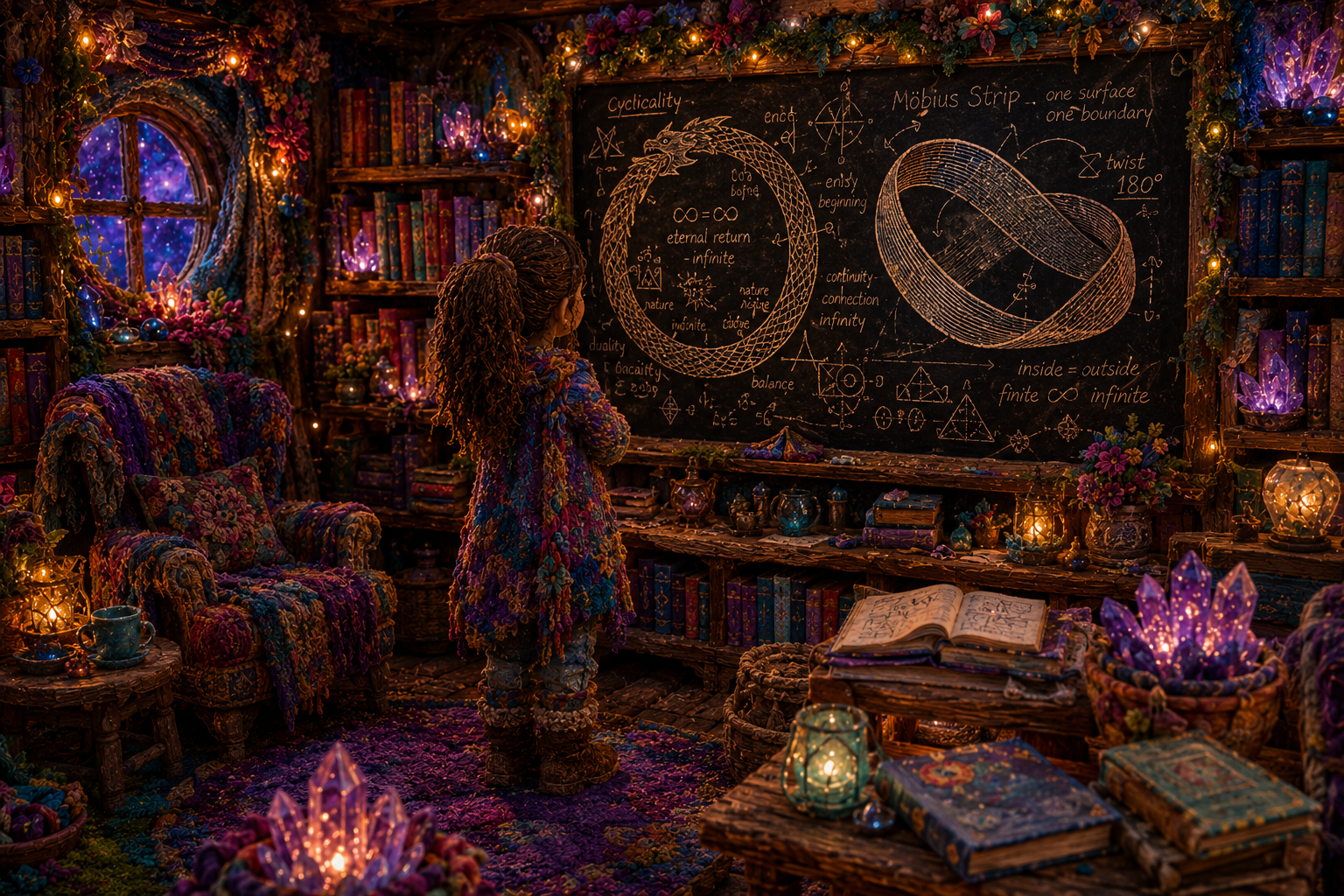
This week we’re talking about the Ouroboros Problem, which is a term I totally made up, but it’s faster than saying: How do you begin a book when the beginning depends on the ending, and the ending depends on the beginning?
And really, this applies to anything—embarking on a relationship, planting a garden, letting yourself rest—where your inner parts have you trapped in the maddening Möbius strip of: “I obviously can’t do A until I do B, but I clearly can’t do B until I do A!”
Also known as my psyche’s favorite strategy to keep me from taking potentially scary creative risks.
Along with this week’s writing problem, we talk about perfectionism, the fantasy of the unblemished book, and a personal reveal that I almost edited out of this episode—no joke—three separate times.
Listen here:
P.S. Do you know someone who’d enjoy this podcast? I’d be so very grateful if you shared it with them! 🙏
Start reading my first book, The Fool & the Threads of Time for free!

Episode 2 Transcript
[00:00:00] What if the reason you can’t start your project isn’t that you don’t know enough or haven’t planned enough, but because starting it would make it real?
[00:00:13] If you’ve ever devoted yourself to a creative project that ended up consuming your entire fucking life, this one’s for you. I’m Aven Winslow, romance writer and Jungian witch. Join me in the final stretch of writing my second romantasy novel. Craft breakthroughs, perfectionism spirals, and all the eerie little ways that fiction can start bleeding into real life.
[00:00:39] Welcome back, friends. So we’re starting with our fire segment, the element that asks, what is our craft issue for the week?
[00:00:46]
[00:00:48] Last week, I mentioned that we’d be exploring the problem of beginning a writing project when the beginning depends on the ending, and the ending depends on the beginning. In other words, the Ouroboros problem.
[00:00:59] So before we dive into particulars, this would be a great place for me to read off the blurb from my work in progress, The Magician and the Labyrinth of Yesterday, so you have some idea of what the book is about. That would be a fantastic idea if the blurb were actually written. But this gets into the funky chicken and egg nature of writing and how my brain works.
[00:01:19] It’s super hard for me to start writing a book until I’m crystal clear on what’s happening in chapter one. But at the same time, it’s easier to write chapter one after the rest of the book exists, and I know precisely what’s needed to properly set up the ending from page one. I know some people can skip writing chapter one and just come back to it, and if that works for you, awesome.
[00:01:40] I’ve tried, and my brain is like, “Hell no.” Anyway, back to the blurb, or rather the lack of blurb. So in hunting through my files, I realized I’d actually written a sort of proto-blurb months ago for a blog post and then forgot all about it. It’s not the official version, far from it, but it’s at least some words strung into sentences that have to do with my book.
[00:02:02] So let’s hear it. Oh, and by the way, for maximum ridiculousness, you won’t be hearing me read this. Oh, no. We’ve got Grandfather Joe, who’s volunteered to tell you all about my book. So take it away, Grandpa.
[00:02:17] Ev Knox’s debut novel is an overnight sensation. And Matt Byrne, the internet’s smoking-hot boyfriend, has just been cast as the love interest in the film adaptation. Unfortunately for Ev, a professional introvert, they’re not filming on some boring old soundstage where she can lurk safely in the wings.
[00:02:41] Instead, her overnight success has landed her a one-month stay at Harrowfell Hall, a secluded, centuries-old estate built by the infamous Finneas Thorne, coal fortune heir, obsessive painter, and rumored dabbler in sex magic. Forget only one bed, only one haunted castle, baby. And stepping outside? Not any safer.
[00:03:09] The castle sits deep in the northern woods, where hikers have been vanishing for hundreds of years. According to Margot Takada, local expert on Harrowfell’s hauntings, the disappearances follow an unmistakable pattern: certain moon phases, certain trails, and bizarrely oversized hoofprints disappearing into the trees.
[00:03:30] Which is inconvenient, given that the next cycle starts now. Naturally, that means only one thing. Ev is trapped inside a haunted castle with Matt Byrne, doing her level best to remember she has a boyfriend back home and that it really shouldn’t matter that her celebrity crush is even hotter and sweeter in person.
[00:03:56] Easier said than done when Matt, famous for guarding his love life like a state secret, suddenly acts like the only thing he wants to keep all to himself is her.
[00:04:09]
[00:04:11] So there you have it, my blurb that is not yet a blurb read to you by your friendly robot grandfather. At any rate, in the same way that chapter one is hard to write until I’ve written the book, that’s hard to write until I’ve written chapter one, I likely won’t be able to finish this blurb until the book is also finished.
[00:04:29] The creative thorn of how to begin when the beginning depends on the end can keep many a well-intentioned writer in limbo. So let’s break it down, first by calling in the power of air.
[00:04:40]
[00:04:42] So Air asks, “What tools did I bring to help solve this week’s craft issue?” One of the issues we run into with first chapters and book blurbs is that both of these are promise-making devices.
[00:04:55] They tug on the reader’s sleeve and say, “Hey, here’s why you might want to read this book.” They establish genre, stakes, main characters, tone, all of which go into making an emotional promise to the reader. Essentially, here’s how you’re going to feel if you read this. And because first chapters and blurbs are promises, they’re typically easier to write once you know what the book actually delivers.
[00:05:18] Which brings us back to the Ouroboros problem. The beginning depends on the ending. The ending depends on the beginning. The snake is eating its own tail, and somehow, I’m supposed to get a marketable description out of this. Here’s the thing, though. I lied in the last segment just a little bit. I said I can’t write a blurb until the book is done, and that used to be true, and the reason it used to be true sheds light on a bigger shift in how I think about storytelling.
[00:05:45] And exploring this will help us figure out how to start a thing that feels impossible to start without knowing how it’s going to end. So, I used to approach plot in a much more linear, mechanistic way. I’d think up a sequence of events, then move my characters through those events like little chess pieces.
[00:06:03] From that POV, a blurb felt like an itemized list of every plot point I spent three years inventing and therefore felt contractually obligated to mention. But that’s not what a blurb is, or at least it shouldn’t be. And in fact, when I start reading a blurb like this, my eyes glaze over in .2 nanoseconds.
[00:06:24] I see this a lot in fantasy novels.
[00:06:27] In the Third Age of Valcor, the Empire of Karaz-Tul stands divided, and the Kingdom of Arundel teeters on the brink of war as the thirteen houses of Valef maneuver against
[00:06:44]
[00:06:45] Okay. I’m sure all of that is super important, but my brain has already left the building and will not be coming back, not for that book, at least.
[00:06:53] To be clear, I still care deeply about plot. I love plot. But I don’t think of scenes anymore as merely the machinery that gets the characters from point A to point B. Increasingly, I’m trying to understand the deeper forces that make a story move, and relative to the blurb, two of the most important forces are the central dramatic question and the emotional promise.
[00:07:18] Once I understand these two things, I have a kind of North Star. For example, in my work in progress, even though the actual plot details of the first chapter are very different from draft one to draft six, which is my current draft, I already knew what central dramatic question I was aiming for, and I had at least a hazy idea of the emotional notes that the beginning needed to strike.
[00:07:41] So what do I mean by central dramatic question? The central dramatic question is the big question the reader is waiting to see answered, the thing that if you ended the book and didn’t answer it- Readers would be royally pissed. But the emotional promise is why we care about the answer. It signals how we’re going to feel by going on this journey.
[00:08:02] In Star Wars: A New Hope, the central dramatic question is, will Luke and the rebels destroy the Death Star before the Empire crushes the rebellion? But the emotional promise is bigger than space battles and lightsabers. It’s the fantasy of discovering that your ordinary overlooked life was secretly the threshold to a mythic destiny.
[00:08:22] It promises adventure, courage, found family, moral clarity, spiritual awakening, and the thrill of watching a farm boy become someone who can help save the whole damn galaxy. In The Wizard of Oz, the central dramatic question is, will Dorothy find her way back to Kansas? But the emotional promise is not merely will a young woman complete a magical travel itinerary.
[00:08:45] It’s the aching journey of wanting to belong somewhere, then discovering that wisdom, heart, courage, and home were never as far away as they seemed. The promise is wonder, homesickness, friendship, and the soul comfort of realizing you already carried something powerful within you. In Finding Nemo, the central dramatic question is, will Marlin find Nemo and bring him home?
[00:09:09] But the emotional promise is the transformation of fear into love. We’re not just watching a fish swim across the ocean. We’re watching an anxious parent learn that love cannot mean controlling every possible danger, and a sheltered child discover his own courage and capability. The promise is humor, tenderness, panic, release, and the exquisite, painful beauty of setting someone you love free If I were writing The Wizard of Oz and I’m sitting down to draft chapter one, I might not know yet that Dorothy is going to meet a scarecrow, a tin man, and a lion.
[00:09:45] The flying monkeys might not have swooped into my imagination yet. The ruby slippers might not exist. But if I have this kernel of an idea about a girl getting swept into a magical land, chances are there’s a question emerging from my unconscious that feels more charged than all the rest. Will she find her way home?
[00:10:04] That question gives me a direction before I have a map. And to be clear, it’s not the only question to orient the story around. Another writer might be more interested in, will this girl become the queen of this magical land? But regardless, a central dramatic question gives me a way into the story, and this is where the Ouroboros problem starts to loosen its grip.
[00:10:27] Because no, I may not know every single plot point yet. I may not know every reversal, every reveal, every exact sequence of events, but I can often sense the dramatic question. And sometimes it works the other way around. Maybe I don’t start with the dramatic question. I could start with the emotional promise instead.
[00:10:47] Maybe I want to explore the feeling of not belonging, of life being too small and too gray, of no one around you recognizing who you really are. And from there, a story starts to unfold. A girl in a drab black and white world is swept into a realm of impossible color, only to discover that what she needed was not escape exactly, but a transformed relationship to the home she already has.
[00:11:13] Either way, I don’t need to know the entire story in order to begin. I need enough of the emotional promise to carve a provisional doorway in the ether. That, to me, is the air answer to the Ouroboros problem. We might want total certainty before we begin, but this is generally impossible to obtain. And really, we don’t need it all.
[00:11:37] We just need enough: a question, a promise, a temporary scaffold strong enough to let us take the next step.
[00:11:44]
[00:11:46] Water asks, “What do these craft insights reveal about me personally?” Good writing isn’t about craft, or it’s not only about craft. You can know all the plotting frameworks in the world. Actually, I take that back.
[00:12:00] There are so many plot systems out there, way more than you could ever possibly need, that it’s probably impossible to know them all. It’s certainly pointless. But suffice it to say, you can have a toolbox brimming with plot frameworks, character arc strategies, grammar know-how, and your writing could still fail to engage a single reader.
[00:12:21] How? Because you never finish it, or if you do, you never share it with a soul. I’m a big fan of internal family systems, or IFS for short, which is a way of relating to your inner world, not as a monolithic entity, a capital I, but as an ecosystem of inner parts or characters. With writing, we might have an inner part who wholeheartedly believes that we cannot share our writing with a single soul until we’re an absolute expert on writing.
[00:12:51] But we’ll never refine our writing skills unless we finish stuff and put it out in the world. In my experience, whenever we notice the Möbius strip of, “Well, I can’t do A until I do B, but I can’t do B until I do A,” this is a really good time to slow down and get curious, because nine times out of 10, we have inner parts who are trying to protect us by keeping us locked in never never land, never taking real risks in our creative life, or in our life-life, for that matter.
[00:13:24] It’s like psyching yourself up to dive into those fast slapping ropes of a Double Dutch game, something that as a kid would almost make me throw up with anxiety. But we all have to start somewhere, and I guarantee no matter which starting point you choose, no matter how much deliberation you do, it will be a bit of a mess.
[00:13:44] But if we’re waiting for that perfect opportunity, the moment when we’re guaranteed not to make a mistake, we’ll be standing on the sidelines literally forever. You just gotta jump in there and fuck things up for a while. Learning how to spot, “Well, I can’t do A until I do B, but I can’t do B until I do A,” is huge.
[00:14:03] It’s the first step in breaking out of tail chasing so you can get some writing done. Here are some examples. “I can’t launch my book until I build my mailing list, but I can’t build my mailing list until I have a book to launch.” “Well, I can’t rest until I catch up, but I can’t catch up because I’m so exhausted I can barely think.”
[00:14:22] “I can’t let myself draft messily because I’ll create too much revision work later, but I can’t discover the interesting version of the story without giving myself permission to write messy drafts first.” These are all variations on the same so-called logic. I can’t choose a direction until I know it’s the right one, but I can’t know whether it’s right until I start walking down the path.
[00:14:44] The Ouroboros problem can sound very reasonable from the outside. Of course, I need to know where the book is going before I write the beginning. Of course, I need a mailing list before I launch. There’s often a little kernel of truth, which is what makes it so sneaky. If it were total nonsense, we’d spot it immediately.
[00:15:02] But underneath the so-called logic, there’s often an emotional bargain. When we submerge the Ouroboros problem in the element of water, the question becomes: What secret emotional payoff do I get from staying inside the Ouroboros? That’s not a comfortable question. It’s much easier to believe I’m simply being thoughtful, strategic, professional, and all the other words my inner parts like to embroider over the fear.
[00:15:31] But often the payoff is that if I stay in the loop, I get to feel like I’m working without putting anything on the line. I get to preserve the fantasy of the perfect book, the one that forever exists as pure potential, unblemished by reader reactions or launch numbers or typos There’s also the pesky reminder of limitations.
[00:15:55] Choosing a starting point means giving up every other possible starting point. Drafting the blurb means this book starts to become this book, not the shimmering cloud of everything it could theoretically still become. Revising chapter one means committing to one particular portal into this particular story.
[00:16:16] Publishing means the book stops being an enchanted possibility and becomes an object in the world that other people might not like. The Ouroboros problem might look like logic from the outside, but underneath, it’s often a fear of choosing, because choosing means losing the protection of pure possibility, the protection of fantasy.
[00:16:37] And here’s the thing. The solution to this is not to bully those protective parts into surrendering. If some part of me is trying to keep the book in Never Never Land, it’s not doing that because it derives deep pleasure from ruining my life. It thoroughly believes it’s helping. It’s doing that because completion has consequences.
[00:16:56] Being seen has consequences. Letting the work become real has consequences. So water asked me to swim below the surface and listen to the murmurings carried on unconscious currents, not just, “How do I solve this craft problem?” But, “What part of me benefits from this problem remaining unsolved?” That means looking at my blurb or chapter one and admitting that the difficulty is not merely technical.
[00:17:24] Yes, there are craft questions. What emotional promise am I making? What central dramatic question am I opening? But there’s also the deeper truth. As long as the beginning is still unsettled, the book is not quite done, and as long as the book is not quite done, I don’t have to face the terrifying intimacy of letting someone else read it.
[00:17:44]
[00:17:46] Last week I mentioned that this final segment, where we look at the week’s craft problem through the element of earth, asks, “What does this artistic conundrum require of me in real life?” And here’s what I’m taking away from the Ouroboros problem of blurbs and first chapters. Starting a creative project requires tolerating provisionality.
[00:18:07] A book becomes real only by moving through imperfect forms. And to be clear, it doesn’t simply move through imperfect forms on its way to some luminous state of perfection. No. It ends as imperfectly as it began, just imperfect in a different way. Maybe a more intentional way, a way that asks a clearer dramatic question, or delivers more fully on its emotional promise, but still very much imperfect.
[00:18:35] The real Ouroboros kicker, I can only release this book if it’s perfect, but nothing I release will ever be perfect. I know this loop very well. With my first book, The Fool and the Threads of Time, I was super anxious about the fact that I couldn’t afford to hire an editor. Honestly, I feel nervous even saying that out loud, and I cut this part from the episode outline, mm, about three times.
[00:19:01] There’s still a part of me that wants to build a little defensive fort around it, but I feel like that might be exactly the reason why I need to share it with you. The thing is, not having an editor became a placeholder for everything I was afraid of, and I didn’t realize that for months. It was only through journaling around and around this loop of, “I can’t release this book without an editor, and I can’t afford an editor.
[00:19:25] I can’t release this book without an editor.” And around and around it went, until I noticed something under the surface. It was really subtle at first, but one morning before I sat down to write, I was standing in my kitchen. I was staring at my back window, watching these really soft-looking doves motor around underneath the bird feeder, which is what I often do while I’m eating my breakfast.
[00:19:48] Seriously, most days I eat my leftover whatever from the night before, and I stare at the doves, wishing I could pet them, because I know deep in my heart that they’re probably the softest things on the planet, aside from maybe chinchillas. Anyway, I’m watching the doves and this thought pops into my head.
[00:20:07] The thought was, “What if I can’t figure out how to fix the meet cute scene?” And something interesting happened. Immediately after that thought arose, another one swooped in and took its place, a very familiar thought. It was, wait for it, “I can’t release this book without an editor, and I can’t afford an editor, and I can’t release this book without an editor.”
[00:20:29] Okay, so maybe you’re thinking, “What’s interesting about that, Aiden? Seriously, what are you talking about?” Well, the thing is, once I noticed this thought loop take over that morning while I was watching the doves, I started noticing how it did that again and again and again, immediately overtaking whatever little anxieties I had about the book.
[00:20:49] Will I be able to learn enough Photoshop in order to design my book cover in time? Can I revise this scene so the emotional impact lands harder? Will I meet my book launch Kickstarter funding goal, or will people watch me fail in public? This and dozens more questions were immediately gobbled up by the thought loop.
[00:21:06] I can’t release this book without an editor, and I can’t afford an editor. I can’t release this book without an editor. And I realized that this editor thought loop had essentially become a bucket, an anxiety catch-all, and it came with a deceptive promise. If I could just find a way to scrounge up thousands of dollars to pay an editor, then all of my anxieties would magically go away.
[00:21:28] And here was the secret, secret promise: I would be safe from all criticism. I would no longer have to face the prospect of someone might not like this book. Find the right editor, the right stamp of legitimacy, and I could finally release the book without risk. I’d be safe. But of course, that isn’t how art works.
[00:21:51] I could hire 12 editors. I mean, I can’t. I can’t even afford one. But regardless, if I did, there would still be people who hate my book. There would still be people who never read it in the first place. There is no process, no professional stamp of approval, no ritual purification in a mountain spring that will make a creative work universally beloved.
[00:22:13] Logically, most of us know this, but then it’s our book, our art, and suddenly perfection starts sounding less like, “Maybe if I work hard enough, I can get it perfect,” and it starts sounding like, “Maybe I have to get it perfect.” Remember what I said before. Starting and finishing a creative project requires tolerating provisionality.
[00:22:36] A book becomes real only by moving through imperfect forms. So if I can’t tolerate imperfection, that book never gets to exist. And let me tell you, without giving any spoilers, this book I’m writing is a rip-roaring good time. It has a haunted castle with a twisted history. It has a smoking hot movie star swooning after a nerdy writer.
[00:23:00] Wish fulfillment, anyone? It has Hieronymus Bosch, and the Holy Grail, and hot, hot sex. I have absolutely loved living in this story for the past year of my life, and I would be so sad if it didn’t exist. If you’ve made it this far into the episode, I’m going to guess there’s something in you that’s seeking permission to exist.
[00:23:21] Some project, some longing, some strange little soul object that wants to live in the world. And I know the world is noisy, and confusing, and frequently terrible, but I also believe it becomes a little brighter every time someone makes something honest and releases it with love. So let’s cast a little spell together.
[00:23:44] Here’s our intention. I make the most beautiful art I can make, and I release it into the world with love. Say it with me. I make the most beautiful art I can make, and I release it into the world with love. One more time. I make the most beautiful art I can make, and I release it into the world with love. So mote it be.
[00:24:16] Next time on Will I Ever Finish This Fucking Book? We’ll look at what’s a writer to do when you realize an entire subplot that touches nearly every scene of your book is actually a mess of hot garbage. I’ll tell you how Shirley Jackson saved my bacon and how not to give up when you’re certain your project is utterly fucked.[00:24:35] In the meantime, did you know you can start reading The Fool and the Threads of Time for free? You totally can. Just head over to twinflames.life/freebies to download your free chapters, and I’ll see you next time.